



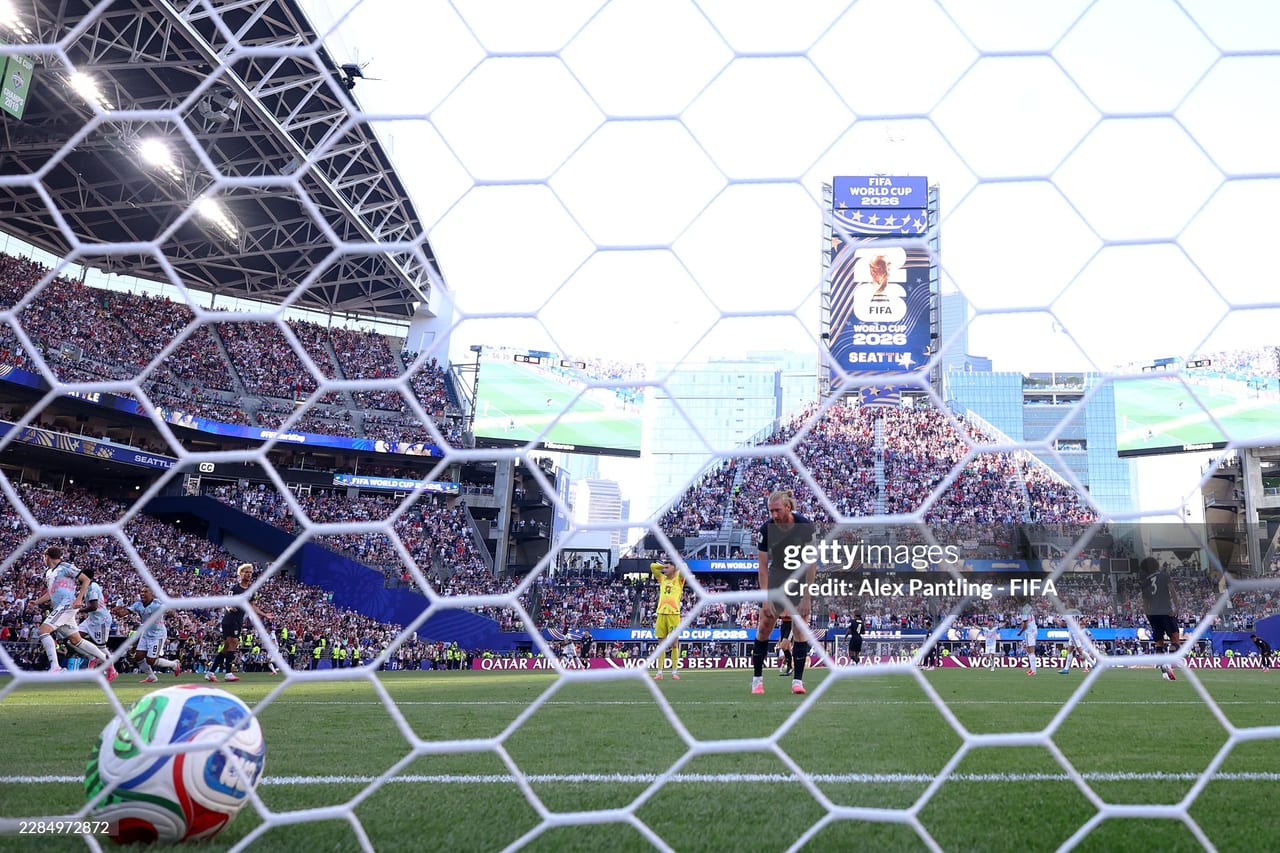

The camera pans to Gianni Infantino; he’s not hard to find; it’s common knowledge where he sits now, ensconced in the middle of a star-studded crowd. Sometimes it’s former footballers, sometimes it’s celebrities, sometimes it’s politicians, and sometimes it’s Pierluigi Collina.
Usually, when we get a glimpse of the FIFA president mid-game, he has the look of a man who is holding court at a cocktail party, like he’s regaling his work colleagues with a story of his most recent ski trip, but not this time. On this occasion, he had the look of someone who knew they were going to get shouted at by their boss, as if the overwhelming anxiety of what was to come had taken a stranglehold on him. A single curled finger across his lips, legs crossed, a thousand-yard stare.
A red card, suspended
Infantino is no stranger to forcing himself into the limelight, but he did so in spectacular fashion this week, as FIFA announced that Folarin Balogun’s red card, which he had picked up in the USA’s 2-0 victory over Bosnia and Herzegovina, had been suspended for a year, meaning the Monaco forward, who had been the USMNT’s star player up to that point, was free to play against Belgium. This is despite the fact that during the World Cup, there is, wrongly, no appeal process for red cards.
The USA president, and BFF of Infantino, Donald Trump, made multiple calls to FIFA’s president in an attempt to have the red card overturned.
“All I did was ask for a review because I didn’t think it was a foul,” Trump told reporters in the Oval Office. “I didn’t tell him what to do. I can’t tell him what to do.
“I’ve never seen anything like it, so I saw the play, and I’m a person that loves sports and was a good athlete. I understand sports really well. Really well,” said Trump.
In the end, FIFA and Infantino said the decision was taken by an independent panel and was not influenced by anyone external to that. But it is hard to deny that the controversy cast the USMNT as the villains of the piece, rightly or wrongly.
And that is a shame, because prior to all of this, Mauricio Pochettino’s men had largely surprised and impressed the footballing world. They had won a lot of praise and admiration from neutrals for their quick, aggressive and positive style of football, and the Argentine has them looking like one of his club sides, namely his Tottenham Hotspur and Southampton.
Their 4-1 win over what we now know as an incredibly stubborn Paraguay team in their opener could very well still be held up as one of, if not the best, performances of the tournament. And yet, thanks to shenanigans off the pitch, largely out of the USA side's control, they were the bad guys; they were the ones neutrals wanted to lose in this last 16 game.
But that could very well have forged an atmosphere that the USA generally thrives on. That "us-against-the-world" mentality that defines the nation, and in the stands in Seattle, the city largely considered America's hub of soccer, the fans were very much leaning into that, as they dressed in American-themed vests and hats, adorned in that famous Star-Spangled Banner flag, wearing arrogance and confidence better than any other country ever could.
But what they, the USA population, and its president, failed to realise is that while FIFA is of course the governing body of the sport, they don’t decide who wins and who loses; that honour belongs exclusively to the footballing gods, and they are largely unimpressed by acts of nonsense, they, in spite of everything in the modern game, believe in a sort of purity, believe in a right and wrong, and good prevailing.
The gods are not impressed
Belgium vs the USA in 2026 is about as even a World Cup knockout game as you can get, especially with the game taking place in the States, in front of a crowd that has really grown to love this team. When the anthem was belted out pre-game by the players and the fans, there was a feeling of occasion, of a moment in time.
It should have been a difficult task for Rudi Garcia’s men, but it wasn’t. In fact, there is an argument that Belgium haven’t had an easier game than this all tournament.
In the first 10 minutes, the USA looked all at sea and unable to cope with the relentless waves of pressure from Belgium, and when Charles De Ketelaere scored early on, it was a goal wholly deserved. Even when the USA scored from a deflected Malik Tillman free kick, there was still a feeling that they were miles off the level of their previous performances in this tournament. So, De Ketelaere’s goal two minutes after the equaliser again felt warranted.
But a bad half of football can happen to anyone; it doesn’t matter who you are. Surely Pochettino, being the elite-level coach that he is, would be able to devise a strategy to extract more from his side in the second period.
The moment it unravelled
This is where the footballing gods made their choice, made their play.
A direct ball by Belgium over the top of the USA’s backline was a touch overhit, and it appeared keeper Matt Freese, who has been solid throughout the World Cup campaign, would be able to deal with it. The New York City FC shot stopper rushed out of his box, got a touch on the ball, and moved it past the advancing Belgian forward. This is where higher powers intervened.
Freese had a chance to clear his lines and looked set to, but as he began the motion of swinging his left boot, he, as his name may suggest, froze. Time seemed to stand still; something else had taken over, and he was robbed of the ball by De Ketelaere. The Atalanta man played it back to Hans Vanaken, who, from 30 yards, hit a rather tepid side-footed effort, one that covering defender Tim Ream could have and should have dealt with easily. But he didn’t; the former Fulham man almost seemed to skip over the ball and allowed it to slowly nestle in the corner of the goal.
A cacophony of calamitous unforced errors. How and why did this happen? There are, of course, footballing reasons, tactical reasons, but it is hard to escape the feeling that something else, someone else, intervened.
By the time Romelu Lukaku scored Belgium’s fourth, the energy had already deserted the stadium in Seattle, and the American bravado had long since disappeared and exited the stage.
Football is not pure. Nations are becoming increasingly involved in the game and its governance, players are paid too much, sponsors, and commercialism are becoming more important than a good right back, none of this can be denied. And perhaps the gods who decide outcomes' power is waning, too, but they still know injustice and wrong when they see it, and they made their judgment.
