

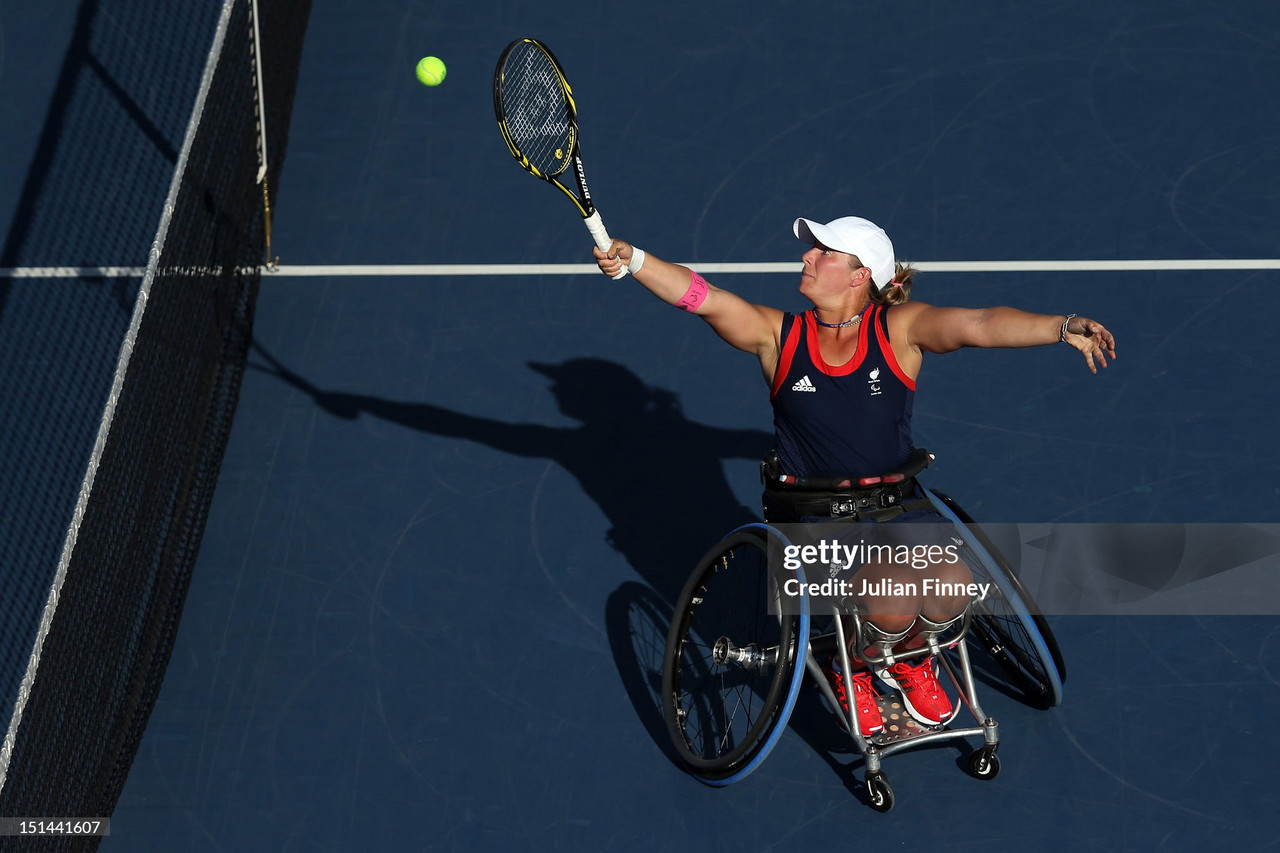

Lucy Shuker knows more about adversity than most. The three-time Paralympic medal winner has overcome many obstacles throughout her life. Whether that is facing the pressures as Britain’s number one wheelchair tennis player and the expectations that come with that mantle. Overcoming an accident that changed the trajectory of the life she had envisioned. As well as having her private life and experiences as part of the LGBTQ+ community broadcast to the world.
In the midst of the busy tennis calendar, Shuker welcomes the chance to share her experiences and the adversity faced on the road to becoming a leading figure in wheelchair tennis. She shares a story that is not just about sporting achievements but embraces challenges and represents both the disabled and the LGTBQ+ community.
“Life is a journey. You will always have speed bumps, or something will happen in your life, and it can deviate you onto another path.
“You're going to face adversity, and it's how you learn from your past. It's how you surround yourself with good people who can help you through life or help you through the challenges.
“It isn't going to be easy, but try and enjoy that journey as well. Don't always focus on the negative bits or the tough times. Because, in theory, we should be able to come through those.
“It might be in a different way. I can't change my accident, but I can deal with it. I can live with it. And I can still live a fulfilled life.”
When Shuker experienced a life-changing motorbike accident at the age of 21, which left her paralysed from the T4 vertebrae, she could not have imagined the success that she would later achieve.
Now, aged 44, the Paris 2024 flag bearer can reflect on an illustrious career where she has claimed over 100 titles across singles and doubles events, helped lead Great Britain to a string of silver and bronze medals in the World Team Cup women’s event, as well as earn two Bronze Paralympic medals at London 2012 and Rio 2016, and most recently a Silver medal at Tokyo 2020.
None of this would have seemed possible on the fateful day in 2001, but testament to Shuker was an incredible desire and positivity to carry on and live life on her terms. Even so, she could have never guessed just how successful and inspiring she would become.
“I played a bit of tennis as a child growing up, and you just play it with family and friends just for a bit of a giggle down the park”, Shuker states with a smile on her face.
“It wasn't until I had my accident when I was 21 that I met Pete Norfolk. He had a disability shop, and I was buying my first day chair.
“We got talking, and I was a badminton player before my accident, and he said try tennis. He lent me one of his old chairs, and the rest is history.”
The history Shuker discusses has enabled her to rise to one of the world's leading wheelchair tennis players, achieving a career high doubles ranking of World Number 3 alongside a singles peak of 5 in the world.
Although tennis began as a salvation, it had a beautiful means to rediscover what life had to offer Shuker.
“I played not to be a Paralympian, but to readjust to life in a wheelchair with friends and family.
"It was a sport that I could do with other people, which was awesome. It [life] felt different, and I'd lost my kind of self-confidence.
“I'd lost who I was, and definitely through tennis, I started to find enjoyment again. Being able to do something while it was really difficult, I started to fall in love with it. Just this little fluffy ball gives you so much joy.”
Testament to the humble nature of Shuker, when she was presented with the sheer volume of accolades earned in her career, the Brit almost looked shy. However, two achievements immediately sprung to mind when quizzed on her proudest moments.
“There's got to be two. The first medal that we won in London [2012 Olympics] was not expected; to do that at a home games was incredible.
“Performing at a home games is one of those things that any athlete never realises how big it is until it happens.
Achieving her first Bronze Paralympic medal, Shuker had to survive two match points in a gruelling affair to secure her spot on the podium.
“It was an ugly match. Over three hours and two match points against us, so to come through it was a real achievement,” Shuker recalls.
“Being a flag bearer at the last Paralympics – when there has only been around 20 in the history of Paralympics GB – is mad. It's a real honour. It’s something that’s not just a reflection of sporting achievements, but the off-court stuff as well.”
Shuker paved the way for disabled athletes with her accomplishments and was awarded a British Empire Medal (BEM) for services to sport in 2023, alongside receiving the 2011 Vitalise Woman of Achievement. She commends the Paralympics for helping to change the way people perceive those with disabilities.
“It's such a spectacle because you're seeing people who have physical disabilities that are achieving such amazing things, and it shows people what people can do rather than showing what people can't do.
“It just puts people in a positive light. If you think of a young person that has an accident or an illness, or a family that gives birth to a child that has a disability of some sort – it gives a future.
-
"Maybe People Can Understand That It's Just Love"
It is not solely the disabled community Shuker has paved a path for with the 44-year-old also serving as an ambassador for the LQBTQ+ community.
“Around the world, people are becoming more comfortable being open. I wish that we didn't have to talk about who your partner is and your sexuality.
“I wish everyone was just comfortable with whoever loves whoever as long as there's respect.
“I know how some people even to this day can't be their open true self, and that's a real shame, so we do need to highlight it, and we do need to speak up.”
Despite Shuker having an overwhelmingly positive experience in sport, she acknowledges that there remains improvement to be made on the global stage.
“I've not really had any negative experiences from colleagues, from friends, from athletes, from fellow tennis players, which is awesome. People hopefully just see me for me.
“However, there is always a way to go, isn't there? When you hear of other countries as well that it is against the law. You're breaking the law for loving someone, and that is tough.
“It’s disappointing that in this current age, there are countries that don't accept it and can go as far as to have laws against it or hate crimes as well.
“Through education, knowledge sharing, and talking stuff through, hopefully we can try to get to a place where maybe people can understand that it's just love.”
The globalisation of sport allows athletes to share the message of inclusivity with everyone, and while the UNIQLO wheelchair tennis tour does not have events in the countries that Shuker alludes to, she does commend and respect sporting stars who use their platform for the fight for acceptance and equality.
“I feel that the WTA and ATP players do speak up, and they do voice their opinions, and they're taken seriously.
“Even big sporting personalities such as Lewis Hamilton, they speak up and that hits home, and hopefully, in time, education will helpfully start to change those laws.”
Shuker also talked about the pressures of the media and how the attention on athletes also comes with a weight of expectations that promotes negativity on a more general level, and that, as a sporting community, we should look to support our athletes more.
“There can be lots of external pressures or issues that can affect you. Tennis is a physical game, but it's also a mental game.
“If there's uneasiness or issues, that can definitely impact you. I know it can impact me. Which isn't great, because you just want to focus on your sport, going out and playing and trying to achieve in the tournaments that you're playing in.
“Lots of athletes’ experience this. I know I do. Athletes can support one another, and organisations can also support each other and their athletes.
“Teams as well, like your team around you. I have a really good team that I can. Talk to, vent to. That help try. And give you the tools to manage external distractions.
“The media can also celebrate more forms of success in different ways. They always focus on the losses or the tragedies and blow out of proportion a result – forgetting that they're dealing with individuals and athletes who have emotions. Maybe they should celebrate more success and be kinder.”
Despite all the accolades and a career that has stretched nearly 23 years, Shuker is not yet ready to hang up the racket. Having fallen short in the final of Grand Slams nine times, she remains hungry to acquire that elusive accolade.
“Whether you win it or lose, you're learning. You trust that with the process, it will come. Whether it does for Grand Slams, ‘who knows?’. There are incredible athletes all over the world, and they’re all fighting for that one title. But the hunger and the drive is still there”
Considering what is next, Shuker avoids limiting her options and remains excited by the prospect of another Paralympics run at LA in 2028, where, if she competed, she would be 48.
“The aim is probably to still be playing next year. ‘People talk about LA, and it could be a sixth Paralympics?’ It's possible.”
