
Stadium
Anfield · Profile

Other languages2
ADVERTISEMENT
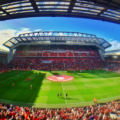
On 10 February 2024, for the visit of Burnley, Anfield opened most of its expanded Anfield Road Stand to the public. The work added around 7,000 seats and raised the ground's capacity to 61,276. Anfield has been the home of Liverpool FC since 1892 and stands in the Anfield district of Liverpool, England. It opened in 1884, but the first club to play there was Everton, not Liverpool.
Origins: Everton's ground (1884-1892)
The first match at Anfield took place on 28 September 1884, when Everton beat Earlestown 5-0. For eight years the ground was Everton's home, and the club grew there into a Football League side. In 1892 a dispute with John Houlding, who owned the ground, broke the relationship, and Everton moved to Goodison Park on the other side of Stanley Park. Left with an empty stadium, Houlding formed a new club to fill it: Liverpool Football Club. On 1 September 1892 Liverpool played their first game at Anfield, a friendly against Rotherham Town that they won 7-1.
The Kop and a growing stadium
Around 1906, after Liverpool's second league title, a large standing terrace was built behind one of the goals. It was named the Spion Kop after the hill at the Battle of Spion Kop in the Boer War, where many soldiers from the region had died. In 1928 the Kop was rebuilt to hold 30,000 standing spectators, and its name was later given to terraces at other English grounds. Anfield's record attendance came on 2 February 1952: 61,905 people watched Liverpool play Wolverhampton Wanderers in the FA Cup fifth round. Floodlights were installed in 1957 at a cost of £12,000.
Gates, stands and remembrance
The Shankly Gates, dedicated to manager Bill Shankly, were put up in 1982. Ten years later the Kemlyn Road stand was rebuilt and renamed the Centenary Stand; UEFA president Lennart Johansson opened it on 1 September 1992. After the Taylor Report ended standing at England's major grounds, the Kop became all-seated in 1994 and its capacity fell to 12,390. The Paisley Gateway, dedicated to Bob Paisley, followed in 1999. In 2016 the memorial to the 97 victims of Hillsborough was moved in front of the new Main Stand, and on 3 May 2017 the Centenary Stand was renamed the Sir Kenny Dalglish Stand.
The expansions of 2016 and 2024
The Main Stand gained a new upper tier, which opened on 9 September 2016 and lifted capacity to 54,074. The next project was the Anfield Road Stand, at the opposite end from the Kop: its expansion was completed in 2024 and took the ground to 61,276 seats. The pitch is 101 metres long, shorter than UEFA requires for its international tournaments, which has kept Anfield out of contention to host them.
Beyond Liverpool FC
Anfield staged its first international in 1889, when England beat Ireland 6-1. Wales used the ground for some home matches during the 20th century, and at Euro 1996 it hosted three group games and a quarter-final. England's last match there was a 2-1 win over Uruguay on 1 March 2006. Other sports have used the stadium too. On 12 June 1934 Nel Tarleton beat Freddie Miller for the world featherweight title; the Harlem Globetrotters played there in 1958; and five rugby league matches have been held at Anfield, among them the 2016 Four Nations final, watched by 40,042. In July 1984 the preacher Billy Graham drew more than 30,000 people each night. In June 2024 Taylor Swift played to crowds of more than 62,000, the ground's record attendance for a non-sporting event.
ADVERTISEMENT
Profile compiled by the VAVEL Editorial Team from historical records and official competition data. · Editorial policy