
Stadium
Ipurúa · Profile

Other languages2
ADVERTISEMENT
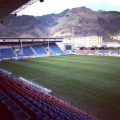
The Ipurua Municipal Stadium stands in the Eibar neighbourhood of the same name, at the bottom of the Ego valley in Gipuzkoa. Eibar City Council owns the ground, and SD Eibar have played there since it opened on 14 September 1947. The club’s women’s team has used it for its top-flight games since 2023. The natural grass pitch measures 103 by 65 metres.
The Ipurua Municipal Stadium stands in the Eibar neighbourhood of the same name, at the bottom of the Ego valley in Gipuzkoa. Eibar City Council owns the ground, and SD Eibar have played there since it opened on 14 September 1947. The club’s women’s team has used it for its top-flight games since 2023. The natural grass pitch measures 103 by 65 metres.
Opening and early years
Ipurua opened on 14 September 1947 with a friendly against neighbours Elgóibar, who won 2-0. Eulogio Echeverría scored the first goal at the new ground. Work on the main stand began a year later, in 1948, and it opened to the public in 1951. The pitch had no grass at first and suffered from its location: at the foot of steep slopes, it flooded easily and drained poorly. Grass did not arrive until early 1959, the same year a new drainage system was installed and the pitch was levelled.
Roofs, floodlights and anniversaries
In 1965 the club marked its 25th anniversary with a match against FC Girondins de Bordeaux. Soon afterwards most of the terraces were roofed and the first floodlight pylons went up. The lights were switched on for the first time on 14 October 1970, for a Real Sociedad v Athletic Club match staged in Eibar. A training pitch next to the stadium and a new west stand opened in 1974. In 1990 Ajax came to Ipurua for the club’s 50th anniversary, and the game finished 1-1.
From the second division to the 1990s rebuild
Eibar’s promotion to the Spanish second division in 1988 meant the stadium had to be rebuilt. Until then it held close to 10,000 spectators, nearly all of them standing. The club spent 18 consecutive seasons in that division, until 2006, and Ipurua was upgraded in stages. In 1998 the original main stand was demolished and replaced by a covered stand running the full length of the pitch. Work on the end stands began in 1999. In 2001 the north end was roofed and given seats, and the drainage and pitch were renewed.
ADVERTISEMENT
La Liga and the Ipurua Tallarra project
Eibar played their first top-flight game at Ipurua on 24 August 2014, beating Real Sociedad 1-0 with a Javi Lara free kick in front of 5,173 spectators. With 6,267 seats it had the smallest capacity in La Liga that season, and its pitch was the second smallest, after Vallecas. To meet league requirements, early in 2015 the club unveiled the Ipurua Tallarra project (Basque for “the Ipurua workshop”, a reference to Eibar’s industrial heritage), which set out to rebuild the north, east and west stands. On 18 July 2015 the club’s 75th-anniversary match against Celtic, lost 1-4, was played with half of the north stand still being rebuilt. The new north stand opened at the end of August 2015, for a league match against Athletic Club.
The new east and west stands
Demolition of the east stand began on 9 May 2016, and by February 2017 capacity stood at 7,083. Demolition of the west stand began in May 2018. In September that year a barrier in the away section gave way when Sevilla fans surged forward to celebrate a goal, and several people suffered minor injuries. The new west stand came into use in 2019, completing the redevelopment and leaving the stadium with 8,164 seats. Eibar spent seven consecutive seasons in La Liga before relegation in 2021.
Women’s football and the attendance record
Ipurua had already hosted games for the women’s team before its promotion: CD Tacón visited in 2017-18, and Osasuna in December 2018, both in the women’s second tier. After promotion in 2023, Eibar’s women began playing their Liga F home games at Ipurua. On 12 June 2024, in the second leg of the semi-final of the promotion play-offs to the top flight, Real Oviedo won 2-0 in Eibar in front of 7,732 spectators, the stadium’s record attendance.
ADVERTISEMENT
Profile compiled by the VAVEL Editorial Team from historical records and official competition data. · Editorial policy