

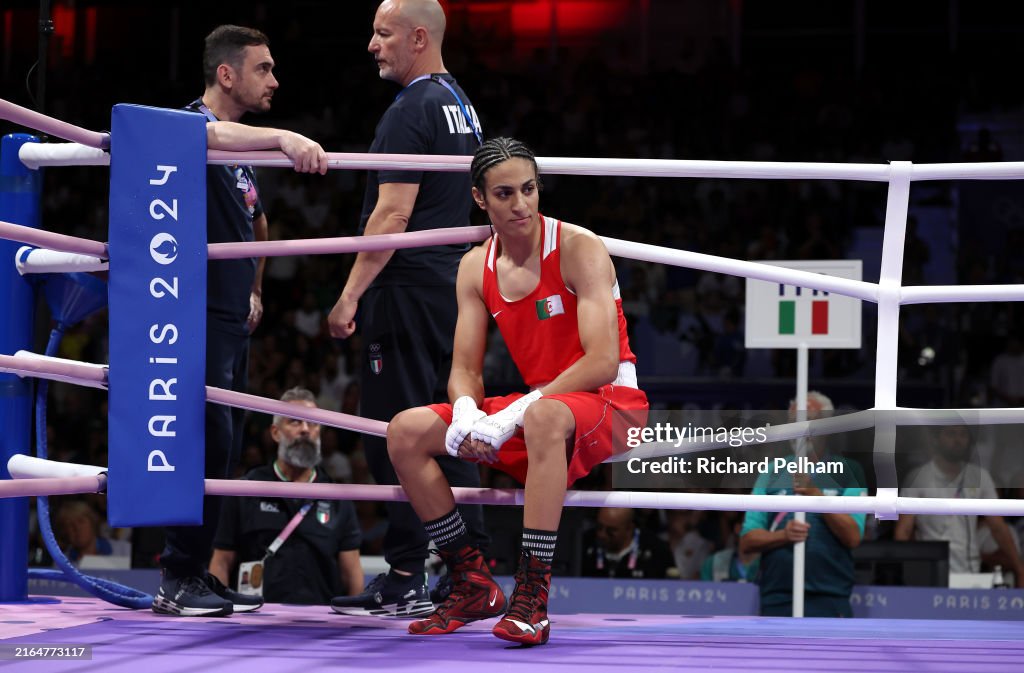

The controversy arose when on the 1st of August, Algerian boxer Imane Khelif defeated Italian, Angela Carini in the opening round of Olympic Boxing in Paris.
Carini, who withdrew from the contest after enduring two punches from the Algerian in 46 seconds, said she “had never faced a punch like that” and withdrew “to preserve her life.”
Given Khelif’s power and the unusually early withdrawal from opponent Carini, the internet unearthed Khelif’s controversial “failed gender test” conducted by the International Boxing Association (IBA), which had disqualified herself, as well as fellow Paris Olympian boxer Lin Yu-Ting of Chinese Taipei, at the World Championships in 2023.
What tests did Khelif and Yu-Ting fail in 2023?
Khelif and Yu-Ting failed unspecified IBA-sanctioned “gender eligibility tests”, which are alleged to have revealed the athletes have male “XY” chromosomes rather than female “XX” DNA.
It is worth noting that Khelif’s failed test in 2023 occurred just before her gold medal match at the World Championships and ensured that Russian boxer Azalia Amineva, kept her unbeaten record intact after losing to the Algerian in the semi-final of the tournament.
Both Khelif and Yu-Ting were allowed to compete in Paris as the IOC deemed the tests performed on them to be “flawed and illegitimate.”
The tests determined that Khelif and Yu-Ting, were “not female”, due to speculated "abnormal chromosome patterns". However, concrete details of the medical results of the tests have never been disclosed.
The ruling came in spite of the fact that Khelif and Yu-Ting have both competed as women boxers since 2018. In that time they have competed in numerous championships, without failing any other doping or gender-related tests.
With both athletes being cleared to compete in Paris by the International Olympic Committee (IOC), and the information of a “failed gender test” filtering through social media, online users subjected them to a torrent of online abuse.
This is despite the fact that both Khelif, and Yu-Ting have female passports and were born and raised as cisgender women.
Who are the IBA?
The IBA has long been dealt accusations of corruption. Michael Conlan’s infamous expletive-laden rant at the 2016 Rio Olympics, accused the IBA of total corruption, after he suffered an unbelievable defeat against a Russian opponent that denied the Irishman an Olympic medal.
Conlan’s incensed reaction encapsulated a feeling of injustice many within the sport had quietly expressed towards the governing body. The Irishman's outburst would help to trigger the International Olympic Committee (IOC) to remove the IBA of its role in regulating Olympic boxing, following the completion of the 2016 Games. Ever since Olympic Boxing has been entirely controlled by the IOC.
In the years since, further controversy has persisted following Russian Umar Kremlev’s ascension to the role of IBA President in 2020.
In 2023, while Russian athletes were allowed to compete at the World Championships, the IBA banned the Ukrainian Boxing Federation, and simultaneously prohibited Ukraine’s junior team from competing under their flag and anthem at the European Championships.
Consequently, the IOC stripped the organisation of its recognised status as boxing’s governing body, with concerns regarding finances, governance and ethics, even extending to the integrity of refereeing and the scoring of boxing matches.
What has happened since the controversy first broke out in Paris?
On the morning of Monday 5th August, the IBA held a press conference addressing the controversy that has marred much of the coverage of the Games. After both the Algerian and Taiwanese federations requested that the results of the gender tests be published, the IBA confirmed that the tests’ findings could not be revealed to the public.
From there, the conference quickly descended into chaos; with numerous technical difficulties and jibes aimed at the IOC's President, Thomas Bach (below), who has consistently supported Khelif and Yu-Ting throughout the tournament.
On the same day, Khelif spoke out against the abuse she has suffered at the games:
“I send a message to all people of the world to refrain from bullying all athletes because it has massive effects. It can destroy people.”
The controversy was further stirred when one of Yu-Ting’s defeated opponents, Bulgaria’s Svetlana Stenova, made a “XX” gesture with her hands before pointing to herself, suggesting she was the only competing boxer with female DNA.
On the closing weekend of the games Khelif and Yu-Ting both won Olympic gold medals for Algeria, and Chinese Tapei respectively.
After being crowned Olympic champion Khelif filed a legal complaint over the online harassment she had been subjected to while competing in Paris.
What could the scandal mean for the sport?
With no new information coming to light, the reputation of the IBA, and of women’s boxing on the world’s biggest stage remains in total disrepute. While the sport has long been subject to controversy, the events of Paris’ Olympic boxing feels seismic.
Brewing tensions between the IOC and IBA threaten to totally spill over and their two respective chairs remain totally at odds. The ongoing discord, compounded by the scale of the controversy, which has escalated into one of the major talking points of the entire games, casts a shadow over the sport.
With all these forces at play it is hard to foresee the boxing returning for the 2028 Olympic Games in Los Angeles.
It would mark an end of 120 years of boxing at The Games, with it first featuring as an Olympic event in 1904, while women's boxing has been a feature of the Olympic schedule for over a decade following its first iteration at London 2012.
Crucially it would remove the platform that Olympic competition has granted many talented amateur boxers on their path towards a professional career.
Modern greats: Wladimir Klitschko, Katie Taylor (below), Anthony Joshua, and even current undisputed heavy-weight champion of the world, Oleksandr Usyk, all won Olympic gold before transitioning to winning world titles in the professional sphere.
