


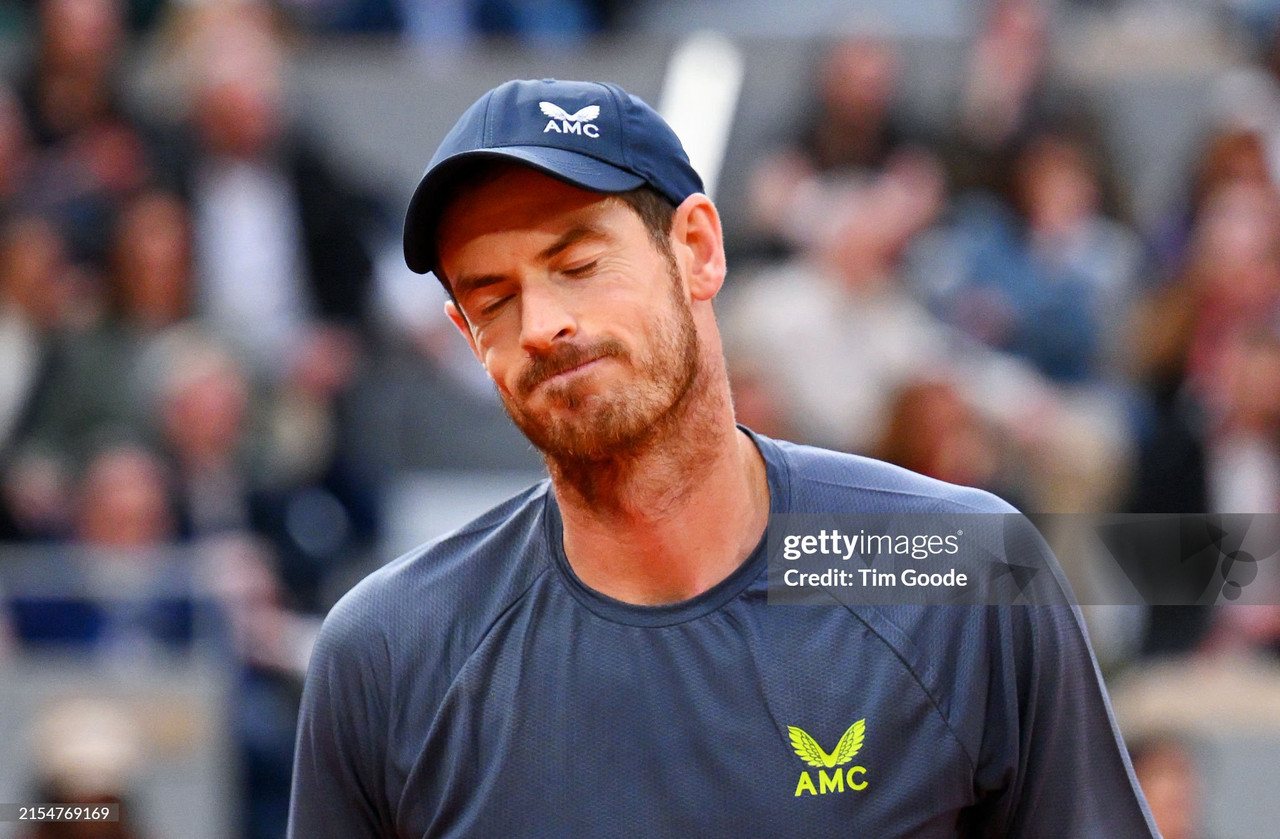

The news broke following his loss to Frenchman Ugo Humbert in the second round of the ATP 500 tournament in Dubai, where he was candid with the press: “I probably won’t play after the summer. I’m tired of being asked the same questions about my retirement. I’m not going to talk about it again until I make the official decision to retire. At the moment there are no plans to keep on playing beyond the end of this summer”.
A few weeks later, Andrey Rublev knocked him out in the second round at Indian Wells.
Once again, he was pressed by journalists trying to get more information out of him. However, the three-time Slam champion’s response did not leave much room for interpretation: “I’m sure every player - when he stops playing- looks back and wishes he had done something different or better. I feel I did really well. I worked hard, I put a lot of effort”.
The former world #1 was a key player in the Big Three era, so much so that he was ranked with them as one of the top four players of the 00s.
Considered one of the strongest tennis players of his generation, he reached the top of the ATP rankings for the first time at the end of 2016, where he stayed for 41 weeks combined.
He won three Grand Slam singles tournaments (Wimbledon twice in 2012 and 2013 and the US Open in), two Olympic gold medals and 41 other ATP titles, including 14 Masters 1000s and the 2016 ATP Finals. He also triumphed in the 2015 Davis Cup, bringing the trophy back to Great Britain after 79 years. That’s something impressive.
Among his other impressive records:
- In 2012 he became the first Briton to reach the Wimbledon final in 35 years and the first man in 76 years.
- He broke Britain’s drought in Slam tournaments, which had lasted since Virginia Wade had won Wimbledon in 1977.
- In 2013 he beat ATP world #1 Novak Djokovic, becoming the first British male tennis player to win the home tournament in the Open era exactly 77 years after Fred Perry in 1936.
- Last but not least, he represented Great Britain at the 2012 London Olympics, winning two gold medals in singles and mixed doubles with Laura Robson. He also played at the 2016 Rio De Janeiro Olympics, becoming the first tennis player to win two consecutive gold medals on two different surfaces: grass and hardcourt.
Murray returned to the court on April 19th, after suffering a serious ankle injury in the closing stages of his match against Tomas Machac at the Miami Masters 1000, where he had lost the tie-break in the deciding set.
The Scotsman had suffered a complete rupture of the astragalus peroneal ligament and an injury to a foot ligament. So two more injuries had complicated his plans for what was supposed to be his last tournament on the circuit.
Before starting his adventure at the 2024 French Open, Murray’s main goal remained to play both singles and doubles. His tough loss to Stan Wawrinka in the first round left him no choice but to concentrate on his doubles match with fellow Brit Daniel Evans, scheduled for tomorrow morning against Brazilian player Thiago Seyboth-Wild and the Argentinian Sebastián Baez.
Given his schedule, with the real possibility of an Olympic “swan song”, a post-grass season and post-Olympic retirement is not out of the question, but let’s try to enjoy as much of his time on the court as we can. We won’t be complaining.
Explore more stats, standings and news on VAVEL Data: Roland Garros
