
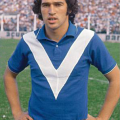
Coach
Carlos Bianchi · Biography

Other languages2
ADVERTISEMENT
The first title of Carlos Arcecio Bianchi's career came in France: in 1974 he finished as top scorer of the French first division with Stade de Reims. Born on 26 April 1949 in Buenos Aires, he played as a centre-forward for Vélez Sarsfield, Reims and Paris Saint-Germain before becoming a coach. On the bench he won the Copa Libertadores in 1994 with Vélez and in 2000, 2001 and 2003 with Boca Juniors. In Argentina he is known as «el Virrey» (the Viceroy).
Youth and debut at Vélez
Bianchi came through the youth ranks at Vélez Sarsfield, the club from the Liniers district, and made his first-team debut in 1967. He was a pure number nine, quick to shoot and strong in the air, who relied on movement off the ball rather than dribbling. He developed fast: he was the leading scorer of the 1970 Metropolitano and topped the scoring chart again in the 1971 Nacional. Those two seasons drew the attention of European clubs and earned him a place in the Argentina national team, for whom he played in the early 1970s.
Top scorer in France
In 1973 he joined Stade de Reims, and France became the stage for his best years as a player. He was top scorer of the French first division in 1974, 1976 and 1977 with the club from Champagne, a side that did not challenge for the title but lived on his goals. In 1977 he moved to Paris Saint-Germain, where he won the scoring award again in 1978 and 1979. After Paris he spent the 1979-80 season at RC Strasbourg. Five French league scoring titles sum up a European decade built inside the penalty area.
Return to Liniers and retirement
In 1980 he went back to Vélez, the club that had developed him, and played there for several more seasons. His last spell as a player was again at Reims in the mid-1980s, by then in the French second division, where he combined the end of his playing days with his first steps as a coach. In France he went on to manage Reims, Nice and Paris FC, years of learning away from the spotlight before his return to Argentina.
Vélez Sarsfield, 1993-1996
In 1993 he took charge of Vélez and won the Clausura that same year, the club's first league title in more than two decades. In 1994 came the Copa Libertadores, won in the final against São Paulo at the Morumbí on penalties. In December that year Vélez beat AC Milan 2-0 in Tokyo to lift the Intercontinental Cup. The team, with José Luis Chilavert in goal, kept winning: the 1995 Apertura, the 1996 Clausura, the Copa Interamericana and the 1996 Supercopa Sudamericana. In mid-1996 he left to join AS Roma, where his spell in Italy's Serie A was short and ended in 1997.
Boca Juniors, 1998-2001
In 1998 he took over at Boca Juniors. His first side won the 1998 Apertura unbeaten and followed it with the 1999 Clausura. With Juan Román Riquelme, Martín Palermo and Guillermo Barros Schelotto at its core, Boca won the 2000 Copa Libertadores against Palmeiras and in November that year beat Real Madrid 2-1 in Tokyo to claim the Intercontinental Cup, with Palermo scoring both goals. Boca also won the 2000 Apertura. In 2001 they retained the Libertadores against Mexico's Cruz Azul, again on penalties, and at the end of the year Bianchi left the club.
Second Boca spell and Atlético Madrid
He returned to Boca in 2003 and in July that year won his fourth Copa Libertadores, his third with the club, after beating Santos in the final. In December 2003 Boca defeated AC Milan on penalties in Yokohama, giving Bianchi his third Intercontinental Cup as a coach. The team also won the 2003 Apertura. In 2004 he reached another Libertadores final, lost on penalties to Once Caldas, and left at the end of that year. In 2005 he coached Atlético Madrid in La Liga, a short spell that ended in early 2006.
Third spell at Boca
After several years away from the dugout, he returned to Boca Juniors at the start of 2013. That spell did not match the earlier ones: the team went out in the quarter-finals of the 2013 Copa Libertadores against Newell's Old Boys and did not contend for the domestic title. Bianchi was dismissed in August 2014, in what was his last coaching job.
ADVERTISEMENT
Profile compiled by the VAVEL Editorial Team from historical records and official competition data. · Editorial policy