
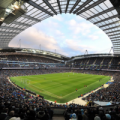
Stadium
Etihad Stadium · Profile

Other languages2
- EspañolES →
- PortuguêsPT →
ADVERTISEMENT
Manchester City's stadium opened on 25 July 2002 with the opening ceremony of the Manchester Commonwealth Games, which Queen Elizabeth II attended. It stands in Eastlands, in the east of the city. It was built as an athletics venue called the City of Manchester Stadium and began hosting football a year later, when the club left Maine Road. It has been called the Etihad Stadium since July 2011.
Origins and construction
The project started with Manchester's bid for the 2000 Olympic Games, which planned an 80,000-seat stadium. After that bid failed, the city adapted the design for the 2002 Commonwealth Games. Work began in December 1999. The engineering firm Arup designed the stadium and Laing built it. It cost about £110 million, paid mostly by Sport England, with Manchester City Council covering the rest. The roof hangs from cables strung from masts outside the stands.
The 2002 Commonwealth Games
During the Games the stadium held about 38,000 people. A lower tier ran around three sides of the track, there were upper tiers along both sides, and a temporary uncovered stand stood at one end. The athletics events were held there, and four Commonwealth records were set, including the women's triple jump and the women's 5,000 metres. The plan from the start was to turn the venue into a football stadium once the Games ended.
Conversion for Manchester City
After the Games the track was removed and the pitch was lowered to make room for a new lower tier of seating. The temporary end was also closed in. The work took about a year and left a capacity of around 48,000. The stadium is owned by Manchester City Council, which leases it to the club. In October 2010 the two sides renegotiated the lease, and City began paying a fixed £3 million a year instead of a share of ticket revenue.
The first matches
City played their first game at the stadium on 10 August 2003, a friendly against FC Barcelona that they won 2-1. Nicolas Anelka scored the first goal at the ground. Four days later came the first competitive match, a UEFA Cup tie against the Welsh side Total Network Solutions, which City won 5-0. Trevor Sinclair scored the first competitive goal. City's first Premier League game there was on 23 August 2003: a 1-1 draw with Portsmouth in front of 46,287, with David Sommeil equalising near the end.
The Etihad name and the South Stand
In July 2011 the ground was renamed the Etihad Stadium under a ten-year sponsorship deal with Etihad Airways, the Abu Dhabi airline. The first major expansion was a third tier on the South Stand. Its 7,000 seats were finished in August 2015 and raised capacity to about 55,000.
Finals, internationals and concerts
England played their first international at the stadium on 1 June 2004. In 2005 it hosted matches at the Women's Euro, including England 3-2 Finland in front of 29,092. On 14 May 2008 it staged the UEFA Cup final, in which Zenit Saint Petersburg beat Rangers 2-0 with goals from Igor Denisov and Konstantin Zyryanov, watched by 43,878. The ground also hosted rugby league, including England's 12-8 defeat to Australia in the 2004 Tri-Nations, and in 2015 England's last group match of the Rugby World Cup. Red Hot Chili Peppers played the first concert there in 2004, and Oasis drew around 60,000 people on 2 July 2005.
The North Stand and the Pep Guardiola Stand
In April 2023 the club got approval for a redevelopment of the North Stand, a project worth around £300 million. Work began late that year. The new stand added more than 7,000 seats in a second tier and includes a hotel, which took capacity above 61,000. On 22 May 2026 the club announced that it would be named after Pep Guardiola. It opened fully two days later, on 24 May, for Guardiola's last game in charge. City lost 2-1 to Aston Villa in front of 60,332 spectators, the stadium's highest attendance up to that date.
ADVERTISEMENT
Profile compiled by the VAVEL Editorial Team from historical records and official competition data. · Editorial policy