
- 17thLiga MX · 13 pts · 16 P
- −19 ptsbehind the leader (Cruz Azul)
- LLDLWLast 5 matches

ADVERTISEMENT
Impulsora del Deportivo Necaxa S.A. de C.V. or simply known as Club Necaxa, Rayos del Necaxa or Necaxa, is a Mexican club based in the city of Aguascalientes, Aguascalientes, as of 2003, and plays in the First Division of the Mx League.
It is a club founded on August 21, 1923 by Englishman William Frasser, and has a history of many ups and downs, having its last return to the highest category of soccer in the country, from the Apertura 2016 tournament.
In its historical track record, it has won 19 titles, including 17 domestic titles (7 League, 6 Cup, 3 Champion of Champions, 1 SuperCopa Mx) and 2 international titles (1 CONCACAF Champions League and 1 CONCACAF Cup Winners' Cup). In the professional era, it has won 11.

Origin of the name
It was 1922, when a group of workers from a couple of electrical companies, supported by the general manager of one of them, decided to join a team that promoted the practice of soccer.
It turns out that these companies, in order to bring electricity to various parts of the country, used the renewable resources of what was the first power generation dam in Mexico, founded in 1905, in the times of Don Porfirio. This dam exploited tributaries of known rivers in the country, highlighting one that crosses the state of Puebla and travels to the state of Veracruz: the Necaxa River. It is worth mentioning that, in those years, the organization prevented the teams from being named after any private company.
Place of play and creation of its first stadium
In the first years of its creation, this red and white team used dirt fields for the practice of the sport. These fields were located in the Condesa neighborhood, in Mexico City, and it was precisely in the Condesa tournament where they began to stand out.
However, in 1930, they had the opportunity to create their first stadium, built with English technology (remember that its founder was English) and whose capacity was for 15'000 fans. It was the Necaxa Park.
The history of this building is worth mentioning, especially if we take into account that it was the first stadium in the country to host a World Cup qualifying match. In 1930, Mexico was invited to the First World Cup that was organized, so it did not have to comply with any protocol; however, for the 1934 World Cup, it had to participate in the Concacaf Qualifiers, which granted a ticket to attend Italy. Thus, in March 1934, Mexico received Cuba in the same Necaxa Park, a venue that still had many things to tell.

Glory years: the 11 brothers
Once inside the First Force Championship in Mexico, Necaxa began a path of struggle and experience, which led it into a decade of the 30's of very good results.
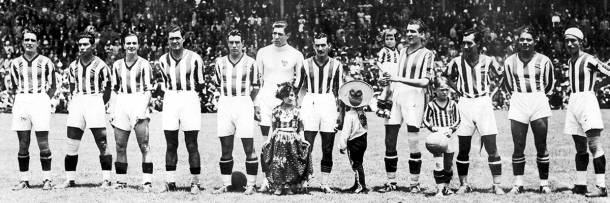
In a short period of time, Necaxa won the league titles in 32-33, 34-35, 36-37, 37-38, the cup championships in 32-33 (which was also its first) and 35-36, represented the National Team in represented the National Team in 1935, obtained the records of 19 undefeated games and 12 consecutive victories (34-35), which caused a great sensation among the fans not only of the club, but of the whole country. The coach was the Englishman Alfred Crowle.
In those years, the Necaxista squad had a great understanding of the field, they talked to the ball and played as if they had known each other for years. There is an anonymous anecdote that named them 11 brothers, which named them as a group that had known each other all their lives:
"And they were the Eleven Brothers,
eleven kings on the court,
all united,
all brothers.
Together forever,
always playing,
like eleven saetas
on the field;
they know how to win,
they know how to win,
they achieve with triumphs
to entertain the public.
They win over their own,
they win over strangers,
they play for notes,
they smash the crossbars.
And they were the Eleven Brothers,
always on a roll,
the winners:
Eleven Kings of the pitch."
The lineup of those '11 brothers' (Raúl 'Pipiolo' Estrada, Antonio 'El León de las canchas' Azpiri, Lorenzo 'Abuelo o Yegua' Camarena, Ignacio 'Calavera' Ávila, Guillermo 'Perro' Ortega, Marcial 'Ranchero' o 'Chato' Ortíz, Tomás 'el Poeta' Lozano, Hilario 'Moco' López, Vicente 'Chamaco' García, Julio 'Chino' Lores and Luis 'Pichojos' López. Lores and Luis 'Pichojos' Pérez) adopted one more member, another character of great level and who also came to make history in the club: Horacio Casarín.
Horacio Casarín was an epochal striker, who quickly fit into that squad, and who stood out above several players in the League. After his retirement with Monterrey in 1957, the Mexican had reached the figure of 283 goals with clubs, a figure registered as the maximum in our soccer, until the appearance of Cabinho, 25 years later.

The 'Campeonísimo
Although the suffix 'ísimo' does exist, and added to some nouns, such as 'campeón', it refers to the superlative of the same, in its entirety, the word 'campeonísimo' has a different connotation in our soccer.
It turns out that the word is used to name the club that won the league and cup double in our country, but the story goes beyond that.
At first, the word referred to those clubs that would have won a large number of championships in a short period of time. But there is more.
It turns out that in the 1930's, just when Necaxa won its first championship (32-33, beating Atlante 9-0 in the final, in yet another edition of the so-called 'Autético Clásico'), the word was used to refer to a club that had won a large number of championships in a short period of time.ntico Clasico'), the club was beginning to awaken a certain empathy among soccer fans in general, certain journalists and people who still saw soccer as a pastime. Titles began to come more frequently, but it was in 1935, with the League and Cup championships at stake, that Mexican journalist, politician and writer Francisco Martínez de la Vega, a contributor to renowned newspapers such as El Día de la Vega, began to see the club as a pastime.El Día and El Nacional, by way of praise, one fine day decided to call the club that was dazzling in those years 'Campeonísimo', logically referring to Necaxa. From that moment on, the history of that word and its different contextualization began.
It is worth noting that, in the same 32-33 season, Necaxa won the first edition of the Mexican Cup (playing with some youth players) and also achieved the record for most consecutive victories (12, later equalled by Leon) and the record for the highest percentage of points obtained (90%).
Necaxa disguises itself as the National Team
In 1935, after some setbacks for the Mexican National Team, the decision was made not to attend the Central American Games in El Salvador. Until, in a meeting held in our country, and after some complaints from the organizing federation, a representative had to be chosen, so the decision was made to send the entire Necaxa club, adding some reinforcements.
The Necaxa team, at that time, had in its ranks striker Julio Lores (Peruvian by birth), who would become the first player to become a Mexican citizen and later wear the national team's jersey (which he would defend for three years).
At the end of the tournament, they won Mexico's first official international title.
Disappearance and the difficult return
After the club's golden age and the pleasant animation it gave to the League, the Federation notified them of a small change that would be made starting in the 1943-1944 season.
It turns out that, through various analyses of the matter, the Federation had made the determination to 'professionalize' soccer. In short, they wanted to introduce sponsorships to Mexican soccer.
Arguing that the situation went against the spirit of the institution, the board decided to step aside and sell Necaxa Park. They said goodbye with a triumph in the 42-43 season, and ended their participation in third place, two points behind the champion Marte.
The situation caused sadness and disillusionment in many fans, so several of the employees of that electrical company decided to make a notable effort to maintain the club, although it was only enough to keep them in the Minor League. Even so, they did not want to waste an era of glory, the best of the club, but it would not be enough to keep it.
Their return to the Major League took place in the 1950-1951 season, but already as property of the Sindicato de Electricistas and now playing at the Estadio Olímpico de la Ciudad de los Deportes, later renamed Estadio Azul.
The results in that first season took them to third place, which brought back the illusion; however, titles were scarce. It was not until the 59-60 season that they lifted a trophy again, in this case, the Cup. They won one more in the 65-66 season.
The historic triumph over Pelé's Santos
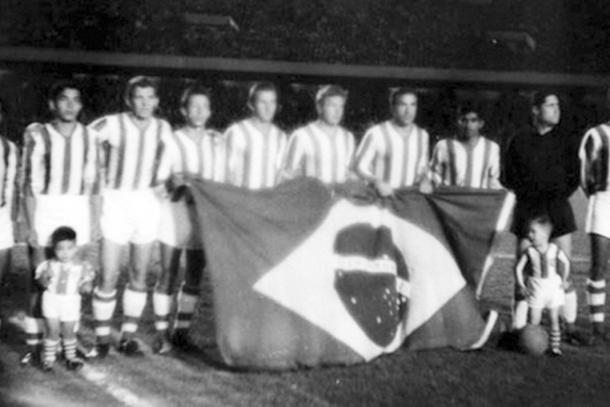
In 1961, a pentagonal tournament was organized in Ciudad Universitaria, which was made up of the Gold, Guadalajara, Independiente de Avellaneda, Santos from Brazil and Necaxa.
When the match between Santos and Necaxa arrived, the Mexican team's aspirations were almost nil, a victory seemed impossible. On the contrary, there was talk of a landslide in favor of Santos.
That Santos team from Brazil was on an impressive run, with a style of play that some journalists described as otherworldly, as part of a game from heaven itself.
With the emblematic Brazilian team came a young figure of the Brazilian national team and the team from São Paulo: Pelé. The Brazilian had already won a World Cup championship and did not know that he would win another one here, 9 years later. However, the memory was not only the defeat, but also an injury he suffered at the end of the game.
The match started very early on February 2, with Necaxa leading 2-0. Unfortunately, in a short time, Santos turned the game around and it looked like a rout. In the final minutes, with the score tied, Dante Juárez scored the winning goal, the goal of pride and Mexican daring.
Some journalists of the time describe that victory as the best game of a Mexican club against a foreign club.
The sale of the club and name changes
With a debacle in recent seasons, the board headed by Julio Orvañanos decided to sell the club to Spanish investors, who decided to change its name to Atlético Español. After this negative decision, the businessman Orvañanos had some problems with some players, such as defender Carlos Albert, current sports commentator.
The fans began to disperse, submerged in uncertainty and sadness, but the situation of Atlético Español was not the best either, so they decided to retake the name of Necaxa and an agreement was reached with Televisa so that they would return it in the 82-83 season, already playing in the Azteca stadium.
The decade of the 90's
Theclub'sglorieswere a bit forgotten, but they were about to return. It all began with the signing of Ecuadorian midfielder Álex Aguinaga, in 1989, from his country's Deportivo Quito. He is the player with the most official games with the club (543).

Emblematic players such as Ivo Basay, Sergio Zárate and the club's top scorer, Ricardo Peláez (158), joined the squad. Finally, coached by Manuel Lapuente, they were ready to win their first league championship in the professional era.
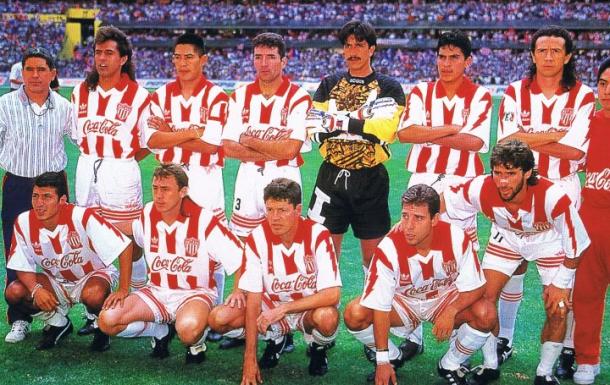
It was the 1994-1995 season, the club finished with 46 points in fourth place, defeated Tecos in the quarterfinals, Chivas in the semifinals and reached the final against Cruz Azul. The final result of that final series was 3-1 in favor of the Rayos, thus winning the first league title.
It was June 4, when Arturo Brizio was in charge of directing a match that Ivo Basay had already given Necaxa the advantage since the first leg and that Álex Aguinaga began to frame, in the second leg, with another goal. Finally, Ivo Basay himself was in charge of signing a Necaxa title.
Necaxa's Champion Lineup
Nicolás Navarro, José María Higareda, Octavio Becerril, Eduardo Vilches, Gerardo Esquivel, Efraín Herrera, Ignacio Ambriz, Álex Aguinaga, Alberto García Aspe, Ivo Basay and Ricardo Peláez. Coach Manuel Lapuente.
A year later, Necaxa finished the 95-96 regular season in first place in Group 4 and second overall. They faced Tigres in the Quarterfinals, América in the Semifinals and reached the Final against Atlético Celaya.
On that occasion, Necaxa was crowned in a final that ended 0-0 and with a 1-1 aggregate score, winning its second title thanks to the away goal criterion in a 5 de Mayo.
Necaxa Bicampeón Lineup
Nicolás Navarro, Uwe Wolf, Eduardo Vilches, Octavio Becerril, Gerardo Esquivel, José María Higareda, Álex Aguinaga, Alberto García Aspe, Luis Hernández, Ricardo Peláez and Sergio Zárate. Coach Manuel Lapuente.
After winning the league championship twice, winning the last two long tournaments in Mexico, Necaxa had to try to achieve the feat of winning one more championship, this time in the first short tournament, the Invierno 1996.
Necaxa managed to reach the final, but the result was not favorable on this occasion, when they lost 4-3 to Santos.
Necaxa'sthird championship came in Invierno 98, just one tournament after another runner-up finish. On this occasion, Necaxa again finished fourth, coming in first place in Group 3. They again faced Tecos in the quarterfinals, then took on Atlas in the semifinals and reached the final against Chivas.
The result of that final, held between December 10 and 13, was 2-0 in favor of the Rayos, with goals by Cabrera and Vázquez, winning the third crown in the same Jalisco stadium, after defeating, curiously, the three teams from the state.
Lineup of the third championship
Adolfo Ríos, Sergio Almaguer, José María Higareda, José Luis Montes de Oca, Markus López, Salvador Cabrera, José Manuel de la Torre, Álex Aguinaga, Sergio Zárate, Sergio Vázquez and Carlos Hermosillo. Coach Raúl Arias.
Third place in the Club World Cup
In 1999, Necaxa earned its place in the first FIFA Club World Cup after winning the CONCACAF Champions League. This took place between September and October of the same year.
Los Rayos had to face Costa Rica's Saprissa in the quarterfinals, then faced D.C. United of the MLS and were crowned champions. United of the MLS, and were crowned against another Costa Rican club, this time against Alajuelense, whom they defeated 2-1.
In the Club World Cup, the Mexican team, representing CONCACAF, was placed in Group B, together with Vasco Da Gama, Manchester United and South Melbourne of Australia.
Among other results, it is worth remembering the 1-1 draw achieved on January 6 against the European champions, Manchester United. However, despite all this, they did not manage to reach the final, finishing second in their group. So they had to face Real Madrid, which had in its ranks players such as Hierro, Helguera, McManaman, Morientes and Raúl, in the match for third place, achieving the feat of beating them in a penalty shootout, and obtaining a third place that, so far, has not been surpassed. In addition, it is the only club to have beaten a European club in the Club World Cup so far.
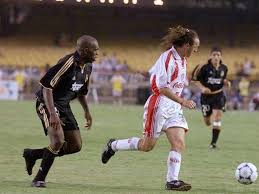
Necaxa's lineup in the Club World Cup
Hugo Pineda, Salvador Cabrera, Sergio Almaguer, Markus López, José Milián, José María Higareda, Luis Pérez, Hernán Vigna, Álex Aguinaga, Cristian Montecinos and Agustín Delgado. Coach Raúl Arias.
Move to Aguascalientes
After a series of attempts to bring the fans to the Azteca stadium, they decided to move the Necaxa team to the city of Aguascalientes. The new venue that would house the club would be the Victoria stadium, owned by the State's City Hall. The decision of Justino Compeán, president of the club at the time, indicated a purely economic motive.
Starting in the 2003 Apertura, Necaxa's fortunes began to fade amid a series of complications that led to relegation and frequent defeats.
Regular to bad seasons, failed signings and changes in the technical direction were the tonic of the new Necaxa, which was trying to find a foothold in its new city.
In spiteof this, in 2007, they were crowned in the now defunct InterLiga Tournament, earning a place in the Copa Libertadores of the same year, where they qualified for the second round, but lost in the knockout rounds to Nacional of Uruguay.
First relegation
After a complicated season in the 2009 Clausura, Necaxa lost the category in the last game against América. However, history in the Liga de Ascenso would be acceptable.
In both the Apertura 2009 and the Bicentenario 2010, Necaxa was crowned champion in the Ascenso and achieved a second championship that allowed it to return directly to the First Division.
This is how that first setback lasted only one year and they had the capacity to return immediately. Unfortunately, the return was not for long.
Second relegation
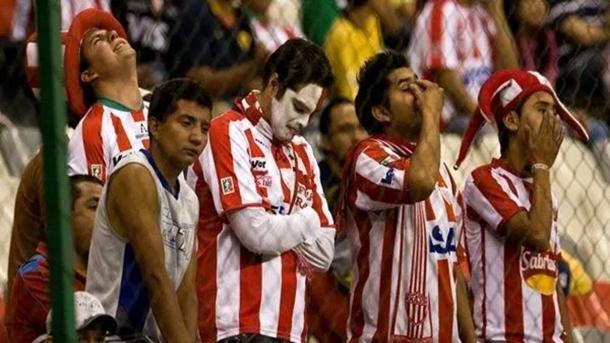
With only one year in the top flight, 17 defeats in 17 games and a series of managerial complications, Necaxa was once again relegated for the 2011 Clausura.
This time, with two games to go, Necaxa drew with Atlante on April 16, signing their second relegation and a new stage in the Mexican Soccer Silver League.
Already in the Ascenso, between league games, undefeated and super-leaders, Necaxa did not achieve the long-awaited return; but, instead, had to face another stage of uncertainty for the club, its sale.
In 2014, president Yon de Luisa announced the sale of the club to a group of investors led by Ernesto Tinajero, but with the requirement that the club's name and headquarters be kept.
After the sale, the team continued at the top of the Ascenso, entering the playoffs, being super leader and winning titles.
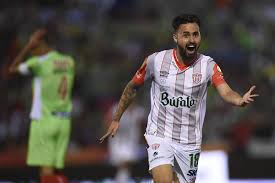
Finally, for the 2016 Clausura, it was crowned Ascenso champion, defeating Bravos de Juárez 3-0 on aggregate.
Final comeback and Copa championship
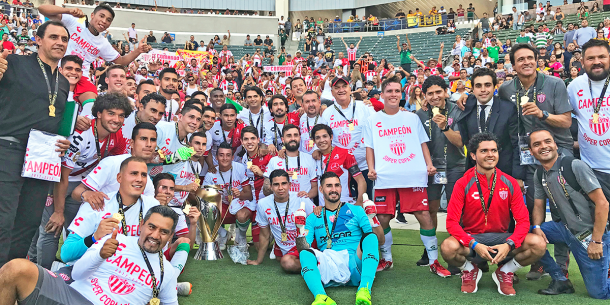
With a new Copa format underway, Necaxa, once settled in Liga Mx, began the Clausura 2018, fighting for the possibility of being crowned in yet another championship, now in the Copa Mx.
The results were favorable from start to finish, achieving another title, after 20 years, after defeating Toluca in the final, by a score of 1-0.
Months later, Necaxa faced the Copa Mx champion in its 2017 Apertura edition, for the SuperCopa title. Necaxa beat Monterreyagain by the narrowest of margins to win another trophy that would go a long way to boosting the club's confidence.
News
In recent years, Necaxa has become a club that imports and markets players, with Ernesto Tinajero at the head of the project.
Edson Puch, Víctor Dávila, Carlos González, Igor Lichnovsky, Jesús Angulo, Cristian Calderón, Luis Felipe Gallegos and Mauro Quiroga, are some of the names that have arrived at the club, left a good impression, only to be sold for a much higher sum than what was paid for their acquisition.
Every tournament, Necaxa is a club that seeks to reinvent itself.
This biography was written by Isay Tena.
ADVERTISEMENT
Profile compiled by the VAVEL Editorial Team from historical records and official competition data. · Editorial policy