


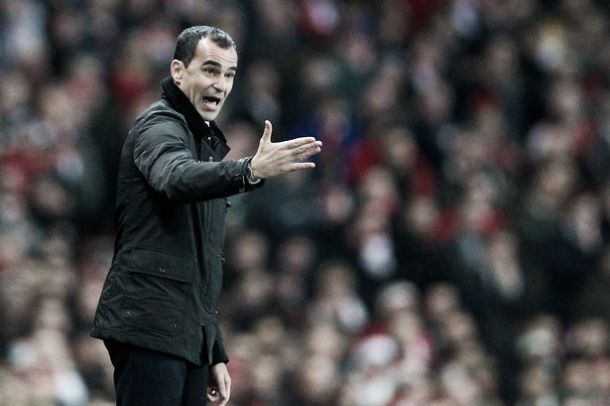
With the undeniably breathtaking World Cup culminating to an enthralling end, the 2014/15 Premier League season is drawing forever closer. For some, it will be a new league, for others a chance to get their hands on some silverware; But for Everton, it’s going to be a whole new challenge altogether.
It’s been a while since Everton achieved European glory. It was in fact the successful 1984/85 season that last saw Everton achieve European glory. However, 30 seasons ahead, and one year into Roberto Martinez’s reign, Everton have been guided into the place they once belonged. Is this the start of a new era? Has the School of Science truly reopened it’s gates? It’s looking all very hopeful for Everton supporters, as Martinez looks to repeat the magnificent feat of Howard Kendall’s mid 80′s side. But every team needs tactics, and that’s where the Catalonian coach is masterful to say the least.
Before tactics can be assessed however, knowing who you’re working with, and which role suits each player best is the fundamental part of any team. Having to participate in the Europa League as well as domestic competitions will prove exhausting for the players, and injuries are certain to occur during the course of the season, so Martinez’s players will have to adapt to different roles and changes within the squad. One indispensable feature of Everton’s squad is the versatility of their players. Both wingers are interchangeable, Barkley and Osman can play either in a more attacking role, out wide or more defensively, Mirallas and Naismith can both play out wide or up front (Naismith is often seen as a false nine). These adaptable players act as the foundation of the team, and can potentially limit the amount of injuries, as Martinez can rotate the squad efficiently.
[Key: Arrow lines: Movement of players Dotted lines: Passes Circle: Fixed position]
The graphic above displays Everton’s tactics under Roberto Martinez. Although it may look relatively complicated, the style of play produced is simple, yet extremely fluid. Rightly given the title of ‘The School of Science’ by Steve Bloomer, Everton have always been known for playing attractive football.
“We owe a great deal to Everton. No matter where they play, and no matter whether they are well or badly placed in the league table, they always manage to serve football of the highest scientific order.
Everton always worship at the shrine of craft and science and never do they forget the standard of play they set out to achieve.” – Steve Bloomer
But how does one define ‘scientific football’? It is to witness a side and be left in awe. It is to look a side play quick, one touch, purposeful football, with one definite result; An absolute dismantling of the opposition. However this phrase used to describe the team of the 1930′s with record breaker Dixie Dean and the 1960′s side with the ‘holy trinity’ of Howard Kendall, Alan Ball and Colin Harvey was lost over time, and forgotten by the footballing world. Now, however, it appears that the new boy in town has reopened the doors of fast flowing, beautiful football, and Everton’s classic style of play has returned.

Before tactics can be assessed however, knowing who you’re working with, and which role suits each player best is the fundamental part of any team. Having to participate in the Europa League as well as domestic competitions will prove exhausting for the players, and injuries are certain to occur during the course of the season, so Martinez’s players will have to adapt to different roles and changes within the squad. One indispensable feature of Everton’s squad is the versatility of their players. Both wingers are interchangeable, Barkley and Osman can play either in a more attacking role, out wide or more defensively, Mirallas and Naismith can both play out wide or up front (Naismith is often seen as a false nine). These adaptable players act as the foundation of the team, and can potentially limit the amount of injuries, as Martinez can rotate the squad efficiently.
The versatility of the players also benefits the way Everton play. With two of the most attacking wing backs in the Premier League, it’s essential Everton use a double pivot. With new signing Gareth Barry and James McCarthy sitting in front of the back four, they not only cover their center backs, but also supply much needed cover for their full backs. If Baines is supporting Pienaar, Barry can drop into the hole left of Stones, or if Coleman is attacking, McCarthy can drop into right back temporarily as they both hold proficient defending skills. The double pivot usually have one player breaking up opposition attacks (a defensive midfielder), and the other putting more emphasis on distributing balls forward for the attacking players (a deep lying playmaker). However, with Everton’s system, both Barry and McCarthy act as anchormen, sitting in front of the back four, intercepting passes, winning the ball and laying off simple balls to the more creative teammates. Once again, this suits Everton’s general style of play – short one touch passing up the field.
Playing the ball out wide is an essential part in Everton’s play. Defending against Leighton Baines’ and Steven Pienaar’s renowned link up play is futile, and almost impossible. However, the often upraised central midfielder (Barkley or Osman) plays a pivotal role in the attacking moves. Although the diagram is coincidentally shaped like a toffee, Everton’s play is based on the simple shape of a triangle. If one was to pick a shape for football tactics, it would in fact be a triangle. A copious number of children are taught to play triangles on grass root level down in their local park, but to execute it to such a high standard is something to commend. Everton do in fact execute this fantastically, with either side of the squad being able to pick out a teammate almost all the time. Everton’s triangular movements usually occur in advanced positions of the pitch, which opens up various opportunities for each player involved; Baines can make a darting overlap from defense, and is given the option to pass it to either Barry or Pienaar, who quickly return the pass, resulting in a threatening cross. Barkley could receive the ball from Pienaar, run at the defense and dispatch a decisive pass to the front men or return the favour to the South African winger. Both Pienaar and Mirallas are used as inside forwards, cutting inside giving their fellow fullbacks space to run into. This separates and perplexes the opposing defense.
Fans were not shy to give away their opinion to Moyes who almost never gave a chance to the young players. Kevin Sheedy, former Everton hero and current academy coach did in fact tweet “All of you out there, moyes was never interested in our youth team or players. “In my 7 years moyes showed no interest in our youth team”. The tactics above combined can also improve the development of young players, which is one of Martinez’s leading philosophies. The mixture of experienced and developing players works smoothly all around the pitch. With the functional and versatile players proficient in covering the youngsters, they are entitled to make mistakes, as, hopefully, someone will be covering.
Despite Martinez having a magnificent connection and understanding of both his players and supporters, he knows that financially, Everton are lagging behind teams such as Tottenham and Arsenal. With a limited squad, the Spanish managers knows he’ll have to be resourceful with the little money he has, but after stating “I have made a shortlist of my transfer targets, I just need to complete the deals”, suffering Evertonians have complete faith in him, as he may be the man to end the hardship. It’s looking like an extremely exciting time for the historic club, as they hope to better their table position from last season round, facing new challenges at the same time.
