


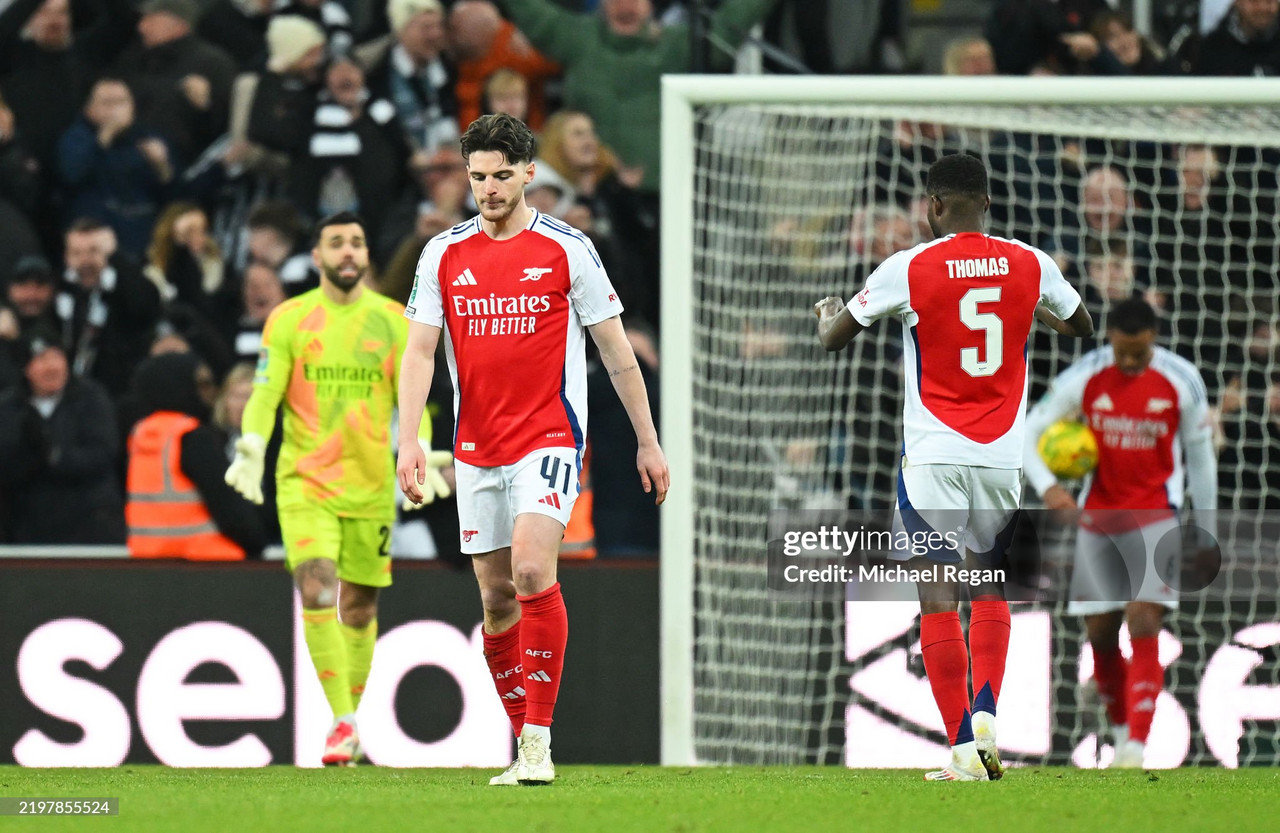

Arsenal arrived at St. James’ Park to try and turn around a 2-0 deficit to Newcastle United in the Carabao Cup. But the score repeated itself on this occasion to dump out the team in the second leg of this semi-final.
Mikel Arteta knew his men needed a fast start to achieve their goal but were nearly out of the contest as soon as it started. In the 4th minute, Anthony Gordon released Alexander Isak and he rifled a shot into the top corner past David Raya. However, the striker had been offside, ruling out the goal.
The Swede would stamp his authority over the defensive line soon enough. He beat William Saliba to a long ball, flicking it around the corner to Gordon. The winger sent the striker in behind the back four, and Isak rattled the frame of the goal. But Jacob Murphy was on hand, converting the rebound.
An unenviable task now seemed to be an impossible endeavour. For the rest of the first half, Arteta's men retained even more of the possession, but they could not force the ball into the back of the net.
The Gunners got their final comeuppance near the start of the second half. Fabian Schär stripped the ball from Declan Rice, who received from Raya on the edge of his box, and Gordon doubled the lead.
The final whistle ended Arsenal's campaign in the Carabao Cup at the same stage that they reached three years ago: their best performance under Arteta. Here are four things we learnt from this exit.
-
Alexander Isak is the one who got away
Newcastle nailed the first phase of this semi-final and a stellar striker was no small part of their plan.
William Saliba, so calm and composed in most matches, was unusually rattled in this contest. The Magpies revel in the task of disrupting the flow, being physical, and barrelling into duels. And they have a mobile, lanky forward that might have been Arsenal's difference-maker in a parallel universe.
Isak was the subject of a saga that linked him from Real Sociedad to Arteta's team in 2022. He chose to move to north-east England and forced fans of Arsenal to regret that decision across the semi-final.
His two goals, quick feet and movement were a thorn in the side of the Gunners. Arteta has met his match with an outfit that identifies itself through intensity and physicality as well as a set of forwards that can do the business in and around the box. And the pride of place in the pack belongs to Isak.
-
A lack of signings signals trouble
Arsenal fans have been crying out for players who can patch up the problems in their dressing room. But the club has a habit of never quite completing the job of squad construction. Already, it appears that the lack of any signings during the winter window could be a costly oversight from the board.
The misses from Martin Ødegaard were another reminder of the lack of efficiency in the final third.
In addition to this, the offensive department is threadbare. Bukayo Saka is the obvious absence with a hamstring injury. But Gabriel Jesus, who had sparked into life, suffered an ACL injury in the middle of last month. Arsenal did not make a move for a new attacker and his compatriot is a new casualty.
Gabriel Martinelli picked up a hamstring injury and left the field before the end of the first half. His scan will suggest the length of the layoff but it ramps up the demand for 17-year-old Ethan Nwaneri to become the answer to a persistent problem— not unlike a fellow Hale End graduate at left-back.
If the Gunners wanted to be fit and firing for the run-in, rest and rotation would have been key. They are already paying the price for the absence of quality and quantity in the zone that matters the most.
-
Regrets from the summer?
It is possible to take a different lens as a sceptic of the squad building that has happened at Arsenal.
The club made only three summer signings— and all of them were on the bench in one of the most important fixtures of the season. By the time they entered the pitch, the scoring had come to a close.
Even when Raheem Sterling stepped onto the pitch, the trust with the ball carrying continued to go to Nwaneri much more than not. Mikel Merino cannot call on creative capacities that mimic the impact of Ødegaard and Riccardo Calafiori seems to be behind Myles Lewis-Skelly in the pecking order.
Most admitted that Arsenal's efforts at the start of the summer were modest. To take the titles that they desired, the trade-off would have been quality for less quantity. Now, it would be difficult to convince fans that the composition of the squad has moved much further forward— in any area of the field.
And this all boils down to the discussions that Arsenal want to go their way at the end of May.
Another trophyless season?
Even though troubles had plagued the squad, the start of the new year still carried the hope of a trophy in any one of four competitions. Most fans would have said that the team's chances were best in one of the two domestic cup competitions. Having already gone out of the FA Cup after a penalty shootout defeat to Man United, this exit eliminates that route to glory until the next campaign.
Now, success with silverware depends on the improbable. They must pray league leaders Liverpool, who are six points ahead with a game in hand, lose momentum. Or they must do what no squad has achieved in north London and climb to the top of Europe’s elite in the UEFA Champions League.
Either feat is unlikely and if the Gunners do not get a trophy, it will be five years since the FA Cup victory in 2020. There is no doubt that Arteta has raised the standards at the Emirates Stadium, but he still seems to be struggling to solve the question of putting it all together to earn the big honours.
