


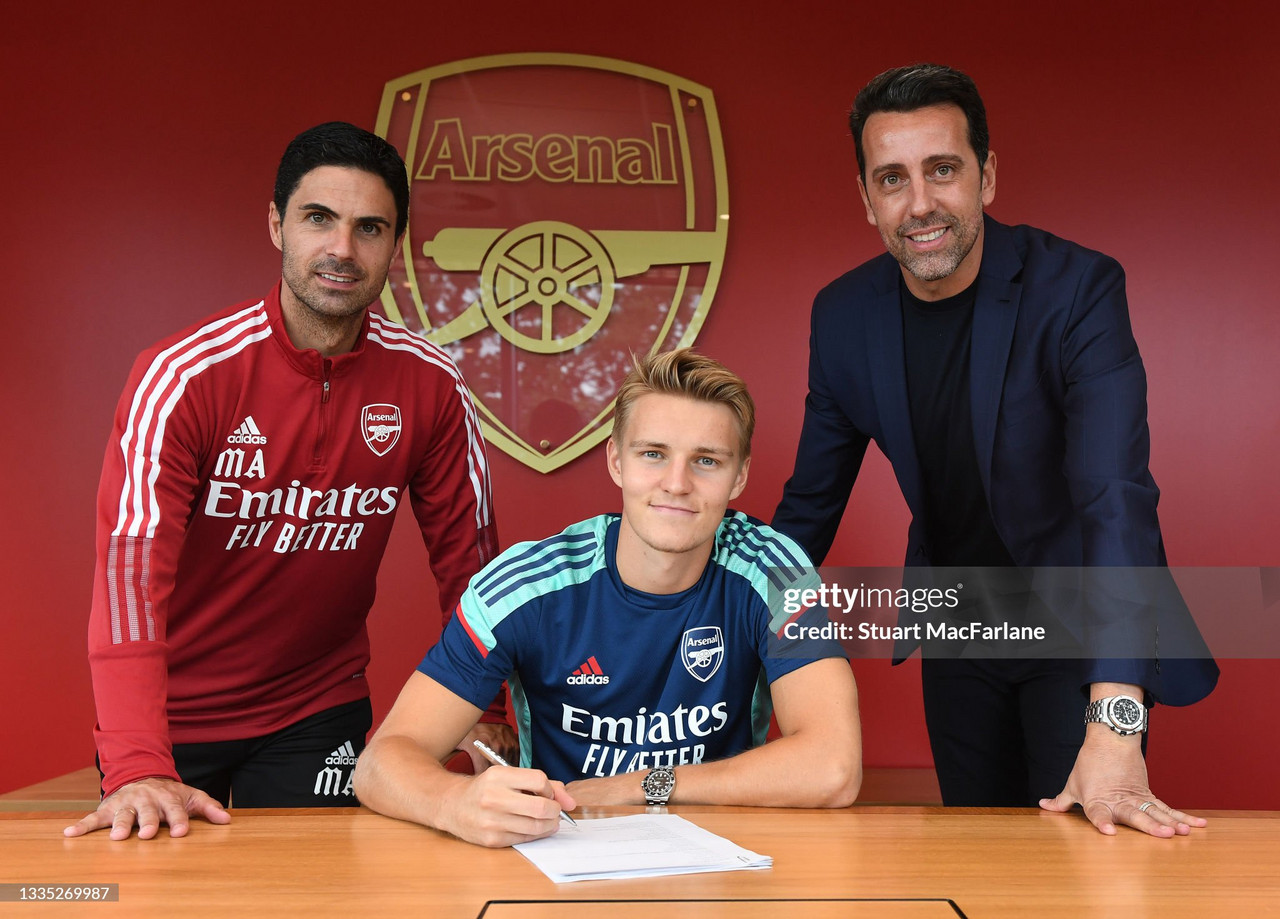

At 26 years old, Martin Odegaard has been through a whirlwind of a career. From being the 'next big thing' in European football to an outcast from Real Madrid, he has finally flourished at Arsenal.
He has the keys to the Gunners' offense and at times, it has come at a cost to his brilliance. But the pair are much better off in each other's company and who better to prove it against than the club where the journey started?
-
A ‘PR exercise’ gone wrong
Odegaard always had football in his blood. He was the son of Hans Erik Odegaard, also a central midfielder at the professional level who spent a decade of his career at Stromsgodset. It was here that the Norwegian captain took his first steps in the senior circuit and announced himself to the world.
He made his debut for the first team as a 15-year-old and became the youngest player in the history of the top tier of Norwegian football. No one was in doubt that this Scandinavian sensation could make waves across Europe and clubs clamoured to sign him. Odegaard went on visits to Bayern Munich, Liverpool, and Arsenal in the winter of 2014, but he chose to put pen to paper for Real Madrid.
However, it soon became clear that the prodigy was not in an ideal environment to grow his game. He came into a club that had just won the Champions League with the strictest of standards: there was no space to worry about the interests of a player who required careful crafting around him to blossom.
Odegaard bounced between training with the first team and the Castilla squad, never settling into either squad. His manager upon arrival, Carlo Ancelotti, admitted in his book the Norwegian was a "PR exercise" from President Florentino Perez, only making one league appearance in May 2015.
Neither Rafa Benitez nor Zinedine Zidane, who worked with him in Castilla, saw Odegaard as a part of the plans for the first team. In the end, the teenager took his talents abroad, spending 18 months on loan at Heerenveen and a year at Vitesse. He would be in a much better place for those experiences.
-
Loans point to pastures anew
In 2019, Odegaard went on his third loan from Los Blancos. He stayed in Spain with Real Sociedad, where he started to rebuild his reputation in the wider public consciousness. At the time, he was still only 21 years old: one of many reminders in his career about how flippant football is as an industry.
His return in front of goal was not massive: a mere four goals and six assists in 2600 La Liga minutes. But this spell signalled much more about his true character as a player. His small space dribbling, ball mastery, and playful passing graced the field, but he likes to use those skills to support and stabilise control of the ball rather than trying to consistently crack opponents with game-breaking actions.
More to the point, he earned treatment as a centrepiece of the project at Sociedad— a precursor to the position of power he now holds at Arsenal. Under Imanol Alguacil, who also hails from the Basque Country, he was the main creative force in their 4-3-3 system. He was a big piece of the puzzle that propelled the team to sixth spot in the table and on the way to a glorious run in the Copa del Rey.
But before he decided to turn over a new leaf for good, Odegaard tried to take the form from his spell at Sociedad back to the Spanish capital. Half a season was enough evidence to tempt him away. He made just three league starts in the 2020/21 season as part of an outfit where Luka Modric and Toni Kroos were kings of midfield, coming off the bench four more times, and also struggled for fitness.
-
A home in North London
At the start of 2021, Odegaard opted to spend six months in north London with Arsenal. The team were in the doldrums, passing through the fire of a rebirth with Mikel Arteta and a motley band of players. But Bukayo Saka and Emile Smith Rowe revealed the youth were the way forward and a 22-year-old on the lookout for a home of his own was in the perfect place to pitch into such a project.
He did not look like a shining star straightaway. Smith Rowe was a livewire in the final third that could thrive in the chaos around the camp better than Odegaard. The Norwegian needed a symbiotic system that he could rely on and that relied on him, and after joining the Gunners for good the next summer, Arteta began to put the pieces in place for the number eight to ascend as Arsenal's spark.
At Real Madrid, Modric and Kroos had right of way in the deeper zones of the midfield. In north London, he is the man who moves into the spaces between the right back and right winger, allowing him to open his body, see the whole field with less pressure, and choose what plays to set up next.
Red and white shirts sit in a set structure around him and the most critical piece of the jigsaw is Saka. With a better sense of the movement of the number seven, Odegaard morphed from a figure who would passively pass through matches into a creator who was unlocking a deep bag of flicks, tricks, dinked chips, and reverse through balls. Confidence came coursing into his plays and as Arsenal went up the table at the start of 2022, he beat Smith Rowe in the battle to be the main attacking midfielder.
-
Redemption in red
The campaign came to a bitter end as Tottenham took the fourth and final spot for the Champions League. But the Gunners got stronger and mowed down most of their opponents in the 2022/23 season with the most fluid football in the Premier League. At the heart of it was their new leader.
Alexandre Lacazette left in the summer and Granit Xhaka was unlikely to step in as skipper after his fallout with the fans against Crystal Palace in 2019. The armband would go to Odegaard: a shy, unassuming figure to the eye, but a player who led by example with his displays in the shirt.
Odegaard was at the peak of his powers, ending up as the joint top scorer for the Gunners that year with 15 league goals. He also got a helping hand from a new accomplice to raise his game in general play. After filling this position in a 5-1 win over Norwich City (one of the early flashes of Odegaard's skill) Ben White would move into the role of right back for good to make room for William Saliba.
White, Odegaard, and Saka have been a mainstay on the right side of the field. The relationship would be even more integral to the team in the 2023/24 campaign. As Oleksandr Zinchenko and Gabriel Jesus fell out of favour, and Xhaka went back to Germany, the limitations of Gabriel Martinelli meant that the attack looked less fruitful on the left of the field and was more reliant on the right.
The captain took time to warm up, but the start of 2024 saw him hit even higher levels of seniority. His reward was a first campaign of double-digit league assists (10) in his career as well as nomination for the club's Player of the Year and the PFA Team of the Season for the second year in succession.
-
The captain comes full circle
At 25 years of age, Odegaard was operating at the levels that attracted so many admirers a decade before. But one more feat would complete his arc at Arsenal. For the second year in a row, his side had also fallen just short of the Premier League title, finishing behind Man City both times.
As the Citizens completely collapsed, the third attempt should have brought the big prize. But it has disappointed: the Gunners sit 11 points off league leaders Liverpool, having gone out of the Carabao Cup and FA Cup to stare at the likelihood of a fifth straight year with no trophies to their name.
Critics continue to call out the captain as one of the foremost reasons for the failure. His output has dropped to two goals and four assists with only seven league games to go on the fixture list; it is an even more painful sight to see how he clams up without the confidence to conduct as he did before.
However, he has never truly been an individualist. It would be better if he could shake off some of the flaws that held him back in the early stages of his career, but more maturity at the top level does not mean that the Norwegian is now a radically different player from the one that entered the scene.
Though has to take responsibility for his performances, his plight portrays some of the squad building issues at the club. Arteta has doubled down on Odegaard being the only creative midfielder as Fabio Vieira went to Porto on loan and Smith Rowe reunited with old faces at Fulham. It is a lot of weight to saddle on his shoulders and a load he could not bear with White and Saka sitting on the sidelines.
Perhaps this will go down as the year that brings the extent of his talent into perspective. But many chapters of the story are still to be written. Odegaard has survived scares in the past to demonstrate to his doubters that he can be a household name: what does he have in store for his old employers?
