



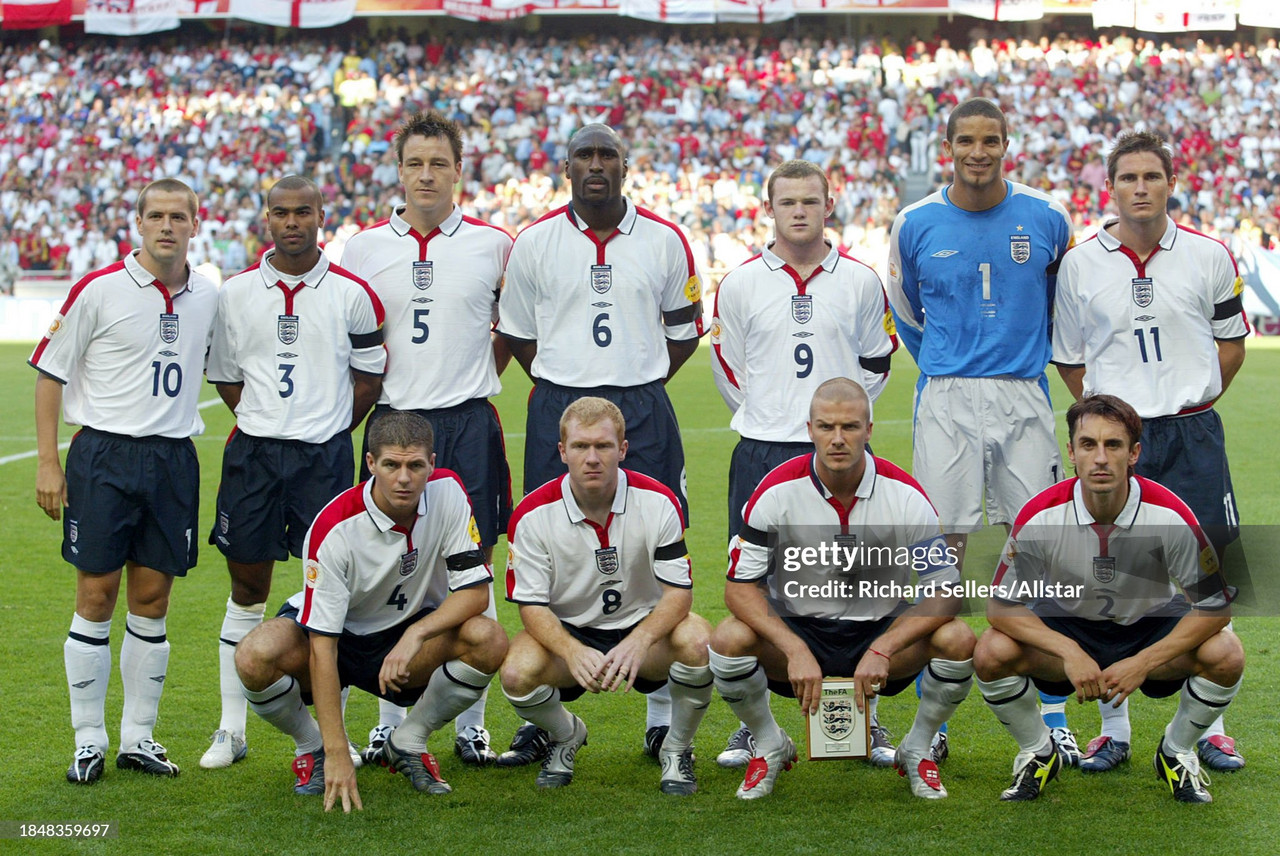

Another major tournament is nearly upon us, and so that familiar cocktail of emotions – anticipation, trepidation, belief and co – will likely have already set in for many.
While a disappointing 1-0 friendly defeat to Iceland at Wembley on 7th June represented an underwhelming final outing prior to Euro 2024 in Germany, England are widely considered to be among the favourites to lift the Henri Delaunay trophy at Berlin’s Olympiastadion on 14th July.
In search of a first ever senior men’s European Championship triumph, and first senior men's major tournament success since the 1966 World Cup, the feeling is that the Three Lions’ chances of securing silverware have rarely been better.
A balanced and flexible group containing established top-level operators such as Kyle Walker, John Stones, Declan Rice, Trent Alexander-Arnold, Jude Bellingham, Phil Foden, Bukayo Saka and Harry Kane, with fresh class offered by the likes of 19-year-old Kobbie Mainoo and 20-year-old Adam Wharton, means the foundations look promising.
The seeded nation in Group C, England will open their campaign against Serbia in Gelsenkirchen on Sunday 16th June, before facing Denmark in Frankfurt on Thursday 20th and Slovenia in Cologne on Tuesday 25th.
As Gareth Southgate’s team look to go one better than 2021’s agonising Euro 2020 final defeat to Italy at Wembley, the current squad is arguably the strongest that the Three Lions have assembled for a major tournament since the mid-2000s.
That spell brought the promise and ultimate disappointment of both the 2006 World Cup, also in Germany, and that enthralling summer of 2004 in Portugal, where Wayne Rooney emphatically announced himself on the international stage within a star-studded side.
-
The Group
Automatic qualification was secured by topping Qualifying Group 7 ahead of Turkey, Slovakia, Macedonia and Liechtenstein.
Within the 16-team format of the finals competition that was in place from 1996 to 2012, England then joined Switzerland, Croatia and reigning European champions France in a strong Group B.
Switzerland – who would finish bottom of the group – actually fielded their current manager, Murat Yakin, at centre-back during this championship.
Euro 2004, meanwhile, remains the last time a Croatia squad at a major senior men’s tournament didn't include the irrepressible Luka Modrić. However, this iteration still featured stars like Ivica Olić, Darijo Srna, Dado Pršo and brothers Robert and Niko Kovač.
France, though, were a different level of opponent. They may have been eliminated in the group stage at the 2002 World Cup, while eventual champions Greece would see them off in the last-eight of this tournament, but this was a Les Bleus outfit that contained much of the spine that won the 1998 World Cup and Euro 2000, and reached the 2006 World Cup final.
The list of those that featured against the Three Lions in their memorable opener spoke volumes.
Fabien Barthez, William Gallas, Lilian Thuram, Mikaël Silvestre, Bixente Lizarazu, Robert Pires, Claude Makélélé, Patrick Vieira, Zinedine Zidane, Thierry Henry and David Trezeguet made up the starting lineup, while Sylvain Wiltord and Willy Sagnol came off the bench.
-
The Manager
This was Swedish boss Sven-Göran Eriksson’s second of three major tournaments in charge of England.
The first non-British manager to take the Three Lions job, he’d built a strong reputation prior to taking over in January 2001.
He’d won 18 trophies in 24 years in management, which saw him in the hot seat at Swedish clubs Degerfors IF and IFK Göteborg, Portugal’s Benfica (twice), and Italian outfits Roma, Fiorentina, Sampdoria and Lazio. His spell in Florence was the only one of those that failed to produce silverware.
After he helped turn around England’s qualifying campaign for the 2002 World Cup, Rivaldo and Ronaldinho goals saw Brazil – managed by Luiz Felipe Scolari, who would become a persistent nemesis for Eriksson’s England – come from behind to beat them 2-1 in the quarter-finals of the tournament held across South Korea and Japan.
Scolari would go on to face the Three Lions as Portugal boss in the last-eight of both Euro 2004 and the 2006 World Cup. The latter meeting – a 4-1 penalty-shootout defeat for England following a 0-0 draw over 120 minutes, which saw Rooney red-carded for a second-half stamp on Ricardo Carvalho – proved to be the Swede’s final match in the job.
Eriksson went on to manage English sides Manchester City and Leicester City, and China’s Guangzou City, Shanghai Port and Shenzen at club level, as well as the Mexico, Côte d’Ivoire and Philippines national teams.
Now 76 years of age, Eriksson was back in the news earlier this year. After announcing in a January interview that he had sadly been diagnosed with terminal cancer, he revealed his support for Liverpool and his long-time ambition to manage the Merseyside club.
It was subsequently arranged for him to be part of the Liverpool Legends management team for their charity match against Ajax Legends at Anfield in March, which saw Eriksson receive a rapturous pre-match ovation.
-
How did they do?
England had quite the collection of talent. This was, after all, within the height of the ‘Golden Generation’ era.
The 12 players that started across their four games at the tournament highlight the ability within the ranks: David James, Gary Neville, Ledley King, John Terry, Sol Campbell, Ashley Cole, captain David Beckham, Steven Gerrard, Frank Lampard, Paul Scholes, Michael Owen and Rooney.
It becomes additionally striking when we factor in that regular centre-back Rio Ferdinand wasn’t available, due to Euro 2004 falling within his eight-month ban for missing a drugs test.
Eriksson's much-discussed conventional 4-4-2 set-up often meant the midfield quartet of Beckham, Gerrard, Lampard and Scholes possessed more quality than it did genuine balance.
The latter, who generally operated from the left flank in this system, would retire from international football later that summer at the age of just 29.
For many, the feeling persists that the tempo-dictating midfielder that Scholes developed into for Manchester United in the remaining nine years of his club career could have been a considerable asset for the Three Lions.
England’s eye-catching opening fixture against that heavyweight France team came at Lisbon’s Estádio da Luz, home of Eriksson's former club Benfica, on the evening of Sunday 13th June.
It looked set to be England's night, until it very much wasn’t.
Lampard headed home a 38th-minute Beckham free-kick to earn the lead and the advantage ought have been doubled in the 73rd.
After outmanoeuvring Thuram, who he'd caught forcefully with his elbow in an earlier challenge, Rooney powered into the France box where his future Manchester United teammate Silvestre scythed him down. Penalty.
Beckham’s effort from 12 yards was brilliantly palmed away by his former United colleague Barthez, though. Only the start of England’s spot-kick pain that summer, as it turned out.
Rooney was puzzlingly substituted soon after and Beckham's Real Madrid colleague Zidane, balletic as ever, then won the game for Les Bleus.
He whipped a 25-yard free-kick inside the left-hand post in the first minute of additional time. Then, after Henry latched on to a loose Gerrard backpass and was fouled by James, he did likewise with a penalty in the third.
Defeat snatched from the jaws of victory.
Still, it was hardly a night without promise. Rooney had bullied and befuddled a seasoned French defence on several occasions and the management of the game had been sound enough prior to the stoppage-time nosedive – which was largely down to the excellence of one of the greatest players the game has produced.
The meeting with Switzerland in Coimbra on 17th June was considerably smoother, although the excitement levels ratcheted up as Rooney propelled England to a 3-0 win.
A deft first-half header put his nation ahead and made him the youngest men's goalscorer ever at the European Championship finals.
That record was actually broken just four days later by Switzerland's Johan Vonlanthen, 100 days Rooney's junior, in their 3-1 loss to France – and it is one he still holds.
After Bernt Haas' 60th-minute dismissal for a second yellow card reduced the Swiss to 10 players, Rooney's powerful right-footed effort and Gerrard’s late conversion sealed a comfortable win.
The return to Estádio da Luz then produced another thriller, although England were the victors on this occasion.
Croatia took an early lead when Niko Kovač capitalised on the failure to clear a free-kick, but Scholes’ opportunistic header and Rooney’s thunderous 25-yard drive gave the Three Lions a 2-1 lead at the interval.
Rooney’s cleverly disguised finish extended the advantage midway through the second half and, although Igor Tudor’s header reduced the deficit soon after, Lampard then weaved through to secure a 4-2 win and a place in the quarter-finals as group runners-up behind France.
Momentum was building, and fast. This quality-laden version of England, with this unrelenting teenager at the forefront, arguably looked as well-placed to beat just about anybody as any Three Lions side at any time before or since.
Yet, as we know, things in football can change so quickly.
Hosts Portugal, and Scolari, awaited at the same venue just three days later. They had elements of a ‘Golden Generation’ of their own, with goalkeeper Ricardo, Carvalho, Maniche, Deco, captain Luís Figo and Rui Costa all prominent contributors.
A certain 19-year-old named Cristiano Ronaldo, meanwhile, was only 10 months into his senior international career, and had started the opening match on the bench, but was now becoming a mainstay.
Assuming he takes to the field this summer, Ronaldo will have featured in 11 consecutive major tournaments for his country, and counting.
The Three Lions made the fast start this time, as Owen nimbly flicked home a third-minute volley. But then came trouble.
A 22nd-minute challenge with centre-back Jorge Andrade saw Rooney briefly loose a boot but, at first, seemingly little else.
Within moments, though, he was down and nursing what proved to be a fractured metatarsal bone in his right foot. By the 27th minute, he’d headed down the tunnel, taking a notable portion of England’s belief with him, and been replaced by Darius Vassell.
Injuries to that particular region of the anatomy were a painfully recurrent menace for England players in the 2000s.
Beckham, Neville, Gerrard and Cole each sustained similar issues over the course of the decade, while Rooney faced a race to be fit for the 2006 World Cup after he suffered a broken metatarsal in Manchester United's Premiership match at Chelsea just six weeks prior to the Three Lions' first game of the tournament.
You’ll do well to find four syllables that send more of a shiver down England supporters' spines.
Back to 2004, and it wasn’t until the 83rd minute that Portugal equalised, when Tottenham Hotspur’s Helder Postiga headed home an inviting cross from fellow substitute Simão.
There was then considerable controversy when Campbell saw a potential late winner disallowed for a supposed foul by Terry on Ricardo.
It was a moment that triggered memories of the 1998 World Cup in France, when Campbell's 81st-minute header was contentiously ruled out during England's round-of-16 defeat to Argentina in Saint-Étienne.
To extra-time we went.
Postiga turned provider in the 20th minute of the additional 30 as he found Rui Costa, another substitute, who hammered home via the underside of the bar from 25 yards.
England clawed their way back, though, as Lampard swivelled to score with trademark efficiency five minutes later after he controlled Terry's knock-down from a Beckham corner.
Penalties, then.
Beckham, with England’s first spot-kick, and Rui Costa, with Portugal’s third, both missed the target, while Owen, Lampard, Terry, Owen Hargreaves and Cole, and Deco, Simão, Ronaldo, Maniche and Postiga each found the net to take the score in the shootout to 5-5 ahead of the second round of sudden-death kicks.
There, the gloves were literally off for Ricardo, who saved from Vassell before he smashed the winning penalty beyond James and into the bottom-left corner.
A painful end for England that, perhaps, has only accentuated memories of the previous fortnight's blissful promise in the two decades since.
-
The Star Player
It’s difficult to look beyond Rooney.
Cole and Lampard were among others to have strong tournaments, but the Everton academy graduate, who was a few months away from joining Manchester United, was the daring, dynamic driving force of this talented England side.
A little over 18 months after a 16-year-old Rooney's first senior Toffees goal famously beat David Seaman and Arsenal, and propelled him into the national consciousness, this summer saw him thrillingly introduce himself to a much larger audience only 16 months into his senior international career.
That his early withdrawal in the Portugal match continues to be looked upon as a decisive moment in this tournament – and, perhaps, in the Three Lions’ broader fortunes within this era – reflects just how impactful a presence the teenager had already become.
After his rip-roaring run earned the penalty that could have seen off France in the opener, his stunning doubles against Switzerland and Croatia supercharged his nation’s campaign and fuelled a rarely seen level of excitement and belief amongst the thousands of travelling England supporters and the millions back home.
How different things could have been if injury hadn’t struck less than half an hour into that quarter-final.
Eriksson’s side would have likely been far harder to pin back, and thus been better-placed to maintain or add to their lead.
If other knockout-stage results remained the same, the Three Lions would then have been widely fancied to win both a semi-final against the Netherlands and the final against Greece.
Rooney would have had every chance of finishing as the tournament’s top scorer, too, given he was on four goals at the time of his premature exit and Milan Baroš of the Czech Republic would eventually top the charts with five.
Ifs, buts and maybes? Yes.
But are such possibilities worth considering? Absolutely.
So much of football – for all its processes, strategies and systems – is about fine margins and sliding doors moments.
Rooney, ultimately, wouldn’t go beyond the last-eight in his six major tournaments with England, who would fail to qualify for Euro 2008.
What remained clear in 2004, though, was that the Three Lions had found a leading figure for years to come.
He would go on to be appointed captain in 2014, earn 120 caps – making him the nation’s most-capped men’s outfield player – and become his country’s record goalscorer in September 2015, prior to retiring from international football in 2017 and making a farewell appearance in a November 2018 friendly against the USA.
The goalscoring title was one he would hold until March 2023, when Kane struck his 54th senior England goal as they won their opening Euro 2024 qualifier 2-1 in Italy.
-
How did their 2024 Qualifying go?
That success in Naples – the Three Lions’ first away victory over the Azzuri since 1961 – kicked-off an eight-match qualifying campaign in style.
It ended with England unbeaten, as they registered six wins and two draws to finish top of Qualification Group C ahead of Italy, Ukraine, North Macedonia and Malta.
Alongside that landmark success in the shadow of Mount Vesuvius, highlights included a 7-0 win over North Macedonia at Old Trafford last June and a thrilling 3-1 Wembley victory over Italy in October to secure automatic qualification, as group winners, for this summer’s tournament in Germany.
The pre-tournament mood took an understandable knock after the Iceland friendly. 2004 and 2021, though, offer reminders that building in-tournament mood and momentum tends to be considerably more pertinent.
