


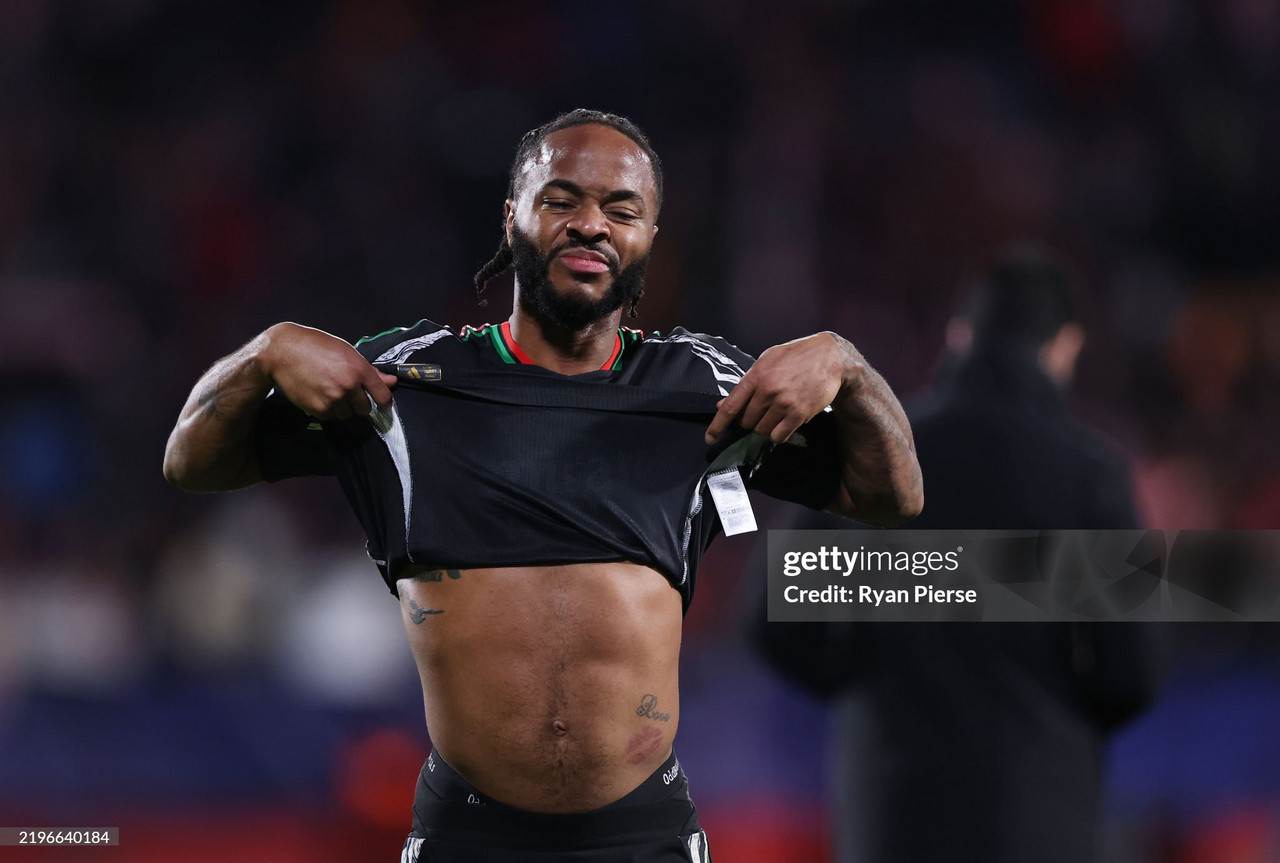

Loanees can liven up a group of players or lift the lid on the problems that are present in a squad. The big bet for Arsenal in the summer was that they could get the best out of an ostracised Raheem Sterling. That ploy has never looked like working in a year to forget for the 30-year-old winger.
-
How did Sterling switch allegiances to Arsenal?
Arsenal added Sterling to their ranks in the knowledge that this move was a need rather than a want.
The 30-year-old has thrived as one of the most complete packages in the Premier League in the final third. A livewire who lived for dynamic dribbling, getting goals, and making smart runs off the ball, he had shown he had both the star quality and intuition to take on instruction to succeed at the highest level. Yet, new Chelsea manager Enzo Maresca jettisoned him, and he was looking for a new home.
That was an ideal convergence of interest for the Gunners, who were gambling on getting a version of Sterling that was becoming rarer on the field. But they had seen the limitations of an attack that was becoming more reliant on service to Bukayo Saka. As fans fervently wished to see the squad go one better than the second spot they earned in the last two years, they yearned for some fresh attackers.
That target did not seem high on the agenda of the club, whose only work had only bought defender Riccardo Calafiori and midfielder Mikel Merino. Time was running out. And so were their options.
Before Arsenal won 2-0 at Aston Villa in August, Arteta had hinted at a close relationship with the winger. The two men had a productive time at Man City before Arteta came back to north London.
Once he had hung up his boots, he joined Pep Guardiola as part of his coaching staff and spent three full seasons with Sterling. The winger would enjoy two highly prolific years with the Spaniard from 2017 to 2019, scoring 18 and 17 league goals as the Citizens kicked off their era of dominance with two Premier League titles and added two Carabao Cups as well as an FA Cup to their trophy haul.
The Spaniard said nothing conclusive in that press conference to convey that Sterling would join up with him from Chelsea. Sporting director at the time, Edu Gaspar, gave more insight into the plans for the transfer window, revealing the team had never intended to bring in Sterling at the start of the summer. However, on deadline day, a deal was struck between the two clubs from the capital city.
-
Sterling’s struggles in summary
Sterling made his league debut for the Gunners in the final minutes of the North London derby and then received his first starting spot in a 3-1 win over Southampton at the start of October. His first goal for the club had already arrived in a 5-1 victory over Bolton Wanderers in the third round of the Carabao Cup, but the expectation was his impact would be in much more high leverage moments.
Almost immediately, there was a sense that all was not well with the winger. Two weeks after that full debut, he deputised for the injured Saka on the right wing in a 2-0 defeat at Bournemouth. He looked lively in the first half hour but would be the sacrificial lamb when William Saliba received a red card.
It was a sign of what was to come. Arteta had given him under 200 Premier League minutes by the start of the new year, and in the three months that Saka sat out of action with a hamstring tear, he only made two more starts in the league. Most of his last appearances for the club came once Saka was available and Arteta attempted to protect his regulars where he felt fit for the Champions League.
The trust of the manager was absent. When Sterling was on the pitch, it was seldom a pretty sight.
He never got on the scoresheet for the club in the Premier League. As the months passed, it appeared that he dropped lower in the pecking order. He turned out to be on the edges of the squad even when Gabriel Martinelli and Kai Havertz were also absent with hamstring injuries as Mikel Merino moved into the role of a makeshift striker and Ethan Nwaneri took his chance on the right flank.
The month of February brought some of his lowest points: from a late free kick he smashed into the wall against West Ham United to being offside more times than he registered shots or completed dribbles against Leicester City. A few highlights meant very little in a year that never got going.
-
Why was this loan deal such a failure?
It all came full circle on the final matchday of the season. Sterling saw 64 minutes on the field in a 2-1 triumph over Southampton before Saka stepped in: it was a symbolic passing of the guard in English football that, in truth, happened long ago. While Kieran Tierney opened the scoring for the visitors on his last game and came off to rousing applause, Sterling's exit was as muted as his entry was loud.
It rounds off a year to forget for a man who might have heeded the lessons from his final months at Chelsea. The explosive fallout with Maresca, who brutally dropped him from the squad and handed his shirt number to summer signing Pedro Neto, claimed as a victim of the chaos in the camp.
But even at the end of the 2023/24 season, Mauricio Pochettino phased him out of the starting plans a little. Noni Madueke made his mark and took the position that Sterling had serviced on the right.
Till that point, Pochettino had trusted him to take on the burden of being the veteran in the final third. Indeed, there have many been anecdotes about his warm words of wisdom and an exemplary attitude that acts as a role model for his juniors— including at Arsenal. But he is also a 30-year-old who has been at the top of the English game since 2012. Time ticks and the clock catches up with everyone.
This is not just a story of a player losing his physical edge. Arsenal fans are accustomed to seeing Arteta turf out players who were once integral to his plans and giving minutes to a smaller group of players than he has at his disposal. Tierney, Oleksandr Zinchenko and Aaron Ramsdale have all bore the brunt of his selection policy and that must also play a part in the story of Sterling's season.
At times, Arteta has bent his will. Ethan Nwaneri and Myles Lewis-Skelly have shown that quality can force his hand if he is backed into a corner. But for Sterling to see so few minutes in a season of struggles must mean that Arteta admits that he is not the same player from his days at Man City.
It would do a great disservice to Sterling to stain his career based on the last twelve months. But no one can argue that his time with the Gunners has gone the way he, or the club, would have wanted.
