



Second place in the Premier League for the third season in a row, an incredible Champions League run which saw the club make history at the Bernabeu and reach the semi-final of the competition for the first time in sixteen years.
Add to that a Carabao Cup semi-final and you have a summary of Arsenal’s season in two sentences.
Football fans from all corners of the globe would be delighted with a season like that for their own club, so why do so many fans of the North London outfit feel underwhelmed.
Supporters, and indeed the club themselves, perhaps do not go as far to perceive the season as a failure, but there is a clear sense of disappointment surrounding the Gunners.
The high expectations that were set at the beginning of the season do not feel like they have been met.
It is of course another season without silverware for the Gunners and Mikel Arteta was not shy in admitting that he felt his side had taken a backwards step in the Premier League this season.
But why? Why did Arsenal underachieve this season?
The fact of the matter is that there is not one simple answer. Football, like most things in life, requires a mix of hard-work, talent, dedication and luck.
So did Arsenal simply have a run of bad luck this season?
Well, yes.
Is that the reason the season played out like it did?
Not exactly.
Whilst bad luck cannot take sole responsibility for Arsenal’s underwhelming season, and Arsenal certainly aren’t the only side to be affected by bad luck this season, it clearly played a large part.
There are many reasons Arsenal fans would point to when trying to dissect their season, but perhaps bad luck would be at the top of the list.
-
The injury crisis
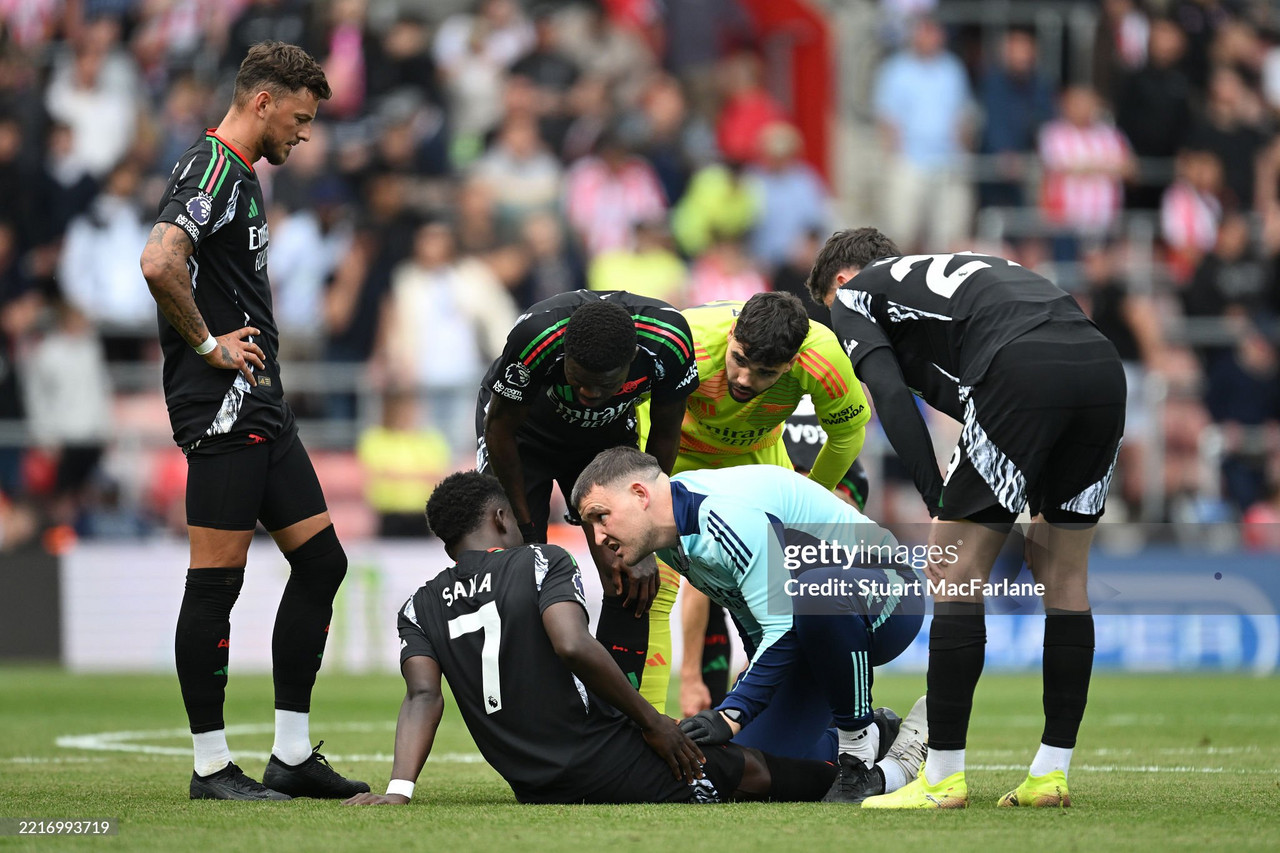
There is no clearer sign of Arsenal’s rotten luck this season than their ever-increasing injury list.
Injuries have always played a part in football. It is an unfortunate risk that will probably affect every player at some point in their career.
But an increase in games and the introduction of new competitions by the sports’ governing bodies has seen the topic of injuries increase in prominence in the media over recent years.
The Gunners have been struck by injuries from all sides this season, a lot of which have been down to players reaching their limits and their bodies simply giving in.
Of course, not every injury was caused this way. Luck also played its part.
Take Mikel Merino who was signed in the summer transfer window. He finally made his debut in October after picking up a shoulder injury in his very first training session.
Or Kai Havertz, who, after putting his body on the line for months and coming out unscathed, picked up an injury on Arsenal’s mid-season break in Dubai.
In fact, Arsenal could comfortably fill out an entire starting eleven of players who have spent time on the sidelines this season through injury, and still have enough players left over to name substitutes as well.
Out of all of the Gunner’s nine first-team defenders, only Jakub Kiwior made it through the season unscathed.
Across all competitions, only Leandro Trossard and Neto can join Kiwior in saying that they made it through the entire season without picking up an injury of some sort. Every other first-team player missed at least one game this season through injury.
Arsenal were forced to play large parts of the season without their captain, Martin Odegaard, without starlet Bukayo Saka or the rock-solid defensive partnership of Gabriel and William Saliba.
After injuries to Havertz, Saka and Gabriel Martinelli all overlapped, the Gunners were left to pick a front three out of 18-year-old Ethan Nwaneri, loanee Raheem Sterling, Trossard and midfielder Merino.
Two of whom also picked up injuries at around this time.
It is credit to Mikel Arteta and his side's flexibility that they were able to make it through this period whilst maintaining a grip on second place in the Premier League, but it could have been a season of so much more for the Gunners.
And maybe it would have been if they had taken a different course of action in the season’s two transfer windows.
-
A poor transfer window
Whilst Arsenal were plagued with injuries all season long, should the club have taken more preventative measures in the transfer window?
With the help of hindsight, the answer is obvious but in reality, could anybody really have predicted the number of injuries the Gunners would face?
The answer is almost certainly no.
Despite this, many Arsenal fans would argue that the club is missing one key piece, and has been for quite some time now.
A striker. A clinical goalscorer who can snatch victory from the jaws of defeat.
It is rather telling that Arteta has only signed six forwards during his tenure with the Gunners. Five when you remember that Havertz was initially signed as a midfielder.
Of those five, the only true centre-forward has been Gabriel Jesus, who has suffered with injury problems of his own throughout his Arsenal career.
As a result, many Arsenal fans would identify Havertz as their first-choice striker, who has found new life leading Arsenal’s front line.
It is unfair to say that the club did not make improvements in the summer.
The permanent signing of David Raya has undoubtedly been vital and without Merino filling in at striker during this injury crisis, Arsenal may have lost their grip on second place.
Riccardo Calafiori has looked at home in an Arsenal shirt since his arrival, but like so many in the squad, his season was hampered by injury.
But despite rumours all summer long suggesting Arsenal were in talks with RB Leipzig striker Benjamin Sesko, a move for the Slovenian did not materialise.
The Gunners did complete the loan signing of Sterling in the Summer, but it is fair to say that his performances were underwhelming for a player of his quality.
Perhaps the most telling assessment of his performances can be summed up by the re-emergence of Kieran Tierney.
The left-back made multiple cameo appearances in a forward position this season, whilst Sterling was left to watch on from the bench.
The January window provided much of the same. Rumours and paper talk, but still no arrival at centre-forward.
Arteta made it clear in the press that he was desperate to bring in attacking reinforcements, but a bid for Aston Villa striker Ollie Watkins was rejected in the final week of the window.
To compound Arsenal’s misery, Havertz sustained his injury mere weeks after the January window slammed shut.
It is impossible to say for certain how different the Gunners’ season would have been had the club been able to sign a striker, but the absence of such a player is hard to go unnoticed.
Too often, an inviting ball across the box went begging after the attacking Arsenal player failed to anticipate the cross.
And this absence has gone on to cause a far larger problem which saw the Gunners go from a title race to only securing Champions League football in the penultimate game of the season.
Arsenal just cannot stop drawing.
-
Too many draws
