


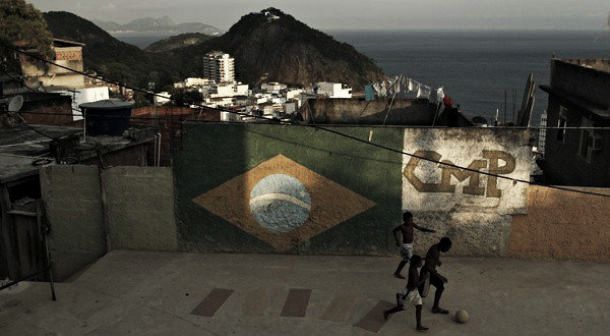
“In Brazil every kid starts playing street football very early. It’s in our blood.” – Ronaldo
When asking ‘who were the greatest ever football players?’, it is likely that in reply you will hear the likes of Cruyff, Eusabio and Beckenbauer’s names scattered among the place. Yet there seems to be a common trend;The first names mentioned tend to be those of players born and raised in the poverty-stricken communities of South America. And even from this selection of accomplished players emerging from impoverished populations, one countries ‘products’ are cited as the best ever; Brazil. However, every player has to start somewhere, whether it’s on a boggy pitch in the local park, or on a far off beach in the tepid summer sun. For many Brazilian children, life starts in a cramped ‘favela’, or slum. The stories of Ronaldo, Zico, Jarzinho and Romario coming from favelas and becoming some of Brazil’s most recognized and applauded players gives the youth a sense of belief and optimism, knowing they too can become one of the best. However, to rise from the familiar favelas in the heart of Brazil to become a Selecao sensation is a perilous journey riddled with various hazards and misdemeanors.
Favelas first popped up in the late 19th century, and were built by soldiers in need of somewhere to live. Only meant for temporary accommodation, these group of huts were not constructed particularly well. As time passed, poor citizens and even Black slaves moved in and out of these dilapidated slums, barely making a living. In a country of massive social differences, the word favela is interpreted to mean various things, to different people. For some, it means violence, to others it’s seen as tradition. However, as the world turns to Brazil for the 20th FIFA World Cup, these slums will be seen in a different light. They will be seen for football.
As we build up to the World Cup, television coverage is full of pictures coming from Sao Paolo. However, it’s not showing the eager Selecao supporters we imagined. Instead, pictures of vandalism, riots and violence are televised. These local residents, are in fact protesting against the World Cup. These local residents are, reasonably, protesting due to the countries money being spent on building new stadiums, when around 16% of the population is living in poverty, like in the many favelas dotting urban Brazil. Strangely in this footballing country, football itself has proved disastrous and has split the nation into two groups – those wanting proper shelter and food, and those dedicated to the beautiful game. Despite the ongoing riots, the underprivileged children of the favelas will not be focusing on affairs outside of their walls; They know it takes their best efforts and wit to succeed.
Due to the lack of income in the favela, many families can’t afford education or work. Without anything better to do, people of all ages often turn to crime and violence. Whether it’s stealing and selling on for money, vandalism or drug dealing, felony acts as a leading source of entertainment and finance. The native slums are riddled with gangs and malefactors, so those with higher aspirations have to be careful with who they get involved with, especially those gifted with the art of football. There has been many a tale of fake agents with the keys to accomplished youth leagues roaming the sandy pitches, inquiring about potential young talent. Once they have validated their credibility, they ask the families of these youngsters to pay a hefty price, in order to send them to a proficient club. Those that refuse to pay are shut out of the system. Those who have the money must be astute in choosing a trustworthy official, otherwise they will vanish the money paid. It’s one thing to be aware on the pitch, but when one lives in a settlement surrounded by devious and dangerous individuals, that awareness must be sharper than ever.
Those who avoid the fraudulent agents have to deal with other problems too. To you and me, communication is a transparent task, whether it’s face to face or through the expansive world wide web. In the slums of Brazil, due to the scarcity of money, communication is a privilege not many people have. Socializing through school or work is almost unheard of, with extremely low education rates. Thierry Henry once commented on Brazil as a footballing nation saying that the reason they’re so good is because of the amount of practice time they have as a result of not going to school. And he’s right. The majority populous of the favelas are deprived of education, and most can’t even read or write, so they need to find another way to communicate and learn; Football. Not only does football teach them of the dangers surrounding them everyday, but it acts as a first language and an alternate, feasible form of entertainment. Once engaged and familiar with those encompassing them, new skills can be learnt and games can be adapted. Favela football has been extremely important to the national side for many years now. In the favela, they play as they live, the style of play is energetic, stylish and tricky, and has taught players such as Ronaldinho and Ronaldo many of their trademark moves. Exclusive game modes are being created every day, if it’s the classic ‘cuppy’ or the deceptive panna matches, the Brazillians always find new, exciting ways to alter them. Sadly for these penniless football pioneers, the World Cup is too expensive, and they won’t be able to see their heroes on the biggest stage in their own country. However, Football beyond borders, an organisation using football to fight for equality, have set up a ‘Favela World Cup’ to let those unable to go to the World Cup get a little taste of the action themselves. This again is inspired by existing slum life, with inter-favela tournaments playing a big part in enjoyment, bragging rights and even prizes. They often bet branded football shoes or shirts that they wouldn’t usually be able to afford, to make it one step more exciting.
The eager, young footballers will have to look on as the idols they aspire to be take aspects of their own onto the World's biggest party, bu sadly they’re not invited. They can’t ponder for too long however, as the favela life is a tough one, with peril around every corner. Perhaps one day they will be playing on the modern grass pitches alongside those who grew up in similar situations, inspiring another generation. But for that, they must continue with the deceptive and crafty ways, whatever the situation.
