


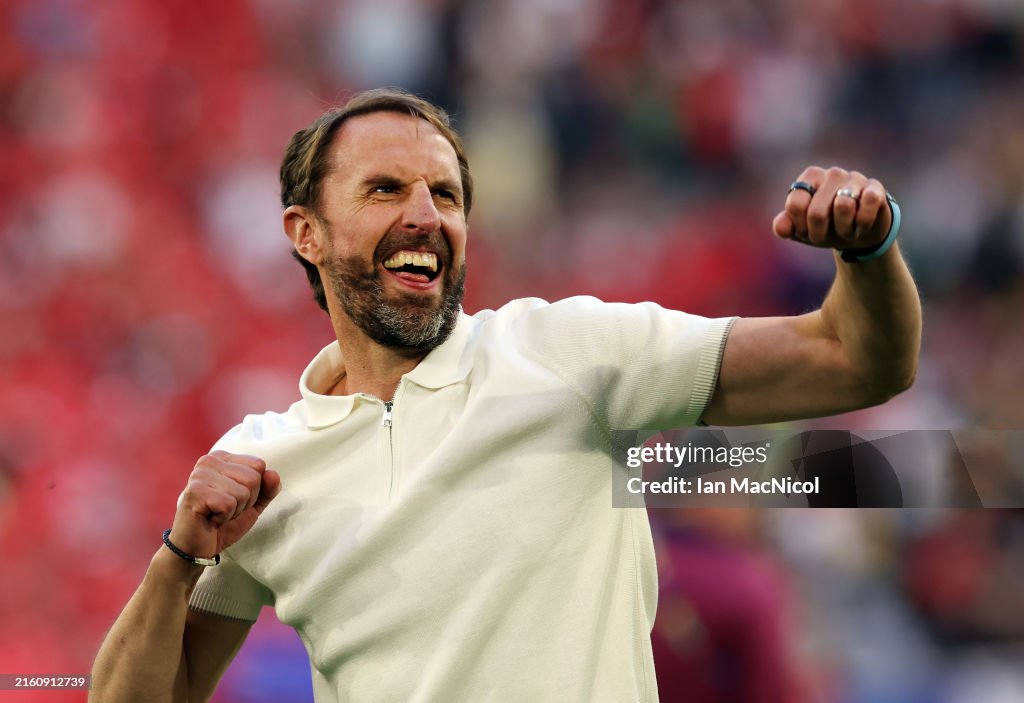

Before Gareth Southgate was appointed England manager in 2016, England had never reached the final the Euros, since the inaugural edition in 1960. Now the country is eagerly anticipating their second European Championship final in successive tournaments.
A complete switch in fortunes, but for many Southgate’s time in charge is still clouded by what ifs. What if the team had pushed for a second goal against Croatia and Italy? What if the penalties were approached differently in 2021? What if a more front foot style of football was deployed?
All valid questions in deciphering the eight years the former Crystal Palace midfielder has had in charge of his country, while leading England to their first final since 1966 and first final overseas in their history – just a couple of records that belong to the Englishman.
And ahead of Sunday’s final against Spain – one England go into as underdogs – for many fans Southgate’s time in charge will be decided by events in Berlin’s Olympiastadion.
-
Tournament dread transformed into belief
Tuesday 28th June 2016, a date that sends shivers down the spines of England fans. Shock exits from major tournaments had become normal for England, but the 2-1 defeat to Iceland in Nice hit new heights of humiliation. This was a country with a population size of 335,000 in their first major tournament knocking out England. A ripple effect was felt across Europe and it cost Roy Hodgson his job after four years in charge.
Two years prior, his England team failed to qualify from their World Cup group featuring Italy, Uruguay and Costa Rica. Go back another two years and England failed to clear the first knockout hurdle with their arch nemesis, penalties, the reason. A similar story can be found in 2010 when Frank Lampard’s ghost goal epitomised another unmemorable tournament. Then in 2008, one of the crown jewels of English failures occurred under Fabio Capello as they suffered the ignominy of failing to qualify for that summer’s Euros.
In eight years, the work in reaching three consecutive quarter-finals in the six years prior had been undone. England were in the doldrums. They had become the laughing stock on the European and World stage.
Back to the present and eight years have passed since that night in Nice and the change in results have been significant. A change that was probably unimaginable to many if you asked them what the next period would have looked like in the aftermath of the Iceland defeat.
A run to the semi-finals in Russia was followed up by a final on home soil, a backwards step in Qatar and now another final awaits England. Fear has morphed into genuine hope and expectation. Scenes of despair in the stands have been replaced by those of jubilation and bodies flying everywhere – Harry Kane’s goal against Germany in 2021 comes to mind. England now have a team to be proud of.
-
A familiar golden generation conundrum
Golden generation is a term that seemingly goes hand in hand with the English national team such is the repetitive nature in which their teams are lauded with that honour. Steven Gerrard, Lampard and Paul Scholes were all part of a team burdened with that tag and it showed with disappointing results on the biggest stages.
The latest cohort containing Kane, Jude Bellingham and Phil Foden are all also under that same pressure but there is a defined difference in their results compared to England teams in years gone by. So, why is that?
Togetherness. Club rivalries that plagued squads before have been ironed out and replaced by an atmosphere and environment created to empower each individual and remove some of the pressure attached to the international football landscape. Reports of disharmony in camp have been resigned to the history books and a close study of video clips from the in-house media team reveals enjoyment is second nature.
A lot of the credit for those feelings can be placed at the door of Southgate. Success on the pitch can’t be achieved without an efficient and effective environment off it. All the players back each other and know their roles in contributing to the wider picture as perfectly demonstrated by Ollie Watkins on Tuesday evening.
-
No new silverware in the trophy cabinet
Yet that elusive first trophy since 1966 has continued to evade England and the manners in which recent events have escaped England’s clutches are what places Southgate under the microscope of criticism.
The biggest of them all came on home soil in 2021 against Italy. Luke Shaw’s early strike fuelled belief that it was finally coming home but England failed to push home the advantage and proceeded to sit off the Italians - an opportunity they relished. Even the handling of the penalty takers in the subsequent shootout drew daggers from fans and media alike.
A similar pattern had happened three years earlier in the World Cup semi-final against Croatia. This time it was a full-back on the other flank, Kieran Tripper, that gave his nation an early lead before England decided to hold what they had and, on that occasion, they weren’t able to reach the dangerous sanctuary of a penalty shootout.
Running throughout both of those performances was the defensive mindset that has typified the Southgate era. A pragmatic approach that had paid dividends on occasions but one that has sometimes held back a team, especially in recent years, bursting with exciting attacking talent. Dour displays in the early stages of this summer’s Euros only bolstered that narrative bearing more gripes from travelling fans culminating in plastic cups being launched at Southgate.
The extra strings in his bow have been demonstrated on occasions against Germany in 2021 and most recently against the Netherlands on Wednesday evening but for many they have been too far and few between.
In the aftermath of Southgate’s 13th consecutive game unbeaten in the Euros, the 53 year-old delivered a passionate monologue on the criticism received in the early games and it was clear that those words had hurt him personally. This is a man who has devoted his life to bringing success to his nation. A nation he had experienced tournament heartbreak with in his playing days and now is trying to repair those old wounds.
The currency that talks in football is trophies and he is yet to add a new piece of metal for the Football Association’s mantelpiece but in the past eight years pride has been reinstalled in the national team, progression is visible and Southgate is responsible for that.
