


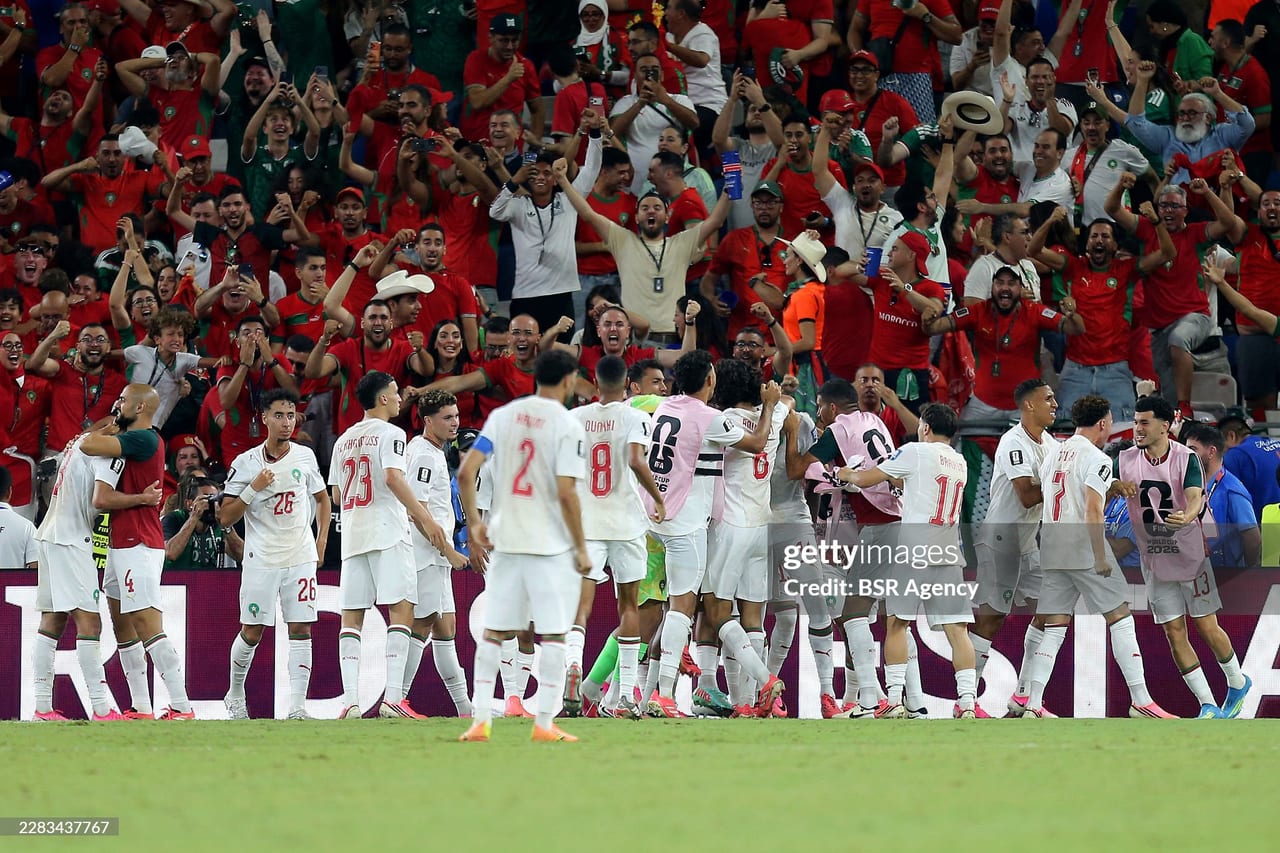

This was a game that leapt off the page – before, during and after.
The match-up, the links between the two nations, even the location. It came with a fair bit of the predictable tension that knockout football on such a stage regularly produces, but it certainly delivered a healthy share of quality and drama.
After a nuanced, engaging contest, which kicked off at 02:00 BST on Tuesday (19:00 on Monday, local time), it ended with the starkness of penalties.
Ismael Saibari converted the decisive one for Mohamed Ouahbi’s side, within a shootout that saw five of the 10 taken scored and only one of the unsuccessful efforts saved.
Having become the first African side to reach the FIFA World Cup semi-finals in 2022, knocking out Spain – also on penalties – and Portugal en route to their defeat to France in the last four, Morocco now have another shot at a deep run into the tournament after defeating another European heavyweight.
Significantly, some feel they look an even stronger outfit than the one that made history in Qatar.
They will now meet co-hosts Canada in the round of 16 in Houston at 18:00 BST on Saturday.
After a lively but goalless first half, things truly stepped up after the second period’s hydration break.
Somewhat against the run of play, Cody Gakpo gave the Netherlands a 72nd-minute lead, cuing emotional scenes. Gakpo and his partner announced over the weekend that their baby boy had sadly passed away during pregnancy.
Issa Diop’s stoppage-time equaliser then sent the game to extra-time.
The scenic home of Mexican club CF Monterrey, Estadio BBVA, which offers striking views of the nearby Cerro de la Silla mountain – and was hosting its fourth and final match of this summer’s tournament, which is taking place across Canada, Mexico and the United States of America – provided a fitting venue for a genuinely storied meeting.
This was only the fourth game between these two nations' senior men’s football teams, the first of which came in Orlando, Florida, during the 1994 World Cup – when current Dutch head coach Ronald Koeman captained the Netherlands to a 2-1 win.
The countries have strong links, though, largely due to notable Moroccan migration to the Netherlands, which was increased by 1960s labour agreements.
Indeed, three members of Morocco’s squad – Noussair Mazraoui, Sofyan Amrabat and Anass Salah-Eddine – were born in the Netherlands. At one of this competition’s many distinctive venues, this was a match that reflected the multifaceted evolution of international football and its most famous tournament.
Story of the match
Koeman made two changes to the side that started the 3-1 victory over Tunisia in their final Group F outing, with Tijjani Reijnders and Donyell Malen making way for Micky van de Ven and Crysencio Summerville. That, notably, saw the Dutch switch from a 4-3-3 shape to something more akin to 3-4-3.
Perhaps an attempt to overload the Moroccans in the first stages of build-up and to, at least partially, neutralise that press that caused Brazil so many issues a little over a fortnight ago? Either way, such a switch felt complimentary of their opponents.
Ouahbi, meanwhile, opted for four alterations from the partially rotated team that beat Haiti 4-2 in their last Group C match.
Diop, Mazraoui, Ayyoub Bouaddi and Azzedine Ounahi came in for Redouane Halhal, Salah-Eddine, Amrabat and Ayoub El Kaabi as The Atlas Lions returned to the XI that started their opening draw with Brazil and 1-0 win over Scotland on matchday two.
The contest’s early minutes, somewhat unsurprisingly, gave off the impression of two sides who were very much aware of the other’s threats. Even so, challenges and chances materialised soon enough.
The Netherlands worked themselves into areas of reasonable promise with relative consistency, but it was the 2022 semi-finalists who threatened most pertinently prior to the hydration break.
Achraf Hakimi, predictably, was prominent. His near-post corner was headed powerfully goalwards by Neil El Aynaoui and sharply palmed over by Dutch goalkeeper Bart Verbruggen in the 20th minute, and the right-back’s brilliantly struck 20-yard effort forced another good save out of the Brighton & Hove Albion stopper moments later.
Bilal El Khannouss, from the left, and Hakimi, via a free-kick down the right, both saw superbly inviting deliveries flash across the face of goal, but narrowly evade teammates, at opposite ends of the spell between the drinks interlude and half-time. Ounahi also shot narrowly over from range after a turnover in the Dutch half cued a swift advance in first-half stoppage time.
Van de Ven’s rasping 25-yard strike had been impressively tipped over by Moroccan ‘keeper Yassine Bounou a few minutes earlier, in what represented Oranje’s most promising moment prior to the interval.
The back-three, it seemed, had offered certain advantages to Koeman’s side in building the play, but perhaps blunted their broader threat, as much as Sunderland’s Brian Brobbey remained reliably committed to occupying opposing centre-backs – and Premier League colleagues – Diop and Chadi Riad.
As can be the case with such set-ups, the weight of numbers high up the pitch too often felt insufficient and that, simultaneously, appeared to embolden Morocco.
Jan Paul van Hecke perhaps embodied the physicality and edge sprinkled throughout the opening half as clearly as anyone.
The Netherlands centre-back initiated a succession of firm but largely fair duels down the Dutch right in the seventh minute and, by the eighth, he and Saibari were confronting each other off the back of a challenge that saw the forward’s boot make contact with Van Hecke’s head.
He then required treatment for a cut to the head in the 38th minute after he was inadvertently caught by the studs of Mazraoui in the Morocco box.
There was less combativeness to the second half, which was likely partially reflective of the hold the North African nation appeared to have on the game between the restart and the second hydration break.
Ouahbi’s team enjoyed around 80% possession within that phase, in which Hakimi twice went through but was denied first by the crossbar and then by a brilliant recovering challenge by Van de Ven, who put his pace to familiarly good use.
Koeman and Co, though, would put that second break – and their bench – to excellent use. Wout Weghorst, who made quite the impact as a substitute at the last World Cup, and Teun Koopmeiners were introduced in place of Brobbey and left-sided centre-back Nathan Aké, in an apparent return to 4-3-3.
Within seconds, Weghorst’s presence and nous paid dividends. His intelligently flicked header sent Verbruggen’s flighted ball forward into the path of Summerville, who still had plenty to do.
And he did it brilliantly.
After racing towards the box and stumbling under pressure from Mazraoui, he somehow managed to shovel the ball into the path of Gakpo to his left, who slammed a powerful first-time finish past the advancing Bounou and in.
A moment of immense emotion. Gakpo knelt on the turf with his head in his hands before being embraced by teammates. Welcome collective joy amidst what must have been an unfathomably difficult time for the Liverpool forward and his family.
Morocco continued to probe in the following minutes, but little in the way of genuine openings materialised, until the first minute of stoppage time.
Chemsdine Talbi, introduced from the bench just four minutes earlier, cut inside from the left and delivered a brilliantly inviting cross that Diop arrived just in time to meet between Virgil van Dijk and Koopmeiners.
His thumping header found the top-right corner and gave Verbruggen little chance. A suitably invaluable way for the 29-year-old to score his first goal for Morocco.
Extra-time it was.
Six minutes into it, Soufiane Rahimi, another substitute, looked set to put The Atlas Lions ahead for the first time when he weaved through, but Verbruggen intervened brilliantly this time. A combination of his right leg and right arm diverted the Al-Ain forward’s disguised attempt wide.
The 23-year-old stopper, who already has 33 caps to his name, looks to be becoming an increasingly central figure for his national side.
As can often be the case, the remainder of extra-time offered plenty of caution and exceedingly little in terms of openings. Penalties loomed and arrived.
For the Netherlands, Koopmeiners scored, Justin Kluivert hit the post, Weghorst found the net and Quinten Timber dragged wide.
For Morocco, El Aynaoui hit the bar, Rahimi scored via Verbruggen, Talbi netted and Hakimi struck the post.
That left it, effectively, at sudden death.
Summerville – such an energetic presence throughout – was denied by a shrewd Bounou save and that gave Saibari the chance to win it. The PSV Eindhoven forward, who is reportedly set to join Bayern Munich this summer, finished with familiar aplom – sweeping into the bottom-right corner as Verbruggen went the other way.
A third successive World Cup finals exit via a penalty shootout for the Netherlands, after Argentina overcame them in both the 2014 semi-finals and the 2022 quarters. It remains a cruel, if often concise, way to lose.
Much Dutch attention will likely now turn to the futures of Koeman, whose current contract expires at the end of July, and potentially of some of their senior players. Major tournaments – World Cups, in particular – can become bookmarks in that regard.
This, eventually, was Morocco’s night, though. They were worthy winners, having largely had the better of the 120 minutes that preceded the shootout.
A fittingly eventful and closely fought contest, particularly given the links and storylines that saw it leap off the page.
