


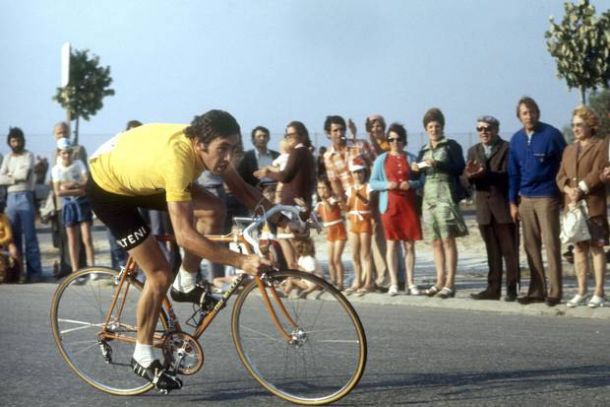

For many cycling fans, it’s impossible to imagine a world without Eddy Merckx. His name and his achievements tower over the sport, and he achieved so much that it’s hard to know where to start, or more accurately, where to stop.
When it comes to the biggest race of all, the Tour de France, he began writing his legend into the record books in 1969, and only eased off after winning in 1972, his fourth win in succession, when the race organisers persuaded him to go and race elsewhere for a year and give the others a chance.
He then won again in 1974 just for good measure.
Although 1969 was Merckx’s Tour de France debut, by the time he took the start line at the age of 24 he was already a major player in the one-day classics. He was a two-time winner of Milan–San Remo, had tamed the cobbles to take victory at Paris–Roubaix, and had won the Tour of Flanders and Liege-Bastogne-Liege. He had also shown that he knew how to ride a Grand Tour, winning the Giro d’Italia in 1968 and snapping up all three classifications; overall classification, king of the mountains, and the points classification.
It’s fair to say that, come 1969, he had form.
To say that he went on to dominate his debut at the Tour de France would be an understatement. The simple facts of that 1969 race tell their own tale; 7 stage wins, mountains classification winner, points classification winner, and the overall race win by a mammoth 17 minutes 54 seconds.
But it was stage 17, a mountainous day in the Pyrenees, which perhaps defines Merckx as a rider.
After attacking over the summit of the Col du Tourmalet, he descended alone and found himself with a 45 second lead in the valley bottom. With an overall lead in the race of around 8 minutes he had no need to do anything other than relax, wait for the chasing riders to reach him, and continue on in the safety of a group.
But Merckx was in no mood to hang around.
Instead, he embarked on a remarkable solo ride through the mountains, pushing on relentlessly over the Col du Soulor, then the massive Col de l’Aubisque, before barrelling on to the finish at Mourenx. After this incredible solo escape of 140 kilometres Merckx ended the day with an overall lead in the race of 16 minutes; his rivals trailed in miles behind.
In Merckx’s position, the standard tactic would have been to ride defensively, conserve energy, and hold his rivals at arms-length. For any other rider the risk of attacking 140 kilometres from the finish on a mountainous stage, when you already lead the race by eight minutes, far outweighs the reward.
But Merckx didn’t ride like other riders; rather than calculate, and do what he needed to do, he figured out what he conceivably could do, and went and did it. In 1969 Merckx led the race from stage 6 and never looked threatened. In 1970, his domination was hardly less complete.
In winning a total of 8 stages he broke a record set in 1930 by French rider Charles Pelissier. The only other rider to spend any time in the yellow jersey in 1970 was Merckx’s team-mate, Italian Italo Zilioili, but from stage 7 onwards Merckx was in command at the head of the race.
As in 1969 he took the overall win, and the king of the mountains prize, but this year finished second in the sprinter’s points competition, losing out to fellow Belgian Walter Godefroot. His overall margin of victory was a still impressive 12 minutes 41 seconds.
In 1971, Merckx won again, but the race is remembered almost as much for the exploits of Spaniard Luis Ocana. On stage 11 he attacked in Merckxian fashion in the southern Alpes, to finish the day with an unimaginable lead of nearly nine minutes over the Belgian.
Merckx counter attacked with little effect, making Ocana’s position appear increasingly strong, but as the race took on the Pyrenees Ocana crashed on the rain lashed descent of the Mente Pass. His injuries forced him to abandon a race that he seemed destined to win. Merckx refused to wear the yellow jersey on the following day’s stage, out of respect for his rival.
It was far from Merckx’s most impressive win, and no-one will ever know whether he could have beaten Ocana without the Spaniard’s heartbreaking crash, but he still built a commanding victory over Zoetemelk to win by nearly ten minutes overall.
After his near-defeat in 1971, in 1972 Eddy Merckx appeared increasingly vulnerable; however, his great battle with Luis Ocana was not to be repeated; the Spaniard couldn’t reprise his form of the previous year and struggled, then crashed, before eventually abandoning once more with an infection.
After three successive Tour de France victories Merckx was also forced to endure the jeers and boos from roadside fans who had become tired with his predictable dominance year after year. Putting all bad feeling aside, he took the overall race win by 10 minutes 41 seconds from Felice Gimondi, to make it four in a row.
It is illuminating to put these winning margins into context, and compare them with the three years prior to Merckx’s winning run; in 1968 the winning margin in the overall classification was 38 seconds, in 1967 it was 3 minutes 40 seconds, and in 1966 just 1 minute 7 seconds.
Merckx’s Tour de France wins between 1969 and 1972 demonstrated an utter dominance of his rivals, and evoked the great Italian Fausto Coppi who won the race twice; by nearly 11 minutes in 1949, and more than 28 minutes in 1952
Come 1973, the race organisers persuaded Merckx not to contest that year’s edition, fearful that his one-sided victories were ruining the spectacle and turning fans away from the sport. In his absence, Luis Ocana took the win that he’d been denied two years earlier, and Merckx took his winning ways elsewhere, winning both the Giro d’Italia and the Vuelta Espana instead.
After a serious crash in 1967 where he suffered head and spinal injuries, and twisted his pelvis, Merckx claimed to have ridden in constant pain from that point in his career onwards, and suggested that he was never the same rider again. Considering the records he broke, and the number he still holds by a significant margin - career wins (525), Classics Wins (28), Grand Tour wins (11) – it’s hard to imagine how many bike races a healthy Eddy Merckx might have won.
In pain or not, it’s fair to say that between 1969 and 1972, apart from a brief flurry from Luis Ocana, he was all but untouchable.
