

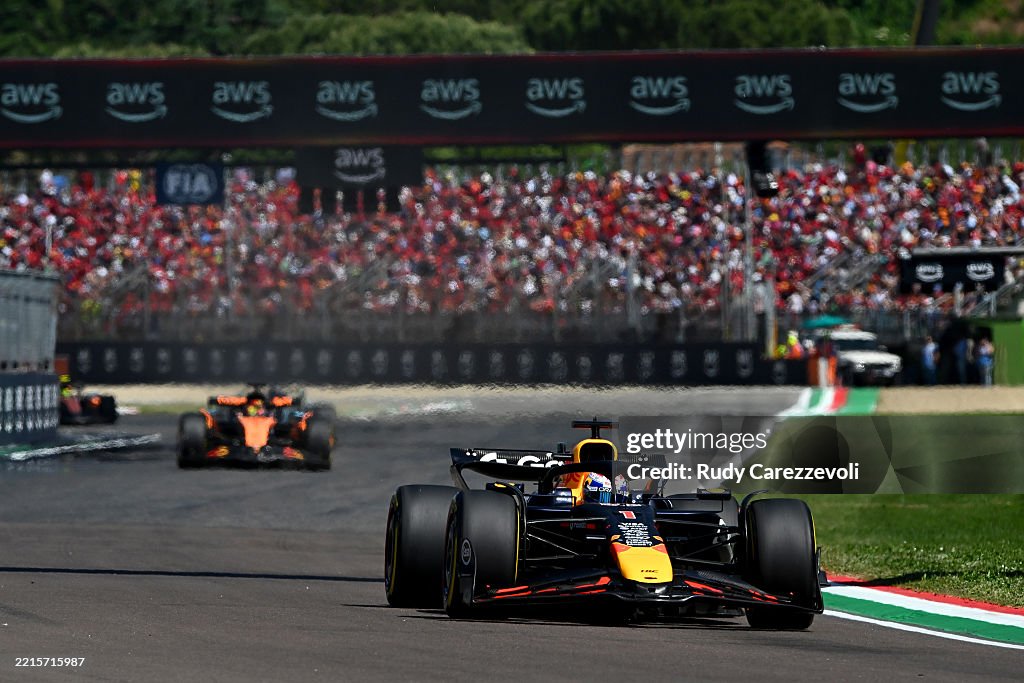

There are moments in Formula 1 history that become immortalised within the sport. Most of these are in a season where it centres around a singular focus. Senna vs Prost, Alonso vs Schumacher, Hunt vs Lauda all spring to mind as some of the greatest rivalries that have been witnessed.
But now, seven races into the 2025 season, that tension now has a new face: McLaren vs Verstappen.
Notice the phrasing - not Red Bull vs McLaren or even a feisty rivalry between long time friends Lando Norris and Max Verstappen. Despite Red Bull's pedigree and engineering prowess, the story this season is shifting away from individual driver dissension but towards a more elemental confrontation: the best car against the best driver.
Resurgence culminating in strong performances
McLaren's rise to the top of the sport has been a great narrative. From finishing ninth in the World Constructor's Championship in 2015 and 2017, their progression to finally reach the heights of their dazzling history is nothing short of extraordinary.
The MCL39 has proven itself to be formidable machine this season with Oscar Piastri taking it to four wins and Norris also notching himself one too.
Over the weekend, at Imola, Piastri secured pole position with just 0.034 seconds separating himself and Verstappen in second place. Team Principal Andrea Stella noted after qualifying that there was “little to choose between McLaren, Red Bull, and Mercedes,” but crucially, McLaren had the edge over a single lap on the day.
The car's strengths have been clear to see: competitive race pace and sheer speed over one lap ensure that the team are able to compete at all circuits.
Furthermore, the chassis responds well to both high-speed and technical tracks. In previous rounds, especially Miami, McLaren’s advantage was enough to turn pole into victory. The expectation was that Imola, with its flowing corners and emphasis on mechanical grip, would suit them perfectly.
Verstappen showing his mastery yet again
The Dutchman is not a four time world champion for no reason. Verstappen proved the difference as he executed a world class overtake on Piastri at the first chicane on lap one. It would not be a surprise if this was voted to be the overtake of the season.
It wasn't a simple case of car superiority that transpired. Verstappen's constant pressure and race management compelled McLaren to make snap decisions despite their strong strategy and pace.
Verstappen just prolonged his stint, kept up his pace, and eliminated the threat, so Piastri's early pit stop, which was intended to undercut him, backfired. Verstappen was unfazed by a late safety car that backed up the field; once racing resumed, he easily restored his lead.
McLaren's advantage in tyre management was undermined for the first time in 2025. Although Red Bull's improvements have reduced the gap, Verstappen's ability to perform well and remain composed under duress was what really made the difference.
"Red Bull has a driver who can win from anywhere"
Imola's result highlights the extremely narrow margins at the top of Formula 1. Red Bull has a driver who can win anywhere, while McLaren has created a car that can win anywhere. The human factor: decision-making, racecraft, and psychological fortitude, determines the result when the machinery is closely matched.
With the second seat at Red Bull being used for experimental purposes as of late, shown by the decision to use Liam Lawson at the start of the season for him then to be harshly dropped for Yuki Tsunoda, Verstappen is saving the team from a huge drop off.
Verstappen's victory at Imola was not solely based on speed. It also involved grasping the situation, controlling the variables, and reminding McLaren that being the fastest car is only half the fight.
The challenge for McLaren is straightforward: they have to turn their technical edge into regular wins or else Verstappen could outsmart them when it counts most.
The Emilia Romagna Grand Prix was not a story of technical dominance but a display of raw talent from the drivers. McLaren have the car. Red Bull have Verstappen. And as Imola proved, sometimes that is the only difference that matters.
