

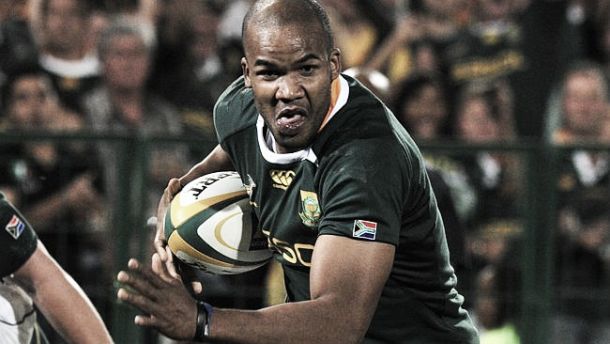


South Africa dominated their Argentine opponents on Friday night in a convincing 26-13 win that secured them third place in the 2015 Rugby World Cup. Argentina never looked like winning and, although they scored a late consolation try, were clearly second best throughout the match.
This win completes a remarkable turnaround for South Africa, who lost to Japan in their first match, and came last in this year's Rugby Championship.
Early yellow card makes life tricky for Pumas
Tomas Cubelli was sin binned early for Argentina, and South Africa took immediate advantage. A strong lineout drive setting the Springboks up to score the first try of the match, JP Pieterson going over in the corner in the sixth minute. Handre Pollard added the extras from right on the touchline to give South Africa an early 7-0 lead.
Less than five minutes later, South Africa thought they'd scored a second, Bryan Habana just beaten to the touchdown by the Argentinean defence.
South Africa were relentless, only bad luck with the bounce preventing Pieterson from scoring his second on ten minutes. A poor clearing kick from Argentina allowed their opponents to keep the pressure on, the kick going straight out from just outside the Argentinean 22.
It wasn't long before the Springboks added to their score, a penalty for obstruction right in front of the posts posing no problem for Pollard.
Not long later, Cubelli was back on the pitch, his first act on his return to feed the ball into an unstable scrum that ended in another South African penalty.
South Africa failed to find touch, though, and Argentina showed their intent to attack with ball in hand. The South African defence was more than equal to the task, and possession changed hands without the ball entering the South African half.
Not long after, the ball spilled out of a ruck, and Habana broke away to again come close to scoring his ninth try of the tournament, but was just unable to get clear of Argentinian defenders, knocking on in a tackle.
In the 24th minute, Argentina got their first attacking set piece, a lineout on the South African 22. Looking dangerous with ball in hand, a grubber kick gave the Springboks back possession through a lineout on their own five metre line.
Minutes later Cubelli almost made amends for his early sin binning with a stunning break which left him just short of the line, the attack eventually resulting in a Springbok penalty.
Habana then missed his third opportunity to score his record-breaking try, a long pass after a break from Pollard that he was just unable to take thwarting him this time.
It wasn't long, however, before South Africa did stretch their lead, another penalty from Pollard making the score 13-0.
Habana's bad luck continued, as he just caught the last Puma defender with his foot as he was overtaking him while chasing his own kick, giving the Argentines a penalty for taking a player out off the ball.
Some more strong running from the Argentinian centres ended in only a South African turnover, then a penalty just before half time. The Springboks kicked for the corner, but were unable to finish the half off with a try, instead taking three more points from another penalty for a half time score of 16-0.
More of the same in second half
Argentina made a good start to the second period, taking their own kickoff to set up the first attack of the half. Going nowhere with ball in hand, they went for the drop goal, firing one from the 10 metre line to get themselves on the board.
The Pumas weren't given long to celebrate though, Eben Etzebeth going over in the corner for South Africa after some quick hands from the Springbok backs in the 43rd minute. Pollard was a long way off target with the conversion, and the match restarted with the score 21-3.
South Africa remained on top, an Argentinean scrum deep in the green 22 resulting in another penalty for the South Africans, and a chance to clear their lines.
From the resulting lineout there was another penalty for the South Africans, who gladly took the easy three points on offer while referee John Lacey warned Argentina over their discipline.
For a change, it was South Africa who were lacking discipline, giving Argentina the chance to kick for the corner and drive for the line. However, the lineout from the Pumas was dropped, another disappointing end to a promising attacking position.
It wasn't long before the Argentineans had another penalty in a similar position though, and this time they chose to take the points, perhaps a strange decision from 21 points behind.
A dull passage of play followed, possession switching between the two teams, but neither making much ground in the middle of the pitch. Eventually Argentina infringed at a ruck, and the ball was put out for a lineout on the Pumas' 22.
A strong driving maul following the lineout was pulled down illegally by the Argentines, and South Africa, turning the screw, opted to kick to the corner.
It was then South Africa's turn to attack without making ground, right on the Argentine try line, before knocking on to give Argentina a defensive scrum. For once, the penalty from the scrum went the Pumas' way, although they failed to find touch from the resulting kick.
Another penalty got them deep in the Springbok half, although rather predictably they lost the ball 10 metres out after showing promise in the buildup.
Bryan Habana was substituted shortly afterwards, looking disappointed not to have broken Jonah Lomu's World Cup try scoring record. The 32 year old may well not get another chance to do so, given that he will be 36 when the 2019 tournament arrives.
The match became uneventful, neither team able to do much with the ball with defences on top. A series of Argentinean penalties inside the Springbok 22 eventually lead to the Pumas forcing their way over to score a consolation try in the 82nd minute.
Consolation prize for South Africa
This was a match with its share of exciting moments, but was largely uneventful, the crowd perhaps a little flatter than usual for the most part. The bronze final is always a difficult match to play in so soon after the disappointment of failing to reach the final, but both teams gave it everything.
Both teams can be pleased with what was ultimately a successful World Cup for them. They will next meet in the 2016 Rugby Championship, where they will begin to build for the next World Cup, in Japan in four years time.
