
Stadium
Old Trafford · Profile

Other languages2
ADVERTISEMENT
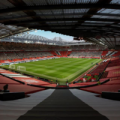
The second tiers of the north-west and north-east quadrants were completed in May 2006. They added about 8,000 seats to Old Trafford. On 26 March 2006, the first day the new seats were used, the ground drew 69,070 spectators, a Premier League record at the time. The stadium is in Stretford, Greater Manchester, and has been the home of Manchester United since 1910. Bobby Charlton gave it the nickname “the Theatre of Dreams”.
Design and opening
The Scottish architect Archibald Leitch designed the ground in 1909. The first plans allowed for about 100,000 spectators. To keep costs down, the scheme was scaled back to about 80,000, and the bill came to roughly £90,000. Old Trafford opened on 19 February 1910 with a match against Liverpool, who won 4-3. Sandy Turnbull scored the first goal at the new ground. In its early years it was also a neutral venue: it staged the 1911 FA Cup final replay and the 1915 final. Its record attendance dates from 25 March 1939. That day, 76,962 people watched the FA Cup semi-final between Wolverhampton Wanderers and Grimsby Town.
War damage and rebuilding
A German air raid in December 1940 caused the first damage. A second raid, on 11 March 1941, destroyed much of the stadium, including the main stand, which later became the South Stand. United did not play there again until 24 August 1949. They beat Bolton Wanderers 3-0, in a ground still largely uncovered. The first match under floodlights was also against Bolton, on 25 March 1957. The Stretford End was roofed in 1959. The North Stand was rebuilt in 1965 with a cantilever roof and room for 20,000. The East Stand followed the same model in 1973. Old Trafford hosted three group matches at the 1966 World Cup. In 1970 it staged the FA Cup final replay.
The all-seater era
The Taylor Report of 1990 required top-flight grounds to become all-seater, and capacity fell to about 44,000 in the early 1990s. The Stretford End was rebuilt in 1992-93. The North Stand was demolished in 1995. Its replacement, with about 25,500 seats, was finished by May 1996 and took the total above 55,000. A second tier opened on the East Stand in January 2000, and another on the West Stand raised capacity to 68,217. After the 2006 expansion came the all-seater attendance record: 76,098 against Blackburn Rovers on 31 March 2007. A seating reorganisation in 2009 removed 255 seats, leaving capacity at 75,957.
Names, statues and memorials
The North Stand was renamed the Sir Alex Ferguson Stand on 5 November 2011. A statue of the manager was unveiled outside it on 23 November 2012. The South Stand became the Sir Bobby Charlton Stand on 3 April 2016. Across Sir Matt Busby Way from the East Stand, the United Trinity statue of George Best, Denis Law and Bobby Charlton has stood since 29 May 2008. A statue of Matt Busby sits above the megastore on the East Stand. The Munich clock, at the corner where the East and South Stands meet, marks the 1958 air disaster.
International football and other sports
At Euro 96, Old Trafford staged three group games, a quarter-final and a semi-final. In 2003 it hosted the Champions League final between AC Milan and Juventus. At the 2012 Olympics it hosted men's matches, including a quarter-final and a semi-final, and women's matches, including a semi-final. England lost 1-0 to Spain there on 7 February 2007. On 6 July 2022 it hosted the opening match of the Women's Euro, England 1-0 Austria. The crowd of 68,871 was a record for the tournament. Manchester United Women had played their first match at the ground in March 2022, beating Everton 3-1. In rugby league, the stadium hosted the World Cup finals of 2000 and 2013. In the 2013 final, on 30 November, Australia beat New Zealand 34-2. In rugby union, England beat Argentina 37-15 there on 6 June 2009.
Plans for a new stadium
In 2021, co-chairman Joel Glazer confirmed that early-stage planning for a redevelopment was under way. On 11 March 2025, Manchester United announced plans for a new 100,000-seat stadium designed by Foster and Partners.
ADVERTISEMENT
Profile compiled by the VAVEL Editorial Team from historical records and official competition data. · Editorial policy