


Ever since the first Modern Games in 1896, there have been many Olympians who have gone above and beyond to embody the spirit, nature and drama of the Olympics by breaking records, becoming trendsetters and simply having illustrious careers. Here we look at just some of the many legends made in the past 128 years, and what they have done to achieve such a legacy.
Jesse Owens
Athletes don't just become legends for what they do in their sport, but for what they do and what they represent outside of it. An example of this is undoubtedly the African-American track and field star Jesse Owens.
In 1935, Owens became a world-record holder in four different athletics events in what was described as "the greatest 45 minutes in sports". It wasn't until the mid-1950s when these records were broken again. He had more than earned the opportunity to represent his country in the Games that took place the year later.
However, the 1936 Olympics took place in Berlin and, while the vast majority of Americans still wanted Owens to compete, the secretary of a leading civil rights organisation attempted to stop him and other African-Americans from participating in the Games.
The American Olympic Committee shut down these requests and, instead of taking part in a boycott of the Games, Owens and the other 17 African-American athletes went on to have huge success in Germany, dominating their field - Owens especially.
Owens won four gold medals in Berlin - the 100m, 200m, 100m relay and long jump. He became the first American, and only American until 1984, to win four golds in track and field events. But his legacy was much more than that.
Away from track and field, the societal and cultural impact of Owens' victories was profound. His triumphs, and those of his fellow athletes, presented a message of equality to the world at a time of deep divisions in the world and Germany specifically.
When Owens returned to America, he was still faced with the same racism and segregation he had experienced prior to the Olympics, with then President Franklin D. Roosevelt choosing not to invite him to the White House to recognise his achievements. However, the four-time gold medallist is one of the most prominent figures of black history in the twentieth century and is still seen as a legend to this day.
Florence Griffith-Joyner
1988 was a significant year in Olympics history: it was only the second time that an Asian country had hosted the Games and the first time it had been held in South Korea. For one athlete in particular, it was especially significant and her achievements still make the record books today.
Griffith-Joyner came into the trials for the 1988 Games in Seoul off the back of a successful World Championships in Rome, having won gold in the 100m relay, and just seemed to be going from strength to strength. As her preparations for the summer built, her sprint times kept on shortening.
In July 1988, during the quarter final stages of the US Olympic Trials, Griffith-Joyner recorded an astonishing time of 10.49 seconds for the 100m sprint, a new women's record which is still the time to beat.
Having already captured the attention of the nation even before the real events got underway, she gained the nickname 'Flo-Jo' and was tipped to win the 100m event - indeed she did by 0.30 seconds.
It isn't just her 100m sprints that Griffith-Joyner is remembered for though.
She holds the 200m women's record of 21.34 seconds which she also broke that year during the event final, breaking her own world record from the semi final. Shericka Jackson came within 0.07 seconds of breaking that record in 2021, and both records are still in the 30-year-old Jamaican's pursuit, but there is no denying that these records, that have stood for the best part of 40 years, are very commendable.
She retired from athletics in February 1989, and attempted to return some years later but suffered injuries, before her untimely passing in 1998. Her legacy lives on and she is a posthumous member of 'The Art of the Olympians'.
Nadia Comaneci
It is often said that there is no such thing as perfect, but this wasn't the case for one young Romanian gymnast in the 1976 Montreal Olympics.
At the age of 14, Nadia Comaneci stunned the world when she was given a 'perfect ten' for her uneven bars routine, the first ever time a gymnast had received the score. Many commentators believed it was impossible for a gymnastics competitor to receive a perfect ten and as such the scoreboard could not display a '10.0;' score, having to show '1.00' instead.
Comaneci proceeded to record a perfect ten seven more times in her Olympics career: five more times in Montreal, two times in Moscow in 1980. She won nine medals over those two Games: five gold, three silver and one bronze. Her achievements were, and remain an inspiration to generations.
She retired from gymnastics in 1984, having not taken part in the Los Angeles Games that year. It was three years after the Romanian government restricted her movement out of concern that she would defect, which she eventually did in 1989, crossing the Romania-Hungary border.
Comaneci's involvement in gymnastics is significant in the present day, though. She is honorary president of the Romanian Gymnastics Federation and, alongside fellow gymnast Bart Conner, runs a number of sports and gymnastics stores, companies magazines and academies.
Since 1976, dozens more gymnasts have recorded perfect tens but hers will always be the most iconic.
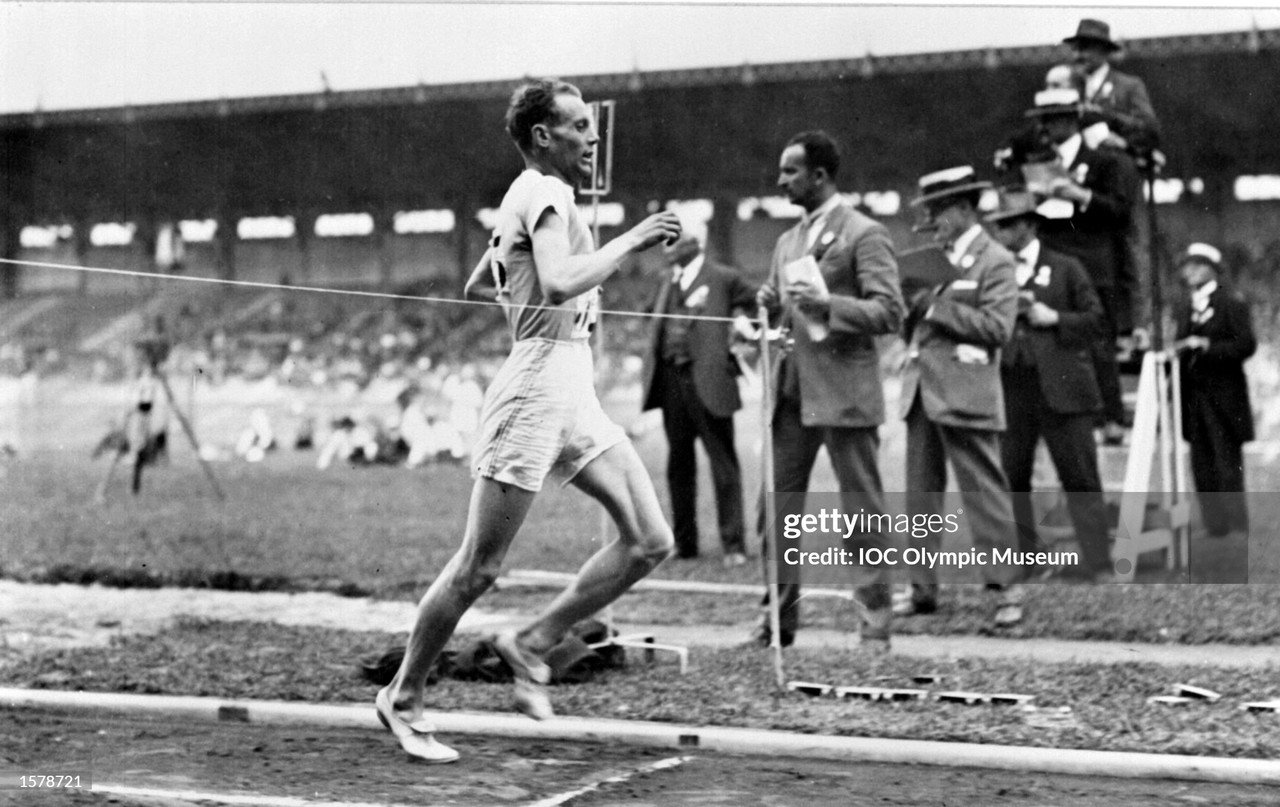
Paavo Nurmi
There is, understandably, a lot of focus around short-distance records in athletics, such as the 100m or 200m. However, one Finnish runner dominated the middle and long-distance scene in the 1920s.
Nicknamed 'the Flying Finn', Nurmi set a remarkable 22 world records during his career and won 12 Olympic medals, nine gold and three silver, in eight years. These medals were won after contesting in a number of events including cross country, 5000m and 10,000m.
Nurmi's journey to all that success was not always smooth sailing. He made huge physical sacrifices to get to where he got to, suffering with dehydration, exhaustion and dealing with extreme heat before, during and after races.
His legacy is extensive and he is undoubtedly one of the most recognised athletes of all time.
For 80 years, he held the record for most medals won at the Olympics - having that record to himself for 36 years before it was matched by Larisa Latynina in 1964. He was named by Time Magazine as the greatest Olympian of all time in 1996.
Charlotte Cooper
The inaugural Modern Olympics in 1896 saw only male competitors take part. Thankfully, four years later in Paris, women were allowed to compete. Although the percentage of female athletes was only 2,2%, that was enough to smash the glass ceiling and create history.
Hélène de Pourtalés was the first ever female Olympian to win a gold medal - this was as part of the Swiss sailing team of three, the other two members being male. de Pourtales rightly deserves legendary status for this, but it would be another two months before there was a female individual Olympic gold medal.
That was Charlotte Cooper, a Wimbledon winner on five occasions between 1895 and 1908. Cooper won both the singles and the mixed doubles in Paris in 1900, claiming victory over Hélène Prévost in the singles final and working with Reginald Doherty to win in the mixed doubles.
One of the most incredible things about Cooper's achievements, as well as being a hugely influential trailblazer in Olympics history, is that she was deaf. Cooper lost her hearing when she was 26 years old in 1896, a year after claiming her first Wimbledon title.
She is probably the least well-known Olympian in this list, but Cooper is certainly an inspiration for more than one reason and a legend of the Games.
Michael Phelps
Nurmi's medal-haul record had been safe for 80 years before the Beijing Games in 2008. A swimming sensation, who had only been on the Olympics scene for four years, was about to surpass his numbers, and wouldn't stop there.
Michael Phelps is the most-decorated Olympian of all time, accumulating 28 medals inside 12 years and four Olympic Games in a number of events from medleys to freestyles to butterflies.
There isn't much to say about him that hasn't been said about him already: at the time of his retirement, Phelps had won more gold medals (23) than 170 countries in their history. He retired following the London 2012 Olympics, but came out of retirement two years later and won five golds in Rio de Janeiro in 2016. He has set 39 world records, four of which he still holds today.
He has only been out of the sport for eight years, but due to how many medals he picked up, his legacy is one of the biggest for an Olympian. The foundation set up in his name has helped hundreds of thousands of aspiring sportspeople realise their potential.
