


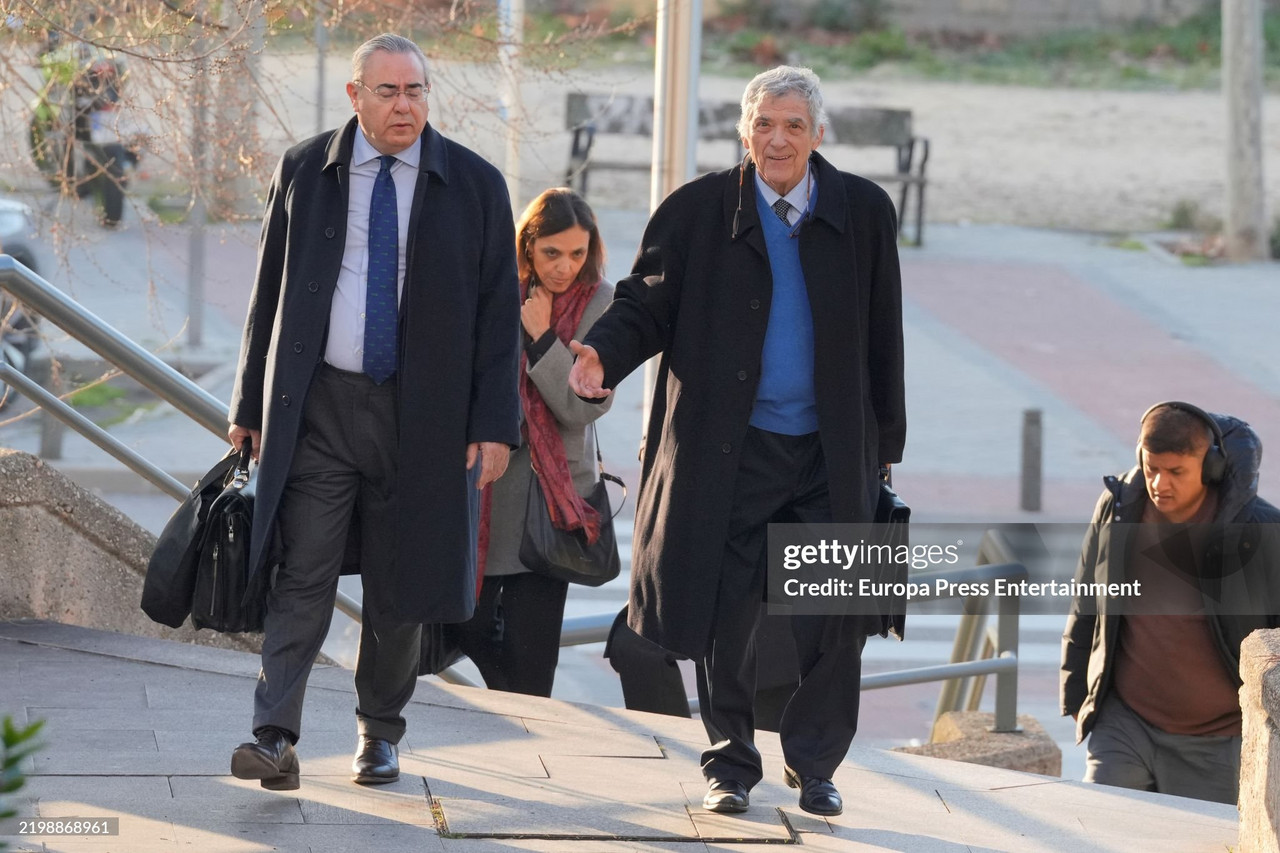

The Anti-Corruption Prosecutor's Office is asking for a 15-and-a-half-year sentence for Ángel María Villar, former president of the Royal Spanish Football Federation (RFEF), for crimes related to unfair administration, business corruption, misappropriation, and false documentation.
The case, known as the Soule case, refers to a series of illegal manoeuvres that Villar carried out during his mandate between 2007 and 2017, mainly through the organisation of friendly matches of the Spanish national team, in which his son Gorka Villar played a central role.
-
The Friendly Matches Case: A Personal Benefit Network.
The prosecution's indictment focuses on how María Villar allowed his son Villar to personally benefit from organising friendly matches between the Spanish national team and foreign teams.
Since at least 2009, Villar allegedly imposed that it was his son who chose the national team's opponents, instead of following the procedures established by the RFEF to organise these matches. Through his company, Sport Advisers S.L., Gorka Villar negotiated these matches' economic and logistical conditions, which resulted in financial damage to the Federation.
One of the most notorious cases was the Spanish national team's match against Chile, which was played in Geneva in 2011. In this match, the RFEF could have earned up to two million euros for broadcasting rights and other economic agreements, but only received 400,000 euros.
In return, Gorka Villar signed a consultancy contract with the Chilean Federation for 4,000 euros per month. This type of agreement was also replicated in matches against other national teams such as Colombia, Venezuela, Peru, and South Korea, in which the RFEF received less money than it was entitled to, while his company obtained additional income.
Estimates suggest that the total damage to the RFEF for these seven matches between 2010 and 2013 exceeded €4.5 million. According to the prosecution, this money was diverted to the private interests of the Villar family, seriously damaging the Federation's finances. The prosecution underlines that Gorka Villar and his company received 366,583 euros for the organisation of these matches, which reflects the size of the irregularly obtained profits.
-
The Strategy of Manipulation and Favouritism
According to investigators, Ángel María Villar's behaviour was motivated by a desire to benefit his son and his company rather than seeking the maximum benefit for the RFEF, the institution over which he presided.
The strategy employed was to arbitrarily choose the opposing teams without considering the Federation's financial interests or following the existing contracting procedures for organizing international matches.
The RFEF had contracted an intermediary for the organisation of these matches, which had agreed to pay half a million euros per match, a figure much higher than that achieved with the agreements signed by Gorka Villar.
The intervention of Gorka's company in organising the matches and the favouring of his interests also undermined the RFEF's image and international relations. Even though the Spanish Federation was at the height of its success after winning the 2010 World Cup, the agreements signed by Villar with the national teams of countries such as Chile and Colombia were damaging financially and in terms of image.
-
The Legal Consequences: Charges and Sentencing Requests
In addition to the charges against Ángel María Villar, the Anti-Corruption Prosecutor's Office has also requested prison sentences for other individuals involved in this corruption scheme.
Gorka Villar, son of the former president, faces a possible seven-year prison sentence for his role in organising the matches and the financial benefit derived from these irregular arrangements.
Both father and son have been asked to compensate the RFEF with more than 3.6 million euros, a sum that should cover the damage caused by their actions.
The case also involves Juan Antonio Padrón, economic vice-president of the RFEF during Villar's presidency, who is accused of misappropriation and false documentation.
Padrón, like other senior RFEF officials, is alleged to have been complicit in the fraudulent actions, consenting to and facilitating the acts of corruption that led to a significant diversion of the Federation's funds.
The Public Prosecutor's Office is asking for six and a half years in prison. Others involved, such as Pedro Rubio, head of human resources, and José María Castillón, general administrator of the RFEF, also face charges for their complicity.
