
Competition
GP de Alemania · History

Other languages2
ADVERTISEMENT
The German Grand Prix for cars has been organised by the Automobilclub von Deutschland (AvD) since its first edition in 1926. That race was held at the AVUS circuit in Berlin and won by Rudolf Caracciola in a Mercedes. The same name is used for the German round of the motorcycle world championship, which has been part of the series since 1952. Between them, the two events have visited the Nürburgring, Hockenheim, Solitude and the Schottenring, and have used the Sachsenring since 1998.
The pre-championship years
After the first edition in Berlin, the race moved to the Nürburgring in the Eifel hills. The Nordschleife, the circuit's long layout, became its main home. Caracciola won the race six times, in 1926, 1928, 1931, 1932, 1937 and 1939. No other driver has matched that total in Germany. Tazio Nuvolari's victory at the Nürburgring in 1935 is one of the most cited wins of the interwar period. In 1950, a year before the race joined the championship, Alberto Ascari won it.
Formula One on the Nordschleife
The Grand Prix joined the Formula One World Championship in 1951, the series' second season. Ascari won again that year and repeated in 1952, and Juan Manuel Fangio won in 1954, 1956 and 1957. Between 1954 and 1974 the race carried the honorary title of European Grand Prix four times. Its only departure from the Eifel in that era was a trip to AVUS in 1959. In 1970 the drivers refused to race at the Nürburgring without safety changes, and the event went to Hockenheim for the first time. Jackie Stewart won in 1968, 1971 and 1973. On 1 August 1976 Niki Lauda crashed on the Nordschleife. His Ferrari caught fire and he suffered serious burns. Brett Lunger was one of the drivers who pulled him from the car. James Hunt won that race, the last Formula One event on the old layout.
Hockenheim and the alternation with the Nürburgring
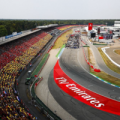
From 1977 Hockenheim hosted the Grand Prix every year until 2006. The exception was 1985, when the race was held at the new Nürburgring. Nelson Piquet won in 1981, 1986 and 1987, and Ayrton Senna took three straight wins from 1988 to 1990. Michael Schumacher, Germany's first world champion, won at home in 1995, 2002, 2004 and 2006, and Fernando Alonso won in 2005, 2010 and 2012. From 2008 to 2014 the race alternated each year between Hockenheim and the Nürburgring. It then became a biennial event at Hockenheim, held in 2016 and 2018. Lewis Hamilton won in 2008, 2011, 2016 and 2018, which gave him four wins, the same as Schumacher. The last edition was held in 2019. Hamilton started from pole, but the race was won by Max Verstappen for Red Bull-Honda, who also set the fastest lap. Ferrari is the most successful constructor in the event, with 22 wins.
The motorcycle Grand Prix
The motorcycle world championship first came to Germany in 1952, at the Solitude circuit near Stuttgart. It was the first FIM Grand Prix on German soil since the end of the Second World War. In 1953 the race was held at the Schottenring. Over the following decades it alternated between the Nürburgring and Hockenheim. Hockenheim hosted it for the last time in 1994, and the Nürburgring staged it from 1995 to 1997.
The Sachsenring, since 1998
In 1998 the race moved to the Sachsenring in Saxony. It has been held there every year except 2020, when it was cancelled because of the COVID-19 pandemic. Marc Márquez won at the Saxon track in every edition held between 2010 and 2021. That was eleven straight wins: the 125cc race in 2010, Moto2 in 2011 and 2012, and MotoGP from 2013 to 2019 and in 2021. Fabio Quartararo then won for Yamaha in 2022, Jorge Martín for Ducati in 2023 and Francesco Bagnaia, also for Ducati, in 2024. In 2025 Márquez, by then riding a Ducati, won from pole for his ninth premier-class victory at the Sachsenring. His tenth MotoGP win at the circuit came in July 2026.
ADVERTISEMENT
Profile compiled by the VAVEL Editorial Team from historical records and official competition data. · Editorial policy