
Competition
Gran Premio de Japón · History

Other languages2
ADVERTISEMENT
The driver with the most wins at the Formula 1 Japanese Grand Prix is Michael Schumacher, with six victories (1995, 1997, 2000, 2001, 2002 and 2004). Lewis Hamilton follows with five, and Sebastian Vettel and Max Verstappen have four each. Among constructors McLaren leads with nine wins, ahead of Red Bull with eight and Ferrari and Mercedes with seven apiece. The race has been held at two venues, Fuji and Suzuka, and the latter has decided more world championships than almost any other track on the calendar.
The Fuji beginnings
Japan joined the World Championship in 1976. Fuji Speedway, at the foot of the volcano, hosted the final round that year in a downpour. Niki Lauda, Emerson Fittipaldi and Carlos Pace withdrew because of the conditions, Mario Andretti won for Lotus, and James Hunt finished third to take the title by one point from Lauda. Hunt won the 1977 race for McLaren, but that event was overshadowed by an accident: Gilles Villeneuve’s Ferrari was launched after contact with Ronnie Peterson and landed in a restricted area, where two spectators were killed. Formula 1 did not return to Japan for a decade.
Suzuka, Honda’s circuit
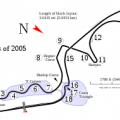
The return came in 1987, this time at Suzuka. The track opened on 20 September 1962 as a Honda test circuit, and Honda still owns it; it was designed by the Dutchman John Hugenholtz. It is the only figure-of-eight layout on the calendar, with the back straight crossing over the first part of the lap on a bridge. A lap measures 5.807 kilometres and strings together the first-sector esses, Degner, the hairpin, Spoon, 130R and the final chicane, added in 1983 to slow the cars before the pit straight. Gerhard Berger won that first Suzuka Grand Prix for Ferrari.
The Senna-Prost rivalry
In the late 1980s Suzuka became the place where the championship was settled. In 1987 Nelson Piquet became champion because Nigel Mansell could not start after a practice crash. In 1988 Ayrton Senna won the race and his first title. A year later Senna and Alain Prost, McLaren teammates, collided at the chicane and the crown went to the Frenchman. In 1990 the scene played out in reverse: Senna, leading the standings, ran into Prost at the first corner, both were out, and the Brazilian sealed his second title. In 1991 Senna was crowned at Suzuka again, in a race won by his teammate Berger.
The Schumacher years
Michael Schumacher first won at Suzuka in 1995 with Benetton and did it again in 1997 with Ferrari. In 1998 Mika Häkkinen clinched the title there for McLaren, and he won again in 1999. Schumacher then added four more wins with Ferrari between 2000 and 2004, missing only 2003, and in 2000 he celebrated in Japan the Scuderia’s first drivers’ title in 21 years; in 2003 he secured his sixth championship there. Fernando Alonso won the 2006 race for Renault and triumphed in 2008 at Fuji, which hosted the event in 2007, won by Hamilton, and 2008.
From Vettel to Bianchi’s accident
The return to Suzuka in 2009 opened the Red Bull era. Sebastian Vettel won in 2009, 2010, 2012 and 2013, and in 2011, the year Jenson Button won for McLaren, he clinched his second title in Japan. In 2014, in the rain, Jules Bianchi went off in his Marussia at the Dunlop curve and hit a recovery crane removing another car. He was left in a coma and died nine months later. Hamilton won that race and those of 2015, 2017 and 2018, while Nico Rosberg won in 2016 and Valtteri Bottas in 2019, all for Mercedes.
Verstappen and the new date
The 2020 and 2021 editions were cancelled because of the COVID-19 pandemic. On the return in 2022, Max Verstappen won and was crowned champion at Suzuka with Red Bull, then won again in 2023, 2024 and 2025. In July 2023 the race’s move to April, between the Australian and Chinese Grands Prix, was announced, away from its traditional September or October slot. In 2026 Italian Kimi Antonelli won for Mercedes, the German manufacturer’s seventh victory in Japan.
ADVERTISEMENT
Profile compiled by the VAVEL Editorial Team from historical records and official competition data. · Editorial policy