
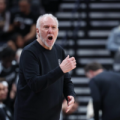
Coach
Gregg Popovich · Biography

Other languages2
ADVERTISEMENT
On June 15, 2014, in San Antonio, the San Antonio Spurs beat the Miami Heat 104-87 in Game 5 of the NBA Finals. They closed out the series 4-1, a year after losing to the same opponent in seven games. It was the fifth championship for Gregg Charles Popovich, born January 28, 1949, in East Chicago, Indiana, who coached the Spurs from December 1996 to May 2025 and led the United States men's national team from 2017 to 2021.
Early life and military career
Popovich graduated from Merrillville High School in Indiana in 1966 and entered the United States Air Force Academy, where he played guard from 1966 to 1970; as a senior he was team captain and leading scorer. He earned a degree in Soviet studies in 1970 and then served five years of required active duty in the Air Force, touring Eastern Europe and the Soviet Union with the Armed Forces basketball team. In 1972 he captained that team to the AAU championship, which earned him an invitation to the trials for that year's U.S. Olympic team.
Early coaching jobs
From 1973 to 1979 he was an assistant coach at the Air Force Academy, and in that period he also completed a master's degree at the University of Denver. In 1979 he took over Pomona-Pitzer, a Division III college program in California, which he coached until 1986 and again in 1987-88; under him the team won its first outright conference title in 68 years. He took the 1985-86 season off and spent 1986-87 as a volunteer assistant to Larry Brown at the University of Kansas.
From assistant to general manager
In 1988 he followed Brown to the San Antonio Spurs as an assistant and stayed until 1992, when owner Red McCombs fired the coaching staff. He then spent two seasons, from 1992 to 1994, on Don Nelson's staff with the Golden State Warriors. In 1994, after Peter Holt bought the Spurs, he returned to San Antonio as general manager and vice president of basketball operations. On December 10, 1996, he fired head coach Bob Hill and named himself to the job. That team, without David Robinson for most of the season, finished 20-62, and the draft lottery handed San Antonio the first pick in 1997, which brought Tim Duncan.
Five titles in San Antonio
With Duncan and Robinson, the Spurs won their first championship in 1999, the lockout-shortened season, against the New York Knicks. Further titles followed in 2003 against the New Jersey Nets, in 2005 against the Detroit Pistons and in 2007 against the Cleveland Cavaliers, by then with Tony Parker and Manu Ginóbili alongside Duncan. In 2013 they lost the Finals in seven games to Miami, and the following year they won the rematch, with Kawhi Leonard as Finals MVP. Popovich was named NBA Coach of the Year in 2003, 2012 and 2014. On March 11, 2022, he passed Don Nelson for the most regular-season wins in league history with his 1,336th victory, and in 2023 he was inducted into the Naismith Memorial Basketball Hall of Fame.
With Team USA
Before taking charge he was an assistant for the national team at the 2002 World Championship under George Karl, at the 2003 FIBA Americas Championship and at the 2004 Athens Olympics under Larry Brown, where the United States took bronze. On October 23, 2015, he was named Mike Krzyzewski's successor, effective after the 2016 Rio Olympics. At the 2019 World Cup in China the team finished seventh, the worst U.S. result at a major international tournament. Two years later, at the Tokyo 2020 Olympics, played in 2021, he won the gold medal with a 5-1 record, beating France 87-82 in the final.
Leaving the bench
On November 2, 2024, he suffered a stroke, and assistant Mitch Johnson took over as interim coach. On February 27, 2025, he told the players he would not return that season; the NBA later credited Johnson with the 77 games Popovich did not coach, a 32-45 record, which set Popovich's regular-season mark at 1,390 wins and 824 losses. On May 2, 2025, after 29 seasons, he stepped down as coach, Johnson was named head coach and Popovich became the Spurs' president of basketball operations.
ADVERTISEMENT
Profile compiled by the VAVEL Editorial Team from historical records and official competition data. · Editorial policy