
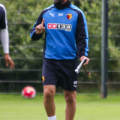
Coach
Quique Sánchez Flores · Biography

Other languages2
ADVERTISEMENT
Enrique Sánchez Flores, known as Quique Sánchez Flores, was born in Madrid on 5 February 1965. He is the son of former footballer Isidro Sánchez and singer Carmen Flores, and the nephew of Lola Flores. He came through as a right-back and played for C. D. Pegaso in 1983-84 before moving to Valencia. As a coach he has worked in Spain, Portugal, England, the United Arab Emirates and China. His most important title as a manager is the 2010 Europa League, won with Atlético de Madrid.
Ten seasons at Valencia
Quique joined Valencia in 1984 and stayed until 1994. He was the starting right-back for a decade, making 272 league appearances and scoring 23 goals. He was at the club when it was relegated and played the 1986-87 season in the Spanish second division. Valencia won that league and went straight back up. He scored more often than most defenders and covered a lot of ground on the flank, which made him a regular in the Valencia side of the late 1980s and early 1990s.
Real Madrid, Zaragoza and retirement
In 1994 he signed for Real Madrid and won the 1994-95 Spanish league title. He spent two seasons there, playing 63 league games and scoring twice. In 1996 he moved to Real Zaragoza, where he played only nine league matches before retiring in 1997. He finished his career with 344 Spanish league appearances and 25 goals.
With the Spain national team
Before reaching the senior side he won the 1986 UEFA European Under-21 Championship with Spain. He made his debut for the senior team on 23 September 1987, in a friendly against Luxembourg in Castellón. He won 15 caps: three under Miguel Muñoz and twelve under Luis Suárez. He was in the squad for the 1990 World Cup in Italy, and his last match for Spain was against France in Paris on 20 February 1991.
First jobs: Getafe, Valencia and Benfica
He made his debut as a manager with Getafe in July 2004, in the Spanish top flight, and finished 13th in 2004-05. In 2005 he returned to Valencia. In his first season the team finished third in the league and qualified for the Champions League. The following season Valencia reached the quarter-finals of that competition, where Chelsea knocked them out. The club sacked him in October 2007. In May 2008 he took over Benfica and won the 2009 Portuguese League Cup. Benfica finished third in the Portuguese league, and he left in June that year.
Atlético de Madrid and the Europa League
On 23 October 2009 he replaced Abel Resino at Atlético de Madrid. In his first season he took the team to two finals. On 12 May 2010 Atlético won the Europa League in Hamburg, beating Fulham 2-1 after extra time. A week later they lost the Copa del Rey final. In August 2010 he added the UEFA Super Cup. Atlético finished seventh in 2010-11, and Quique left in May 2011 when his contract ran out.
The Emirates, England, Barcelona and China
From November 2011 to June 2013 he coached Al-Ahli in Dubai, winning the UAE League Cup in 2012 and the UAE President's Cup in 2013. He then won the President's Cup again in 2014 with Al-Ain, where he worked from September 2013 to March 2014. He returned to Getafe in January 2015 but resigned in February. In June 2015 he joined Watford, newly promoted to the Premier League. He was named Manager of the Month for December 2015, and in 2015-16 the team finished 13th and reached the FA Cup semi-finals. He managed Espanyol from June 2016 to April 2018 and won the Catalan Super Cup in 2016. He coached Shanghai Shenhua from December 2018 to July 2019, then had a short second spell at Watford between September and December 2019.
Getafe, Sevilla and Alavés
In October 2021 he began a third spell at Getafe and kept the club in the top flight in 2021-22. He was sacked in April 2023. On 18 December 2023 he took charge of Sevilla, who finished 14th in 2023-24, and he left in June 2024. On 3 March 2026 Deportivo Alavés hired him to replace Eduardo Coudet, with the team fighting relegation. In May 2026 Alavés beat Barcelona 1-0 at Mendizorroza and then beat Real Oviedo, also 1-0. The win over Oviedo, on the penultimate matchday, secured survival with 43 points.
ADVERTISEMENT
Profile compiled by the VAVEL Editorial Team from historical records and official competition data. · Editorial policy