


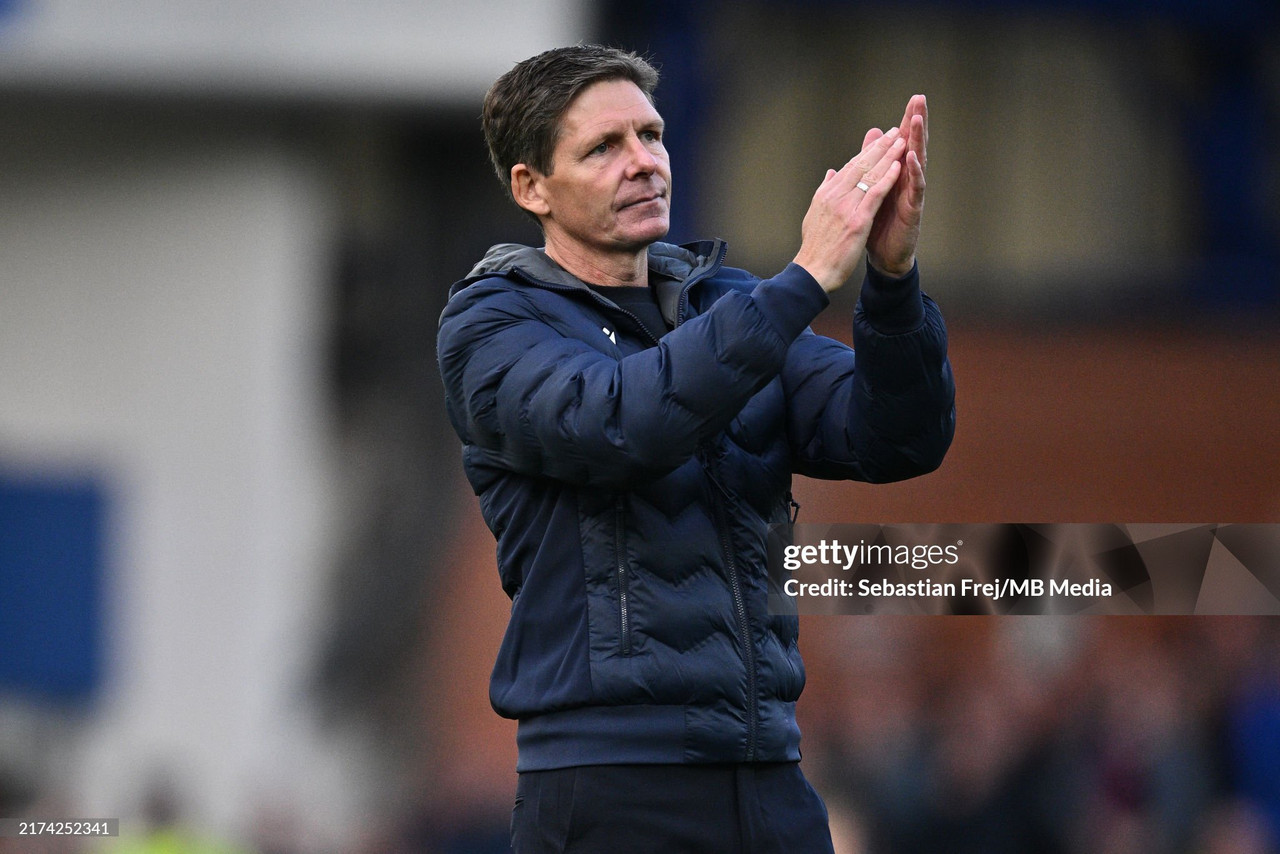

It's not Crystal Palace's worst start to a Premier League campaign but it's not far off. That particular record came under Frank de Boer in 2017. However, when you factor in the excitement from the back end of last season along with a full pre-season under their new coach, many inside and out of Selhurst Park were optimistic for the upcoming season.
There were talks of top ten finishes and ambitions to push on for Europe, but after six games it seems a long way off. It goes to show how quickly things can change in football.
It was clear that six wins from the seven games was always going to be difficult to maintain in the long term, but to go on a winless run of six games and find themselves in the bottom three for the first time since March 2018 was not expected.
Glasner acknowledged in his post match press conference that they have been given somewhat of a reality check following the way last season ended and how this one has started: "Maybe [the start to the season] is a welcome back to reality. Maybe they were flying too high after the great finish to last season. Many forget that seven rounds before the end of the season we were five points away from relegation."
It is a mix of bad luck, poor decision making and tactical mistakes as to why Palace have started so poorly, even with a favourable set of fixtures to start the campaign, but what exactly has Glasner and his team got wrong so far?
-
Constant changes to the starting XI
In all areas of the pitch this season for Crystal Palace there have been changes to the starting XI. For example, in the back three the only constant has been Marc Guehi. They are yet to start with the same back line for continuous games, and this is down to selling Joachim Andersen to Fulham, and injuries to both Chadi Riad and Chris Richards.
The left side has been filled by Guehi, Riad, Richards, Maxence Lacroix and Jefferson Lerma. In the middle of the three has seen Andersen feature for the opening game, then Guehi take over from that point on and the right side has seen Richards, Nathaniel Clyne and Lacroix all play two games each in this position.
Defensively Palace were strong last season, but that was because both Guehi and Andersen had built a tremendous partnership over the previous two seasons together. Richards also came into the frame when Glasner used a back three and settled in nicely but since then there has been no familiarity.
It will take time for the new players to gel with the existing ones and understand each others strengths and weaknesses, but with so much chopping and changing you can see why Palace have leaked goals early this campaign, particularly on the counter attack.
The same can be said about the midfield and front three in terms of rotation and players playing other positions. New signing Daichi Kamada has been used as the right sided 'ten' and in a deeper role as part of a midfield two, the latter being a position which the Japanese international has struggled in to say the least.
The only constant in the midfield two is Adam Wharton who has been partnered by Will Hughes, Cheick Doucoure and Kamada at times again showing the inconsistency in the starting eleven.
Palace's front three has also been changed regularly, with only Ebere Eze and Jean-Phillipe Mateta being able to hold down their place, whilst Kamada, Odsonne Edouard and Eddie Nketiah have all played in the right sided 'ten' role.
Glasner needs to figure out his ideal and strongest starting eleven and until the Austrian manager finds the right balance in all areas that first win could still be in the distance.
-
Glasner's stubbornness and in game management
Something many noticed last season with Oliver Glasner was his in game tweaks and changes, he more often than not got things right when it came to making substitutions in game. The same cannot be said this season.
For example his persistence on taking off Nketiah in games when he has often looked bright, even when the former Arsenal striker has been played out of position.
There is the argument to bring off Mateta, who has looked far from his best this season, and push Nketiah into his more familiar striker role. This would then suit Kamada who would benefit from a more technical striker when linking play as the right 'ten'.
Glasner however, is persistent on playing Kamada as one of the holding midfielders when he has demonstrated time and time again that he is not suitable to fulfil the role.
The signs were there early doors such as the West Ham match, when Kamada's introduction in the holding role exposed Palace and handed control of the midfield to the Irons, who effortlessly broke through to score twice within five minutes.
Since this game Glasner has used the former Lazio man in this role twice from the start against Manchester United and Everton. The most recent game against the latter saw Kamada's underweighted pass intercepted, allowing the Toffees a way back into the game.
It is not just the use of Kamada where the Austrian coach has proved to be stuck in his ways. Since bringing in Nketiah from Arsenal for £30 million, Glasner has tried to fit Mateta and the England international into the same team without adapting his system.
For all his technical ability, Nketiah is not a natural number 'ten'. The 25-year-old is often too far from goal to be able showcase his brilliant finishing expertise and as a result is nullified. The sooner Glasner realises that shoehorning both strikers into the same team without adapting the system won't work, the better. With Mateta failing to demonstrate the form that saw the Frenchman called up to his nations Olympic squad, it may be time for Nketiah to have a chance as the main man up top.
This begs the question of who plays as the right sided 'ten'? Palace supposedly signed Ismaila Sarr and Kamada to replace Michael Olise yet the former is yet to start, whilst Kamada is now being utilised as a holding midfielder.
Whilst the Japanese international offers more technical ability to the front line, Sarr gives Palace more pace which is much needed.
A front three of Eze-Nketiah-Sarr has good balance to it and will allow Palace different options when going forward. Both Eze and Nketiah offer the technical ability on the ball while Sarr can be a threat in behind and force opponents to drop deeper, allowing more space for his strike partners and the midfield two.
There is the option of using Kamada however, this would mean Palace's 'tens' are both very narrow, resulting in the width coming from the wing-backs.
Whilst both Tyrick Mitchell and Daniel Munoz are capable of offering width, they are very different players.
Munoz is someone who is comfortable going forward and can take players on, but has been isolated at times with little options to pass to, resulting in him playing aimless crosses or going backwards when finding himself in good areas.
On the other side, you have Mitchell who is superb defensively but struggles going forward and will often look to retain the ball and pass backwards rather than taking his man on.
This was seen for large parts of the second half when Palace were looking for an equaliser at Goodison Park, working the ball into good areas before having to go backward due to lack of options of ability of Mitchell on the ball.
What is without question is Glasner needs to change something and find the formula that makes this team tick, but he can't continue to be stubborn and set in his ways regarding many of his players.
With Trevoh Chalobah featuring on the bench at the weekend and edging closer to a start, it could see Lerma move into midfield and the Chelsea man slot into the back three.
This will allow Glasner to use Kamada higher up the pitch or keep him as an option from the bench, which will be better than having him struggle in the holding midfield role.
Glasner has options at his disposal, using these are a different matter, but for Palace the reality is that things might get worse before they get better.
With top of the table Liverpool up next Palace will need to be at their best to cause an upset, but the same was said last season when they travelled to Anfield and won 1-0, which coincided with their fantastic end to the campaign. The question is, will history repeat itself?
