


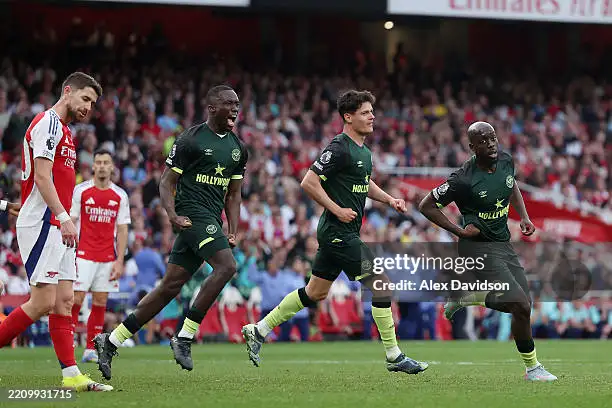

If it was not clear already, Arsenal are limping to the end of the Premier League campaign. They have dropped points for the second week in a row following a 1-1 draw at home to Brentford.
The Gunners were back at the Emirates Stadium for the second time in four days, keen to carry the energy from midweek into this all-London affair. Thomas Partey put the hosts ahead on the hour mark, the Bees stung back through a strike from Yoane Wissa to leave with a point by full time.
Here are four things we learnt from this game:
-
Arteta acts with relative caution
Though the team are now three goals to the good, the main focus for most fans will be the second leg of the Champions League clash against Real Madrid. As the trip to the Santiago Bernabéu awaits on Wednesday night, it was fair to expect that Arteta would rest and rotate some of the regulars again.
The Spaniard selected six of the starters from the first leg and the other five all came off the bench in the second half. Those choices can shine some light on the state of the first team squad at the moment.
Bukayo Saka switched out for Leandro Trossard after he picked up a knock before the second goal. Arteta gave him half the game against Everton after half an hour for his return against Fulham, but rest for the right winger was the priority here. It is hard to phase a return to fitness at such a critical point of the campaign, but clearly, caution is still advisable with the health of the number seven.
Similarly, Jurrien Timber took a knock in midweek and Ben White would replace him in injury time. So, it was sensible to take him out of the firing line for this fixture. No such concerns clouded the thinking around Myles Lewis-Skelly, but Arteta is aware that the 18-year-old should not be thrust into the fire unnecessarily. He hopes to reap the reward of that protection in the next ninety minutes.
-
Midfield generals are all guns blazing
Despite the meaning of the match in Madrid, the manager made two big calls in the starting eleven. While he dropped Martin Odegaard to play Oleksandr Zinchenko as the attacking midfielder, he sent out Thomas Partey on the right of the back four and Declan Rice in the middle of the park.
These two players are usually at the heart of the engine room. They are not in a similar predicament to Jakub Kiwior and William Saliba, who are likely to benefit from more minutes on the field together.
Nor was it an absolute necessity to fill holes in the squad. Mikel Merino was one of the men to enter the pitch after the restart and could have joined Jorginho in the midfield. White was missing with a knock from training and though Timber's knee issues loom over his availability, Partey cannot boast of a pristine bill of health, being prone to niggles throughout his five-year career in north London.
Their selection is a strong statement. Arteta has belief in not only their quality but also their durability. Indeed, the two combined for the only goal of the game from the Gunners: a clean counterattack with a galloping carry from Rice and a punchy finish from Partey. The two were integral to the victory over Los Blancos earlier in the week and will seek to stay at the same level for the next leg in a few days.
-
Draws demonstrate domestic struggles
This may go down as a mundane match, but it also adds evidence to signs of a fatal flaw for the team.
It is the twelfth time Arsenal have drawn this season; only 14th placed Everton have endured more league stalemates (14). Out of those 12 draws, the Gunners gained and gave up the lead eight times.
One might choose to chalk up the last three draws, with 1-1 scores against the Bees and Everton themselves at Goodison Park after a 1-1 stalemate with Man United last month, as outings where the team tried to safeguard the squad to play in the latter stages of the Champions League. However, that would be a choice that casts no concern on similar outcomes from fixtures at the start of the season.
The Gunners are still excellent at controlling the ball. But they have been far less of a threat than in the last two years and do a worse job of killing opponents with all their possession in enemy territory. That puts pressure on the defence and if the back four is not as impenetrable as it was a year ago, then draws are the logical outcome of many matches. It is a fault to resolve sooner rather than later.
-
The best of a bad bunch
Arsenal are now 13 points behind league leaders Liverpool, who won 2-1 against West Ham United on Sunday afternoon. A charge for the top spot and the Premier League trophy is out of the question. But the faltering form of the Gunners might have boded badly for their Champions League hopes.
At least, that would have been the case recently. A total of 63 points after 32 games equals the tally of fourth placed team at this stage of the season (Aston Villa and Man United) during the last two years.
This weekend was the latest demonstration of the flaws that plague the chasing pack around Arsenal. Chelsea could not beat Ipswich Town, who were missing Omari Hutchinson and Liam Delap in their lineup, while Nottingham Forest fell to a second loss in a row against Everton at the death.
Even Manchester City, who crushed Crystal Palace with five unanswered goals, were on the cusp of a three-goal deficit in the first half. A place in the Champions League next campaign ought to be in the bag for the Gunners and sitting six points ahead of Forest, the second spot should also be theirs.
That would be the third year in a row that Arsenal are the runners-up in the league. But make no mistake: this second position tells much more about the teams around them than their strength.
