


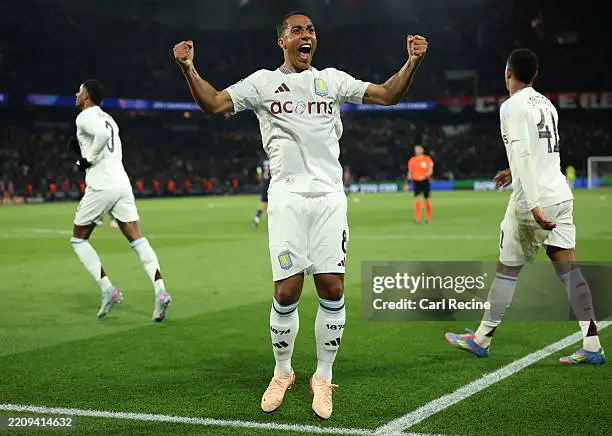

Aston Villa are up against the odds next week as they try to turn around a 3-1 loss to PSG in the first leg of their quarter-final clash with the newly crowned French champions in the Champions League.
Morgan Rogers rolled the ball into the back of the net to cap off a quick counterattack as the end of the first half drew nearer. However, the lead lasted for less than five minutes - Desire Doue dug out a sweet strike from the edge of the box to level the score and reward the Parisians' significant shot count.
The score swung the way of the hosts not long after the restart. Khvicha Kvaratskhelia cannoned a strike into the roof of the net, and the Parisians were purring. Villa valiantly battled to leave the tie in relative balance by the end of the night, but Nuno Mendes might have put a comeback beyond them.
Here are four things we learnt from this game.
-
Aston Villa can still compete
Ahead of the first leg of the Round of 16 contest against Club Brugge, Unai Emery said "it is not time" to put his team in conversations for trophies with the top teams. This would be the test of their true capabilities against a club that has lost only once in all competitions since the start of December.
The approach was familiar to those who have seen the Villans' blueprint in big games in England. The side sat in a lower block with a 4-4-2 formation, kept the lines compact and disciplined, and waited to try and unearth weak points in their opponents. Some might say such a passive approach was always doomed to fail, but compared to PSG's last Premier League opponent, that might not be so true.
The guests gave up 29 shots, only two more than Liverpool in the first leg of the last round. They also created five more (seven to the two from the Reds). Indeed, there was always a feeling that the team was somewhat in the game, which was not the case when Arne Slot showed up in Paris last month.
It is a credit to Emery, a mastermind of matches in elite European competition, that this is the case. In less than three years, he has transformed this team, and they can be proud of their effort on the night.
-
McGinn moved the needle
One of the main reasons for the team's success in the first half was one of their age-old leading lights.
John McGinn, who has served seven and a half years at the Midlands, was the man to lead out the team at the Parc des Princes. He acted as the attacking midfielder next to Marcus Rashford but spent most of the match within his half of the field. The Scot is a willing worker without the ball, but his real worth was in the moments when the visitors were able to break out from their low block.
With a stocky stature, McGinn makes it tough to take the ball away from him. That was key for respite on the night. The Parisians pressed man to man and were keen to try and react with intensity whenever they lost the ball, but the captain continuously knew how to break up their aggression.
First, it was Fabian Ruiz in the 11th minute and then Vitinha at the half hour mark who could not contain the midfielder. Then came the crucial act for the first goal: he tackled Mendes and switched the ball to release Rashford in transition. Rogers could have scored a second strike deep into the second half and he would have owed more gratitude to McGinn for charging down Lucas Beraldo.
Captains can lead by example and McGinn must be respected for taking the fight to the favourites.
-
Stacked squad a strong signal
The survival of the Villans was also possible because of the options on the bench.
Emery's men are in the middle of a battle for the top five and also look forward to a fixture in the semi-final of the FA Cup. To compete on three fronts until May, especially after the exit of Jhon Duran, the team has required fresh faces over the last few months. Many members of the squad played their part in putting the club in a position to try and fight on an even keel with the Parisians.
First and foremost, Emery could rest and rotate before this first leg. His men beat Nottingham Forest on the weekend with eight of the starting eleven for this fixture not being in the initial lineup. That meant they could last longer in a low block with better physical power and mental concentration.
Once fatigue set in here, he could make a big power play for the final half hour. Between the 58th and 80th minutes, he chose to send on four substitutes. Among those players were Marco Asensio, a winter loanee from PSG, who had one of three shots in the second half, last season's top scorer Ollie Watkins, and Amadou Onana, whose powerful frame forged inroads on the Parisian midfield.
Whatever happens next week, a stacked squad signals this season should not fizzle out before its time.
-
Axel Disasi decision draws doubt
Yet, elite European football is ruthless. Villa did a lot of things well and were a little unlucky to leave Paris two goals down. But Emery might wonder if he ought to have handled one change differently.
His first introduction came just after half time. He asked Axel Disasi to sit on the right of the back four with Rogers and Boubacar Kamara coming to his aid in the low block. The 27-year-old, a loanee from Chelsea, was a much-maligned figure in west London in this position and many people preferred to see him in central defense: it did not take long to see why these criticisms have surfaced.
Kvaratskhelia cut him apart for the second strike with a brilliant ball roll using the studs of his boot to shift inside and outside of the fullback. In a team full of dribblers, the Georgian grabbed most of the attention after the restart. Three times in the first five minutes of action, Ousmane Dembele popped up in positions to shoot from cutbacks because the winger was able to trick his way around Disasi.
To be fair to the Frenchman, he was not the only player in a white shirt to wilt as time ticked away. Moreover, he came on as a precaution because the Georgian got first-choice right back Matty Cash on a yellow card within the first twenty minutes of the match. But there is no doubt that the home side smelt blood when he entered the pitch in that position and the duel was decisive for the outcome.
