


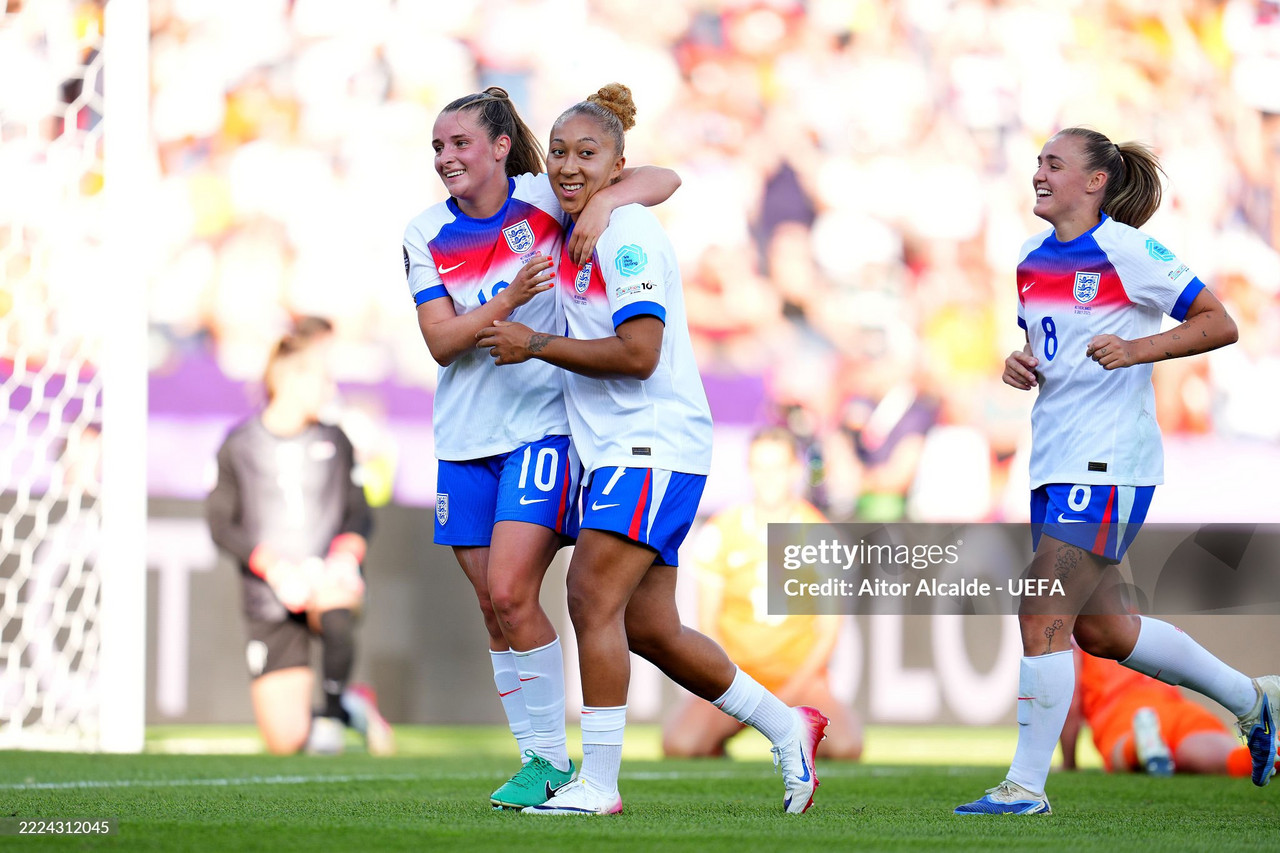

Sarina Wiegman’s Lionesses responded to last Saturday’s setback against France in emphatic fashion, dismantling Group D rivals the Netherlands 4–0 in their second UEFA Euro 2025 group fixture.
Lauren James set the tone with a fantastic strike into the top corner to open the scoring, before Georgia Stanway doubled the Lionesses' lead before the stroke of half-time with a drilled effort from distance.
After the break, James doubled her tally tapping in from close range before Ella Toone capped the rout.
Alessia Russo’s excellent linkup play unlocked the Dutch defence three times to register a hat‑trick of assists.
Here are four key takeaways from England's fantastic performance in Zurich.
-
James flourishes on the wing
In the build-up to Euro 2025, there had been plenty of debate over Lauren James’s ideal position for England. In the tournament opener against France, the Chelsea forward featured in a central number 10 role behind Russo, but, like many of her teammates, struggled to influence the game.
Against the Netherlands, however, Wiegman deployed her on the right flank - and the change unlocked her true potential.
On the wing, James linked up brilliantly with Chelsea teammate Lucy Bronze. Their quick one‑twos and clever overlaps consistently pushed the Dutch defence onto the back foot.
James’s direct running caused panic whenever she received the ball, and she wasn’t afraid to drift inside to exploit pockets of space.
Her two goals perfectly encapsulated her varied skill set - the first a sublime curled effort into the top corner, leaving Daphne van Domselaar grasping at thin air; the second a ruthless close‑range finish born of instinct and anticipation.
All evening, James combined neat link-up play, deft footwork, and composure beyond her 23 years. Tonight was yet another example of James, with her cool and composed nature, firmly proving any doubters wrong.
The Chelsea forward shows, time and time again, that she is a player brimming with quality and she must be considered, based on technical ability, one of the most gifted players in the women's football world.
-
Russo top-class
Alessia Russo may not have found the back of the net against the Netherlands, but the Arsenal striker was one of England's standout performers.
The 26‑year‑old excelled at dropping between the lines to link play effectively. Russo’s hold‑up play was a masterclass in balance and strength, allowing teammates to join attacks while she patiently waited on the shoulder of the last defender.
Beyond her creative contributions, Russo’s work rate was relentless. She led the high press, harrying every Dutch midfielder and defender, and won crucial second balls in England’s favour.
Her fearless commitment to the physical side of the game - shielding the ball, winning aerial duels, and chasing lost causes - set the tone for the Lionesses’ intensity.
While she came close on several occasions, narrowly missing out on a goal, Russo’s influence extended far beyond the scoresheet. Her tactical intelligence, combined with a killer instinct just inches away from fruition, underlined why she is on her way to becoming one of the most complete and dynamic strikers in world football.
-
Midfield much improved
England’s midfield woes against France were laid bare in their tournament opener - Georgia Stanway looked tentative after an injury layoff at Bayern Munich in recent months, Lauren James lacked the energy to influence from number 10, and Keira Walsh’s absence at times left a worrying void despite her eventual goal. In contrast, England's midfield excelled against the Netherlands.
Stanway was back to her usual self, marrying crisp passing with timely interceptions and aggression off the ball as she rediscovered her pre‑injury rhythm. Her excellent long‑range finish to double England’s lead - steering a low, driven effort into the bottom corner - was both a statement of intent and a reminder of her quality.
Wiegman’s decision to start Ella Toone in the number 10 berth paid immediate dividends. Though she may not possess James’s flash, Toone’s tireless work rate, energy and intelligent movement ensured England retained tempo through the middle. Her persistence was rewarded when she lashed home a second‑half strike from close range.
Toone's performance underscored the value of relentless energy in that role for England. Grace Clinton’s lively cameo later on kept the momentum high, illustrating the depth England boast in attack‑minded midfielders.
Finally, Keira Walsh was back to her imperious best, shielding the back four with assured positioning and dictating the game’s pace with her trademark composure. Her ability to relieve pressure and launch forward moves with precise distribution provided the foundation upon which England’s renewed midfield dominance was built.
-
Defensive frailties resolved
While Wiegman will have savoured four goals against her native Netherlands, the clean sheet may have been just as satisfying for the Lionesses boss.
England’s defence looked vulnerable against France, with full‑backs Bronze and Jess Carter repeatedly beaten by the lightning pace of Sandy Baltimore and Delphine Cascarino. Against the Dutch, however, the back four were far more compact and assertive.
Wiegman tweaked her back line by swapping Carter infield to partner Leah Williamson at centre‑half, allowing the versatile Alex Greenwood to patrol the flank.
Greenwood, who earned her 100th cap against France, was imperious in tracking Aston Villa winger Chasity Grant - cutting out crosses and stepping up smartly to intercept through balls.
At centre‑back, Carter thrived alongside captain Leah Williamson. Carter’s composed positioning and rugged 1‑v‑1 defending helped nullify Vivianne Miedema, one of Europe’s most potent strikers and the Women's Super League's all-time top goalscorer, who was left frustrated and without a clear chance.
Williamson’s leadership and reading of the game ensured the pair worked in tandem to marshal the Dutch attack.
Improved communication, organisation and sharper pressing triggers meant the Lionesses’ rearguard not only looked secure but also launched attacks with confident, accurate distribution. In solving their defensive lapses from game one, England now boast a foundation capable of supporting their free‑scoring forwards through the rest of the tournament.
