


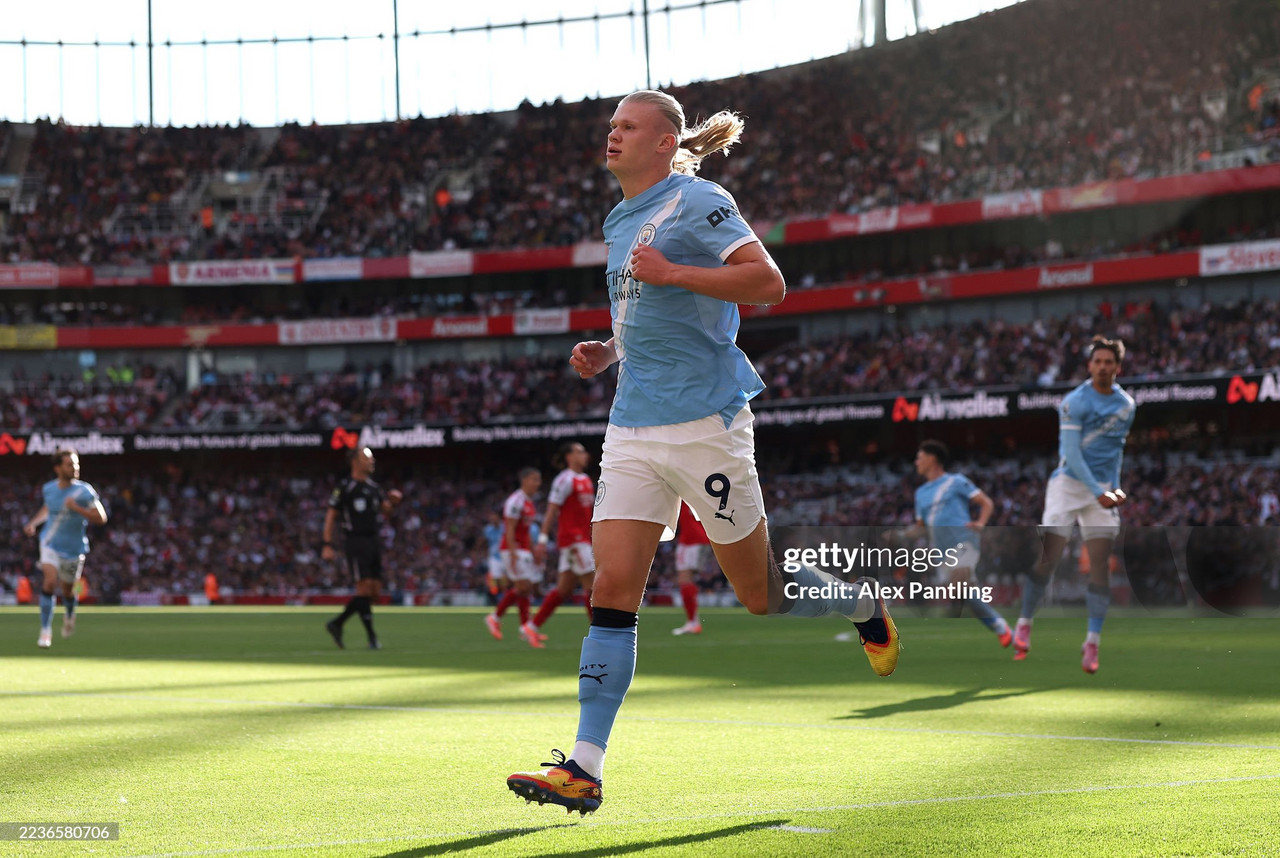

Almost a year to the day after a 2-2 draw at the Etihad Stadium, a role reversal saw Arsenal peg back Man City at the death in front of their fans at the Emirates Stadium. Yet, it was another blow to the record of the Gunners, who faced a resurgent outfit looking for the foundations of future success.
Here are four things we learned from this stalemate.
-
Guardiola gets pragmatic
The Citizens were the most ball dominant outfit bar none in the Premier League for a long time under Pep Guardiola. But they were also among the fittest, strongest, and most street-smart— things that do not come to mind about a Guardiola side but are all key to the powers of his former kingdom
They began the game in a 4-1-4-1 system and the same lineup for the third fixture in a row. Tijjani Reijnders and Bernardo Silva jumped forward in the press, and it appeared something that Mikel Arteta expected with the choice of a left winger in Leandro Trossard, who likes to feed runners.
City continued to try and press but found they could get spun by direct passages of play to release Noni Madueke while the underlaps of Riccardo Calafiori carved routes forward on the left.
So well before the 'bus parking' began, Guardiola started to adapt. Bernardo sat next to Haaland, and City defended against their opponents in a 4-4-2 formation that did not expose the centre of the midfield so strongly in terms of running power and duels. It was a sensible concession and a move that paid off, with Abdukodir Khusanov no longer depended on to be a stopper with his pace.
Pep has always been more pragmatic than the discourse might depict him. Even if the final phase of this clash was extreme, he is always toying with ideas and knows this team are a work in progress.
- Haaland and Doku drive the initiative
What a weaker City does allow is the opportunity to unlock certain strengths in the attack.
Just three days after he had netted a 50th Champions League goal in record time, Erling Haaland was at it again. Between rattling the cages of William Saliba and Gabriel Magalhães, he ensured he was ready to motor on the breakaway for Reijnders to assist him when an inaccurate Calafiori cross caused more chaos for the hosts than it should have done. His transitional threat remains unrivalled.
Meanwhile, the wide threats from City are not at the same level as the past. Guardiola reminisced about working with Leroy Sané and Raheem Sterling on match plans to break with the vision and passing on the stride of Kevin de Bruyne, and this version of the side cannot repeat that 1 to 1.
Phil Foden is more of a swivel and slalom player, and Jeremy Doku is more devastating in terms of acceleration over small spaces. But the pair are in better form of late in their unique way, and the Belgian stood out again in North London. He shimmied down the right wing repeatedly, setting up Haaland to strike before he nearly doubled the advantage by blowing around Gabriel in the box.
For a team that conceded a historical amount of possession in a match involving Guardiola, City recorded more xG than the Gunners. That fact does not make the score any less painful, but they are a reminder that the classic City does not need to be back again for their attackers to make a mark.
-
Donnarumma does it again (almost)
With more conservatism as time went on, City might have expected to face a barrage of efforts from the men of Mikel Arteta. But credit should go to the defensive block, who did enough to frustrate the favourites even after the entries of Bukayo Saka on the right and Eberechi Eze in a central role.
Of course, in both halves of the clash, some moments required a solid response to danger. In a week, their newest shot stopper has laid down the law and given the spine some much-needed confidence.
Gianluigi Donnarumma delivered a decisive display in North London at the end of April with strong saves to stop strikes from Gabriel Martinelli and Trossard to either side of half time in a 1-0 semi-final first leg triumph for Paris Saint-Germain. Now at City, he was back up to his old tricks.
A firm hand repelled a rasping effort from Madueke; he was equally alert to a drive from Eze that followed the restart. His shot stopping and presence in the penalty area are a plus in such phases of a game, and only the Martinelli magical run and lob left the Italian a little red-faced by full time.
He would have had a noteworthy part in a victory if the visitors had taken away all three points.
-
The group is getting the fire in the belly
Before the international break, City had been beaten by Tottenham Hotspur and Brighton, suffering the scrutiny of the media as a force on the decline. Indeed, even their showings in the last week have signalled that all is not well at the Etihad Stadium, but the narrative is becoming more optimistic.
Guardiola has got a defiant streak he wants to transmit to his players, who pulled out performances in their first week with European football. Once on top, they turned the screw to dispatch Man United 3-0, found a way to unlock Napoli with a 2-0 win, and finally took a point at the Emirates Stadium.
For what it is worth, the Spaniard seemed content with the camp even at the end of August. His catchphrase has been "body language" since the start of the Club World Cup, and the rebuild that began in the winter window is also involving a reset of the minds to have the stomach for the fight.
Defensive determination, no matter how offensive a team wants to be, is a show that a squad have players who are willing to back up each other on the field. That togetherness is one of the things that will satisfy the Spaniard the most and he is backing himself to add tactical layers to refine the team.
