



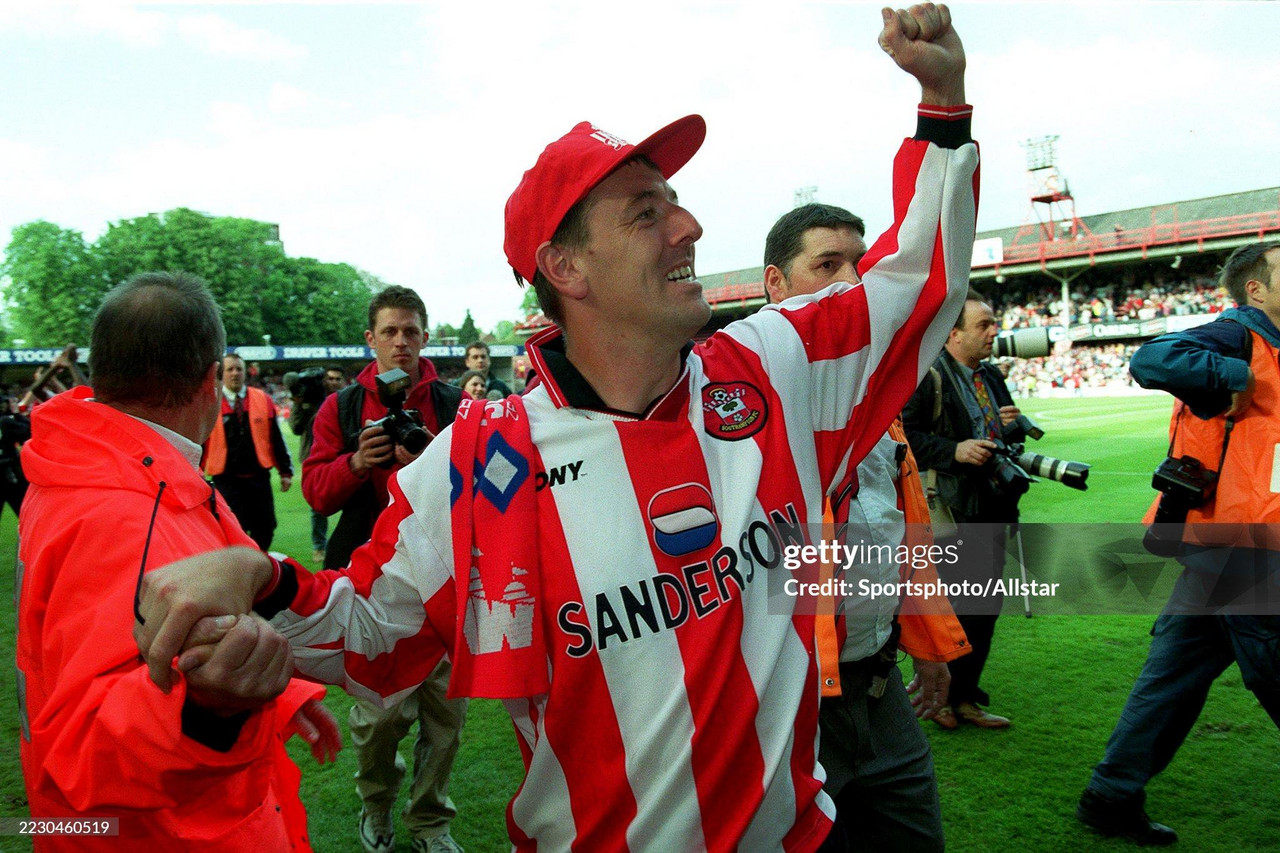
443 appearances, 161 goals and 16 years of service for Southampton FC is enough to make Matt Le Tissier a Saint's legend. The fans call him "Le God" and rightly so, as he rejected big money proposals to move away and, in doing so, kept the team in the top division throughout his career.
However, a fiery off-the-field personality as well as controversy during and after his playing days make him much more than just an excellent football player; Matt Le Tissier is in every sense a complete cultural icon.
-
Personal Habits and Personality
Is it true you only drank a Malibu and Coke?
"My choice of drink is Malibu and Coke. I've never had a pint of beer in my life, never drank a glass of wine and never had a cup of coffee."
Any reason?
"I just don't like them. I don't like the smell. I don't like the taste. So if I don't like it, I don't do it. I don't give out to peer pressure."
-
Guernsey, Family & Development
How did that council estate upbringing shape you as a person?
"Growing up in Guernsey and not being attached to a professional club until the age of 15 allowed me to play freely and experiment a lot in matches.
"I wasn't over-coached and wasn't a coach's dream in terms of playing in positions and knowing all the tactics; I was very much a free spirit.
"On the Council Estate, I used to play with my brothers, so it helped me to develop quickly because you've got to find ways of getting around them as they're bigger and stronger than you. I am a pretty good, complex problem solver, so I found a way with my skill and touch. I grew up in a very close-knit family, and that helped me keep my feet firmly on the ground."
How did living in Guernsey impact your route into football?
"I was spotted by Southampton when I turned 15, which is really late and back then most players at Saints had joined two or three years before me.
"Growing up in Guernsey, you don't really get a lot of football scouts going over there to watch players and to see if there's any talent because the football scene is pretty small. I actually had to come over to the UK to get spotted playing in a game in Millbrook for the Guernsey Under-15s.
"The game that I did get spotted in, I was asked by my coach to play out of position as a right winger when I wasn't a right winger at all. I played centre midfield and that was the first time I'd ever really played right wing.
"I came over for a trial and didn't say anything because I was just happy to be there, so they stuck me at right wing, I did well, and they signed me up."
Would you have been scouted had you not played right wing?
"If I'd have played centre midfield and had a shocker, I might never have been a professional footballer. It's got to be right time, right place. You've got to have the right person looking at you, who's looking for the abilities that you've got. There's so many variables, so you need to get lucky at times."
-
Leaving Home at 16 to Settle in Southampton
Were your brothers good at football as well?
"All three of them were pretty good. One was a defender, and the others who played similar positions to me were equally as talented. One of them was offered a contract at Oxford, which he rejected because he didn't want to leave the island, before the other brother turned down an apprenticeship at Southampton, also because he didn't want to leave Guernsey."
Why were you more mentally resilient than your older brothers?
"It’s because I had an ambition from a young age to be a footballer. I saw the chances that my brothers had turned down, and I saw how disappointed my parents were that my brothers turned down the chance to be footballers, even though they certainly had the ability to play in the First Division."
Did older brothers turning down contracts add extra pressure?
"I don't think so. I never really put pressure on myself. I just knew I had this ability, and I wanted to do something with it. I think seeing them turn down contracts was a bit surprising and a little bit disappointing because had they gone before me, then my path into football might have been easier."
-
The Influence of Dave Merrington
Who were the main influences in the early stages of your career?
"Dave Merrington, without a doubt. He was my youth coach for the first two years, then became the reserve coach, and eventually the first-team coach.
"It was a crucial period for me, between the ages of 16 and 18. I grew so much as a person and a player because of Dave's influence. He was hard as nails, but really passionate about football and wanted the best for everybody. I will be eternally grateful to him for what he did for me in my younger years."
What is the Best bit of Advice you have ever received?
"From Dave Merrington when I was a youth player. He used to call me a genius. I didn't understand, but he would drill it to me that I had something other players didn’t and that I must never let people drill that out of me.
"He's one of the reasons why I'm so strong-willed and strong-minded and thick-skinned. He had a massive influence on my football career, but also had a big influence on us as young apprentices at Southampton."
-
Coaching, Freedom & Playing Style
Modern coaches have strict tactics. How was it back in your day?
"I had nine different managers in my time at Southampton, and there was a lot of difference in terms of how much freedom they would let me have.
"It ranged from Ian Branfoot, who played a classic 4-4-2 with me as the right midfielder or left midfielder. It was a very basic way of playing, so we were very long-ball, and it wasn't really suited to my favoured style of play.
"Following him, we went to the other extreme when Alan Ball came in and told me that I could go anywhere I wanted on the pitch. ‘Don't do any defending, you're crap at that’ were his exact words. All he asked of me was to be in the right position to receive it, and he would make sure that I had plenty of touches of the ball because I was the best player on the team."
-
Loyalty, Transfers & One-Club Career
You spent a whole career at Saints; do you still value that loyalty?
"One of the proudest things that I look back on is that I spent all my career at one club and all of that was spent in the top flight of English football.
"Spurs tried to buy me in 1990 when I was 21 and I agreed a contract, but then changed my mind and signed a brand new deal with Southampton.
"I agreed to join Spurs and was about to get married, but my fiancé decided she didn't want to live in London. So my choice was to join Spurs or get married. I decided to get married, and six years later, I was divorced.
"Chelsea tried buying me in 1995 when I was on about 1700 pound a week. If I'd gone to Chelsea, I would have been on about 10, 12 grand a week. So that was the money that I decided to turn down to stay at Southampton.
"I was playing the best football of my life. I had a manager who loved me and let me play however I wanted to, and I saw no reason to change."
-
Matt Le Tissier's England Career
Why do you only have 8 caps for England?
"I would rather look back on my career with people saying, you didn't get as many caps as you should have done, as opposed to someone going, How the hell did you get 50 caps? I'm proud of the 8 caps that I did get, and if you'd have told me as a youngster that I would get 8 caps, I would have taken that.
"I only started three games. One of those was abandoned after 27 minutes because of crowd trouble, and the other two matches were three years apart.
You were part of a golden generation, is that why you got less caps?
"Yeah, especially when the main player taking up your position was a short Geordie fellow who was pretty good at the whole football thing as well."
"In the mid-90s, the depth of English forwards was exceptional. There were lots of players around that era who would also say, “How did I only get so few caps?” like Andy Cole, Ian Wright and Les Ferdinand.
"The competition was pretty hot. There was a lot of good players to choose from and I am disappointed that I only got 8 caps, but I'm not distraught about it. I feel like winning 8 caps for England playing at Southampton is equivalent to 50 caps whilst playing for Man United."
Should you have gone to the 1998 World Cup?
"The thing with international football is that your place in the team depends on one man's opinion and if that man doesn't think you're any good, you got no chance. Unfortunately for me, I made two decisions at Southampton that probably maybe cost me a quite a few England caps.
"I turned Spurs down in 1990 and their manager was Terry Venables who wanted to speak to me but I refused; he then became the next England manager. In 1995, I turned Chelsea down and refused to speak to their manager Glenn Hoddle who also became the next England manager."
-
Falling Back in Love With Football
Has being a director at non-league affected your view on football?
"It has made me fall back in love with what I call proper football because I think there seems to be a real renaissance in people going to support non-league football as people are getting a little bit fed up with VAR and with the amount of diving that's going on in the game today.
"Sometimes it is just the fact that a lot of the games are boring at the moment because of the tactical stuff. It's almost become like a game of chess where teams have so much possession, but when you look back at the end of the 90 minutes, how many chances did they create? That is why I find myself watching Premier League football matches and getting a little bit bored."
Do you think fans are being priced out of top tier football?
"Football is not cheap anymore. It was always billed as being the working man's sport and it's now hard for the working man to be able to afford to take his family to the games. It's really tough. I think that's why we are seeing real interest come back into Non-League Football."
-
Other Sports & Life After Football
What other sport would you have liked to go professional in?
"If I wasn’t a footballer, I would have been a cricketer. I was so obsessed with football, but cricket wasn't far behind. I was a decent batsman who also kept wicket. I played youth level back in Guernsey and a little bit over here."
What's given you the biggest fulfilment after your career?
"Towards the back end of my career, I got a bit addicted to golf, so the most fulfilment I've had is playing lots of golf and getting my handicap down.
"Strangely enough, golf is one of the games I didn't play when I was a kid as it's quite expensive so my parents couldn't afford a membership. So people used to ask me what I wanted to do when I finished playing and I said golf."
-
Media, Sky, Politics & Controversy
Could you cope as a footballer in today’s world with social media?
"If I was a footballer today, I would not be on social media, not a single account anywhere. If I was an agent of a player, I would highly recommend staying clear until you hang your boots up and then have some fun."
-
Reputation, Legacy & Identity
What do you hope people remember you for?
"I hope they remember me for being somebody who was prepared to stand up for what he thought was right... then after that, I wasn't a bad footballer."
