



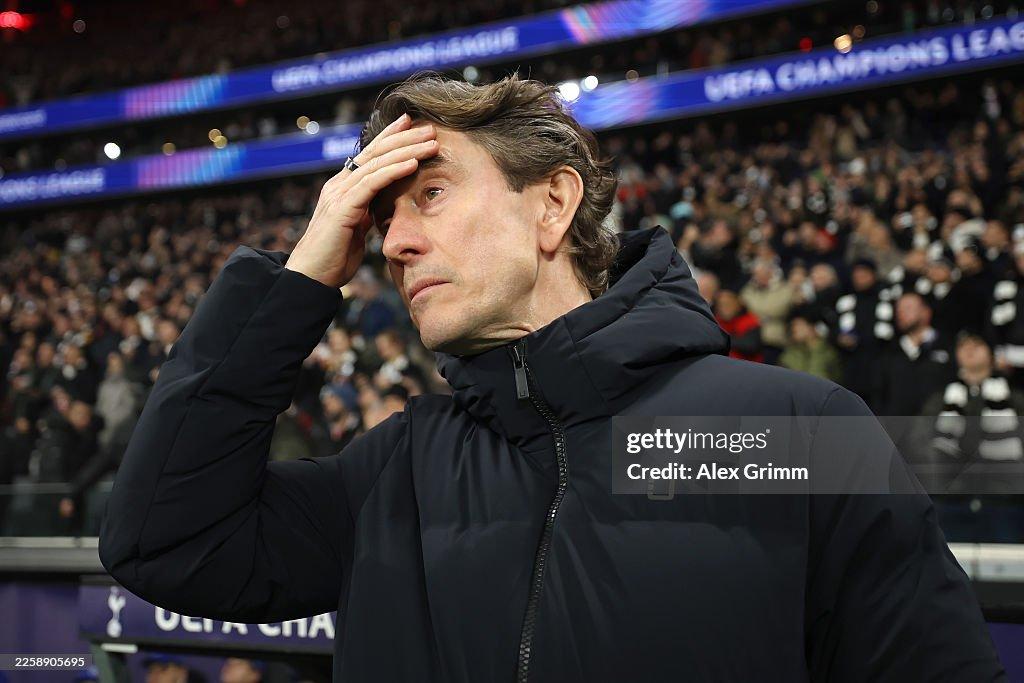

It may seem fairly simple to write about where it went wrong, the reasons are very well, and very publicly, documented after all.
Did Thomas Frank struggle with the scrutiny now imposed on him? Absolutely. Was he unable to adapt his tactics and style of play to keep with the expectations of his new club's supporters? That much is obvious. Is the club being run too poorly, too chaotically, for a manager who had only ever enjoyed stability at the very well run Brentford? It seems very likely.
However, none of these issues needed to be insurmountable. Thomas Frank is an intelligent, thoughtful manager who had clearly earned a chance with club who, while they may not always act it, are amongst the most successful in the country.
Spurs, on a high from last season's Europa League win, having bolstered the squad in the summer with a blend of experience and talent, in theory only needed a calmer head than Frank's predecessor.
Then this squad would prove that the poor league position of 24/25 was but an anomaly, that consistency was all that needed to restore the North London residents to the top third of the table.
Terrible league form
Consistency did come, but in the worst way. The league form remained dreadful and while early signs away from home were positive, the trend at home was abject failure compounded by more abject failure.
In 13 home matches there have been 2 Spurs wins - on the opening day against Burnley and once more against Frank's former employers Brentford (ironically high flying having lost their top goal scorers, captain and manager last summer).
Data is not needed to understand why the home form has been dreadful - Thomas Frank has sent his team out to react to the opposition in every single match.
When the squad has players almost entirely geared to being as far from their own goal as possible, the result is predictable. When the fanbase has, rightly or wrongly, an expectation to see imposing, identity driven football, but is served "Frankball" even against the division's weakest sides, it won't take much for the crowd to turn.
Even then, this doesn't need to be fatal. The manager can learn, he can show humility, he can adapt - that is what Thomas Frank's calling card was meant to be after all. Frank's response, however, was at one point to criticise the supporters.
At other points, it was to insist the side had been playing well and was merely unlucky, despite all evidence to the contrary. Then, as if completely aware of whom he managed, he reportedly openly hold up rivals Arsenal as the example of why he should be given time, praising the red half of North London regularly.
If you know your history...
If that were not enough, Thomas Frank on more than one occasion diminished the greatest moment in the Spurs' supporters recent history, last season's Europe League triumph. Spurs were not a Champions League club really. It was only because they managed to win some trophy (the very thing Spurs were ridiculed across the past decade for never doing). They were actually a 17th placed club who got lucky.
Someone in the club should really have pointed out to Frank that these supporters would be fiercely defensive of this particularly point, and maybe mentioned that Spurs had been in the Champions League more season's than not in the past decade anyway.
Success comes to those who adulate
In the past two decades, since Spurs qualified for Europe under Martin Jol for the first time since before the beginning of the Premier League, the club has had two types of managers - those who clearly relished the job as the opportunity of a lifetime and did everything they could to invest in the club's values and tradition, and those who felt they were doing the club a favour, that their CVs were elite and Spurs were not.
In the former camp you have Jol, Redknapp, Pochettino and to an extent Postecoglou - all managers who ultimately brought attractive football and comparative success to what preceded them.
In the latter camp you had ex-France manager Jacques Santini, serial winners Jose Mourinho and Antonio Conte, and the very self important Andre Villas Boas. Only Juande Ramos transcends both camps - he won a trophy and played some lovely football following his serial success at Sevilla, but was also clearly miserable in role, brought the club its worst ever start to a season and banned ketchup from the canteen.
Frank had no CV to suggest he should see Spurs as beneath him, you'd have expected him to fall into the same camp as 'Arry, Ange and Big Martin. However, actions speak louder than words, and his actions were to persist with a midfield duo that clearly couldn't progress the ball.
His actions were to completely neglect talented footballers, albeit raw in some cases, in favour of 'safe' options until those safe options were injured. His actions were to put the player signed specifically to create and entertain from the middle of the pitch either on the bench or on the flanks.
Only when there was no other option did Xavi Simons find himself in his preferred central attacking position.
Opinion: Let's be Frank
When I look at a manager being given the biggest opportunity of his career refusing to buy into the values of Tottenham Hotspur Football Club by any metric, be it his comments, his decisions or his reverence to the past, I don't see someone who was unlucky with injuries (he was, but not to the extent that he should've treated Wolves at home like 1970 Brazil), I don't see someone who was let down by signings and structure.
What I see is someone who, for all his reputation as an erudite, respectful manager, was too arrogant to learn the lessons needed to succeed. And that, in my humble opinion, is why Thomas Frank now departs as manager who has failed most spectacularly at Spurs.
