


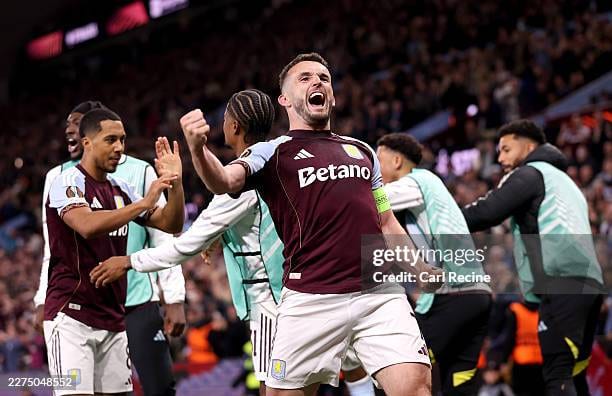

Aston Villa stand on the brink of history as they prepare for their first European final since 1982, when Peter Withe’s goal against Bayern Munich secured the European Cup.
Now, more than 40 years later, Unai Emery has the chance to guide Villa back to continental glory against SC Freiburg in the Europa League final.
Emery’s record in this competition only strengthens belief around Villa Park.
The Spaniard has won the Europa League four times during his managerial career, and his experience in knockout football has helped transform Villa into one of Europe’s most organised sides.
Villa arrive in strong form following a dramatic semi-final comeback against Nottingham Forest, while their recent 4-2 Premier League win over Liverpool, which secured Champions League qualification, has only strengthened belief heading into the final.
Summer additions such as Amadou Onana and Ian Maatsen have also added important depth throughout the campaign, helping Villa compete across multiple competitions.
-
Can Villa control the tempo of a European final?
Villa’s greatest strength this season has been their ability to impose structure on matches without requiring complete territorial dominance.
Under Emery, they have evolved into a side capable of slowing games through composed possession before accelerating quickly through midfield once spaces begin to open.
That adaptability has been central to their European campaign, particularly in knockout ties where momentum and game states can shift rapidly.
Villa’s defensive organisation has also become one of their defining traits.
The partnership between Pau Torres and Ezri Konsa has provided calmness in possession and stability during transitions, allowing Villa to maintain their shape even during difficult spells.
The concern in a final, however, is that structure becomes significantly harder to maintain once pressure intensifies.
Villa have responded impressively in big moments throughout the season, but a European final introduces an entirely different emotional landscape.
The key for Emery’s side will be maintaining patience in possession without becoming passive or losing attacking intensity.
If Villa can dictate rhythm early, they may prevent Freiburg from turning the contest into the chaotic transitional game they thrive upon.
-
Will Villa be clinical enough when chances arrive?
Villa’s attacking structure has been one of the defining strengths of their European run.
Ollie Watkins has led the line superbly, combining intelligent movement, relentless pressing and consistent end product throughout the season.
The England international has continued to develop into one of the Premier League’s most complete forwards under Emery, regularly delivering in decisive moments.
Behind him, Morgan Rogers and John McGinn have provided consistent goal threat from midfield, timing late runs into dangerous areas and exploiting spaces created by Watkins’ movement.
Rogers, in particular, has emerged as one of Villa’s breakout performers this season following his arrival from Middlesbrough, adding directness and physicality in attacking transitions.
Emi Buendía also offers an important creative layer between the lines, particularly in matches where Villa are required to break down compact defensive blocks rather than attack open spaces.
His ability to operate in tight areas and unlock defensive structures could become crucial if the final develops into a controlled, low-margin contest.
The concern for Villa is not whether chances will arrive, but whether they can be ruthless enough when those moments come.
Against an organised Freiburg side, Villa may only require one decisive attacking sequence to define the outcome.
-
Villa’s midfield control could decide the game
Villa will be fully aware that Freiburg’s greatest threat comes through repeatable transition patterns rather than sustained control of possession.
The Bundesliga side are at their most dangerous when winning the ball high up the pitch and attacking quickly before defensive structure can reset.
Villa’s midfield discipline will therefore be essential in preventing those transitions from developing through central areas.
Set pieces also represent a major concern.
The delivery of Vincenzo Grifo consistently creates high-quality opportunities, while Matthias Ginter and Igor Matanović provide significant aerial presence inside crowded penalty areas.
Villa will require complete concentration during both first-contact and second-ball situations.
For Emery’s side, the midfield balance could ultimately decide the final.
Youri Tielemans offers composure and rhythm in possession, allowing Villa to dictate tempo and progress through central zones, while McGinn and Rogers provide the intensity needed to convert control into territorial pressure.
The possible return of Boubacar Kamara could also provide an enormous boost defensively, with the French midfielder’s positional awareness offering additional protection against Freiburg’s counter-attacking threats.
If Villa fail to control central areas, the final could quickly become fragmented and unpredictable.
In one-off matches, momentum can disappear rapidly once structure is lost.
However, if Villa reproduce the intensity and hunger shown against Liverpool last weekend, they possess the quality to pin Freiburg back and force the game into controlled attacking phases rather than transitional chaos.
For Aston Villa, this is an opportunity to complete one of the club’s most significant modern achievements and bring European silverware back to Villa Park.
