


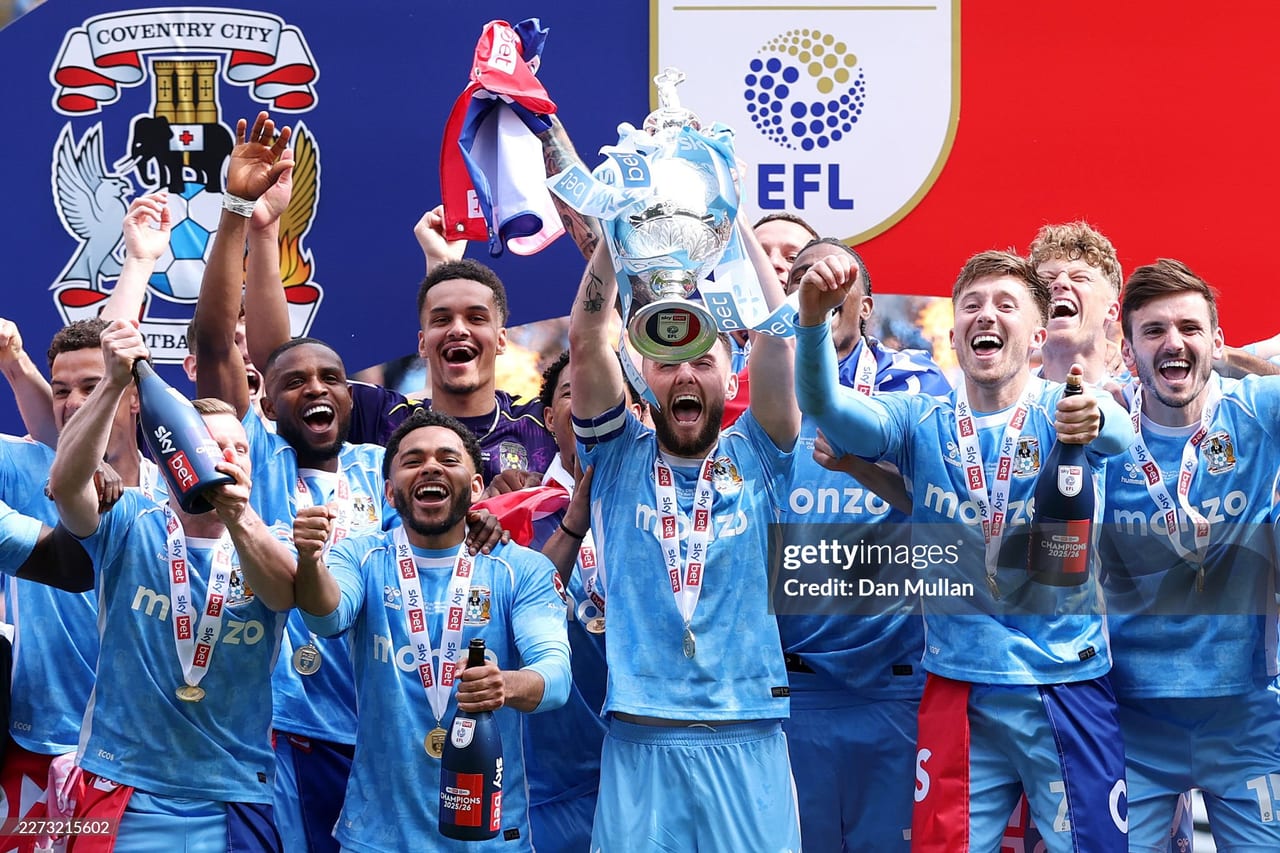

After years of 'almosts', Coventry City are Premier League at last. Frank Lampard's Sky Blues turned red-hot, storming to their first Championship title since 1967.
Joining them in second, Ipswich Town enjoyed a quieter but nonetheless successful promotion campaign under now-departed club legend Kieran McKenna.
Proceedings were less pleasant for crisis club Sheffield Wednesday, League One bound alongside Leicester City and Oxford United after relegation.
Controversy set the Play-Offs alight as Hull City overcame Millwall and Middlesborough to seal the final promotion slot. Southampton, ironically, could do nothing but watch.
In a season that saw points deductions, all-timers, and the greatest spy scandal since the Cambridge Five, every blink would miss a moment of madness in the English second-tier.
In case you missed it, here's what happened in the Championship last season.
The title charge
Coventry City, under managers Mark Robins and Frank Lampard went on a journey.
Less than a decade ago, the sky blues were playing in League Two. It was Robins who laid the foundation; a League One title, second-tier stability, a Championship Play-Off final.
When the difficult decision was made in November 2024 to change manager, with Cov 17th, Lampard arrived to finish what his predecessor had started.
The Chelsea legend's side were flexible, regularly shifting from a back four to a back three when building an attack.
Matt Grimes anchored the midfield, spraying passes onto dangerous, direct runs by Milan van Ewijk and Brandon Thomas-Asante - a right-side combination that fullbacks everywhere feared.
Their intentions were clear from minute one. Five goals against Derby County in August, seven goals against QPR one match later. This time, there would be no 'oh so near'.
And yet, it wasn't always simple.
A December double-loss to Ipswich wrecked Coventry's momentum. The tractor boys smelt blood. Middlesborough and Millwall started to close in.
Compounded by January defeats to Norwich and QPR, a once-unassailable gap at the league's summit was annihilated.
Kim Hellberg's high-flying Middlesborough were happy to oblige, leapfrogging to top slot with a win at Bramall Lane in February.
The sky blue pleasure-cruise had drifted into the crimson waters of the Tees. A match against Boro was imminent, Coventry needed a win to restore their lead.
Enter Haji Wright. A perfect performance. Hat-trick. 3-1.
Lampard's side lost just one of their remaining games after that now-famous night at the CBS Arena. Like champions do, they weathered the storm.
An April draw against Blackburn Rovers made online chatter of a 'bottle' a mathematical impossibility. Nine days later, a win against Wrexham put the title in Matt Grimes' grasp.
Coventry are Premier League.
Shambles in Sheffield
Sheffield; the steel city and an absolutely dreadful place to watch football last season.
In S2, Bramall Lane was rocked by the news of Chris Wilder's dismissal just weeks after a 90-point season was ended by Sunderland's Wembley triumph.
What followed was a mirror image of Netflix's Money Heist; a Spanish academic stealing a living. Sheffield United appointed Ruben Selles.
Under Selles - whose playing career never exceeded University level - the blades were dismal, directionless and bottom of the table.
After a dramatic u-turn by the ownership, Wilder was soon back in the dugout. Victories - eventually - followed, including a double over neighbours Sheffield Wednesday.
Despite this, a 1-2 loss at home to Wrexham in March killed any slim hope of a blades Play-Off push. Midtable mediocrity was all United could muster.
The Owls began 25/26 under the thumb of Thai owner Dejphon Chansiri - a man so comical he reportedly asked club staff if they could change the direction of the River Don for good luck.
Chansiri's financial mismanagement left Wednesday in an impossible position heading into the season. Key players departed, those who remained went unpaid, and administration saw 18 points wiped off the board by the EFL.
Fans at Hillsborough endured a year of misery. The departure of club captain Barry Bannan and relegation at the hands of resurgent rivals Sheffield United occurred less than a month apart.
And yet, the blue and white of Sheffield head to League One with a smile. Chansiri has been forced out. The club is safe.
The same cannot be said about another Thai-owned blue-and-white side: Leicester City.
The relegation scrap
With Wednesday all but condemned before a ball was even kicked, the Championship effectively had only two relegation slots. Nobody could have expected that the 2015/16 Premier League champions would fill one.
For outsiders, Leicester looked to be in a relatively stable position heading into the season. New boss Marti Cifuentes knew the division well, and his side had young talent in abundance - notably loanee Jordan James.
The foxes picked up nine points from their opening four matches, including a 2-0 win against Chris Davies' free-spending Birmingham City. Soon, however, a rot set in.
Leicester - in the spirit of Christmas - spent the festive period gifting sides 3 points. December losses to QPR, Watford, and a miserable New Year's Day away to Sheffield United set alarm bells ringing.
Cifuentes wouldn't last until February. A loss at home to Oxford United proved the final straw. Chairman Aiyawatt Srivaddhanaprabha said he hoped the sacking would "improve performances and results".
To the South, that Oxford side had struggled. Manager Gary Rowett (remember that name) proved incapable of keeping his side out of the relegation zone.
Leadership at the Kassam Stadium clearly weren't feeling as Christmassy as Leicester, and Rowett was sacked on 23 December.
Despite a spike in the goalscoring form of Tottenham Hotspur loanee and summer arrival Will Lankshear after January, the yellows continued to struggle.
The arrival of 2026 lured another club into the mixing pot - West Bromwich Albion.
Hoping to build on a failed push for Play-Offs the term before, long-time Spurs coach Ryan Mason was brought to The Hawthorns for his first senior managerial position.
Ten away losses in a row followed. Mason, his side sat in 18th by the new year, was out of the door no sooner than he had arrived. But yet again, a club flirting with relegation found that sacking their manager was not the tonic they had hoped.
New coach Eric Ramsay lasted just 44 days - exactly the length of Brian Clough's infamous spell at Leeds United, and no less of a calamity.
The British coach, who enjoyed a successful spell at Minnesota United in the MLS, failed to win any of his nine games in charge. His final match - a hopeless 1-1 draw to strugglers Charlton - put the Baggies a point from relegation.
Back in Leicester, things were bleak. The club needed a relegation specialist. Someone with a recent proven record of avoiding the drop zone. The foxes waited four games to land on a name, lost all of them, and ended up with Gary Rowett.
Signing the very same man sacked by relegation-threatened Oxford did not aid Leicester's fight to stay up. The new manager's first victory - a 2-0 win against Bristol City - was not capitalised on, and the losses continued to pile up.
After April's 1-0 loss away at Portsmouth - another side seeking to climb above the drop - things turned hostile.
Outside Fratton Park, midfielder Harry Winks told a fan to 'f*** off' during a confrontation. Though Vice-captain Hamza Choudhury tried to calm tensions, the boos still echo as foxes players board the coach home.
The very next game, a sombre crowd watches as Leicester draw 2-2 with Hull City. Relegation is confirmed that evening.
A more spirited fight was put up by Oxford under Matt Blomfield, Rowett's replacement. U's fans had reason to be encouraged after three wins in a row going into March as more sides were dragged into contention.
With West Brom, Charlton, Blackburn, and Oxford all at risk, the relegation battle came down to the penultimate game-week.
It was Blomfield's Yellows who battled hardest; hitting Sheffield Wednesday for four in a desperate last-gasp. But heartbreak came on the final whistle.
In East London, Charlton had beaten Hull 2-1. The score settled the question of relegation; the Addicks were safe, and Oxford would join Leicester and Wednesday in League One.
The Play-Off push
As the first few game-weeks passed and the table started to take shape, one thing was clear: promotion could be anyone's.
Traditional heavy-hitters were sinking. Sheffield United had shot themselves in the foot with a Spanish bullet, Leicester were fixing to implode, and Southampton's faith in manager Will Still was not being repaid.
It's scarcely a surprise, therefore, to have seen the likes of Derby, Hull, and Millwall - once regarded as peripheral clubs, fighting at the top of the table.
An excellent Wrexham bore their fangs early with a 3-2 triumph against Coventry - the eventual champions' first league defeat of the season.
Striker Kieffer Moore had a mixed 24/25 in Sheffield. It was his shoddy backpass, seized on by Tommy Watson, that had gifted Sunderland promotion at Wembley.
At the Racecourse Ground, however, the 34-year-old was reborn. His excellent hold-up play created chances, and the Welshman was always happy to score some of them himself. Wrexham fans were hungry for Moore.
The Red Dragons, like opponents Derby, ultimately missed out on a Play-Off slot to Hull City on the final day.
From North Wales to East London, from the darlings of Disney+ to 'no-one likes us', Millwall were a welcome addition to the chase.
Despite losing star centre-back Japhet Tanganga to a £7mil bid from Sheffield United, the lions at The Den formed the most impressive defence in the league.
Marshalled around experienced captain Jake Cooper and supported by the arrival of goalkeeper Anthony Patterson in January, Alex Neil's side kept 18 clean sheets - the most of any side.
Millwall rarely delivered 'batterings' - only once scoring more than three goals in a game - but they didn't need to. The basics were executed perfectly, and wins followed.
The Bermondsey side finished third, a highest league finish in three decades.
Their eventual Play-Off opponents, Hull City were the surprise package of the season. The Tigers were a side that only survived on goal difference last season, were hit with a transfer fee embargo and had an unknown manager in Sergej Jakirović.
Recruitment was smart. The additions of Leeds' Joe Gelhardt, Nigerian international Semi Ajayi, and above all striker Oli McBurnie instantly improved the starting XI.
Hull defied all of their underlying data. Only Sheffield Wednesday harboured lower xPoints and xGoalDifference. Next season, the former will play in the richest league in world football while the latter will be playing Bromley.
Middlesborough and Southampton - now iconic rivals - swapped fortunes.
The Teesiders started the season well under Rob Edwards, and even mounted a title challenge with Kim Hellberg, but ran out of steam.
Briefly topping the table in February, a rotten streak of form followed, and March saw Boro slip down the table after going 7 games winless.
Further south, the Saints endured a miserable start to the season under Will Still. The young Belgian coach came into the spotlight at French side Reims, and had professed his love for the English game before joining Southampton.
Still's dream job soon turned nightmarish. Of his 13 games in charge, the 33-year-old won just two. When he was sacked in November, his side were inside the relegation zone.
His replacement, Tonda Eckert, delivered immediate reprieve. His high-tempo, fluid system pressed opponents to breaking point, proving impossible to defend against without defensive risk-taking.
In turn, Eckert's system capitalised upon error to create counter-attacking movements.
Incredibly, Saints went unbeaten in the league from January onwards, even securing an FA Cup semi-final along the way. From the doldrums, their German manager had lifted them to Play-Off contention.
Spygate
It's May 7 in Middlesborough, and preparations are underway at Rockliffe Park for one of the biggest games in the Teesiders' modern history.
In two days time, Boro will walk out under a roaring crowd at The Riverside to fight against Southampton for a place in the Premier League. Hellberg's players are training hard, but something's wrong.
Club staff spot a man, clad in black and denim, hid behind a tree. He's filming on his phone, and has his headphones on.
Immediately, suspicion rises. The EFL still bears the scars of Leeds United's attempts to spy on Derby County in 2019 - is it happening again?
When approached, the stranger makes his escape through a nearby golf club, but not before being photographed by onlookers. From this, The Times are able to identify him as Will Salt, a first-team analyst at Southampton.
The metaphorical dam bursts, and the Championship Play-Offs explode into controversy. After the first leg of the Semi-Final - a 0-0 draw - Middlesborough's manager publicly accuses the Saints of cheating.
"The Championship should be angry" said Hellberg after the first leg, and they are. At the EFL's head office in Preston, a response is being put together.
Tonda Eckert refuses press questions. The second leg is three days away.
On May 11, Hull City pull off a brilliant away performance in their play-off tie against Millwall. Their counter-attacking football pierces The Den's defenders, while the home side's attack is mauled by the Tigers back three.
Hull are off to Wembley. But nobody is watching. All eyes are on the South Coast.
The fixture now dominated by 'spygate' meets again at St Mary's. It all comes down to one night in Southampton's turf - or so it seems.
116 minutes into the second leg, the game is tied 1-1. Shea Charles, the Saints' prized young midfielder, is on the edge of the area.
He fires away a speculative cross.
Dael Fry scrambles, but can't meet it.
Solomon Bryn in the Middlesborough goal watches the ball glide past him.
It's in. Southampton are going to the Play-Off Final.
In the rapturous celebrations that follow, defender Taylor Harwood-Bellis is seen miming binoculars, mocking the dejected Boro fans.
Little does he know, it is the Middlesborough faithful - not him - who will be heading to the capital singing songs about that night in Southampton.
The EFL released a statement four days before Southampton vs Hull City was due to kick off at Wembley:
'An Independent Disciplinary Commission has today expelled Southampton from the Sky Bet Championship Play-Offs after the Club admitted to multiple breaches of EFL Regulations related to the unauthorised filming of other Clubs’ training."
The shockwave rippled across British football. In an unprecedented sanction, Middlesborough could now claw a lifeline from defeat, and the Saints were made to rue their sins.
Wembley and the Tigers' return
Throughout the noise, one club had stayed very quiet, and dipped their heads below the parapet: Hull.
Once thought of as relegation candidates, Jakirović's side stood 90 minutes from their return to the top flight after 9 seasons of turmoil.
Boro, meanwhile, had been offered a once-in-a-lifetime shot at redemption after heartbreak on the South Coast.
Those in black-and-amber were somewhat overshadowed by the scandal-ridden path to Wembley in the bracket opposite to them, but refused to be a sideshow.
Like their display against Millwall, the Tigers were comfortable in ceding ground and defending set pieces.
Middlesborough held 68 per cent of possession, and no Hull player was able to garner more than Charlie Hughes' 51 touches of the ball.
When it came to effective chances, however, the Jakirović setup proved far more efficient. McBurnie saw an effort smash against the crossbar just before half-time.
Meanwhile, City goalkeeper Ivor Pandur was entirely untroubled despite Boro's relative freedom of movement. The Croatian, now at Rangers, did not have to make a single save.
In the end, the two sides were separated by a simple mistake. Brynn - so impressive throughout the season - flapped at an incoming cross, lighting up McBurnie's striking instinct. It had to be him.
The amber end of Wembley Stadium erupted. Hull City - the underdogs - were joining Coventry and Ipswich in the big time.
