


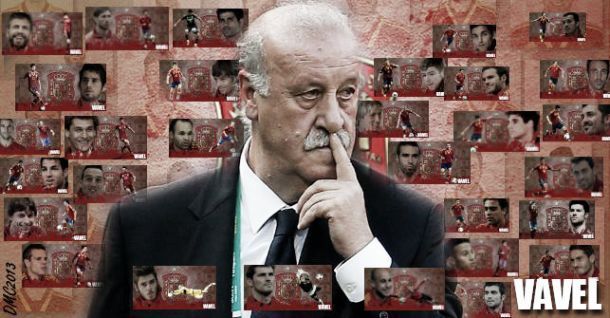

On the eve of the 2014 World Cup millions of changes are afoot for the beautiful game. New players will emerge, while others will bid goodbye to football at the truly elite stage. New countries will prove their dominance, while others will fade away. There will be joyous surprises, and heartbreaking lows. Tactical debates will ensue, as will the drunken discussions down the pub! When the world comes together in such a uniquely unified fashion, despite the equally important political unrest not to be ignored, football truly shines.
The World Cup is time where the new – and the old – meet in true battle. Experience meets the youthful dreamer. When looking at all the possible variation of what could ensue in this World Cup I cannot go far without wondering how the current champions – Spain – will get on in this World Cup. Far from a tactical intricate – see Michael Cox’s brilliant team by team reviews for each side competing this summer - I hope to nostalgically look back upon why Spain’s dominance had such an effect upon the world since their European Championship win in 2008, and why, in their twilight, respecting some of the elder-statesmen of their side should be part of this summer’s World Cup gospel.
Although clearly a talented player as he rose through the ranks at Barcelona’s famed academy La Masia, it would be folly to think many would have envisaged Xavi to define arguably the most dominant style of international football ever seen. Although Brazil may have defined the famed and eulogised ‘Samba’ style it was never been so intensely dominant over a period as Spain’s tiki-taka style.
As the world awaits the kick off of the most highly anticipated sporting event in the world I look back to realise this will be the final time to see this Spanish side, one of the most domineering and uniquely mesmerising sides of all time, with the aforementioned Xavi Hernanez at the core of this truly era defining football team.
Until the summer of 2008 Xavi was the epitome of an underrated footballer. While playing a clearly very talented team at Barcelona under the likes the Frank Rijkaard it was not until Luis Aragones finally began to hone the potential of a very special crop of Spanish players. Throughout the 2008 European Championships boys became men, and pretenders became leaders, with Xavi at the heart of it with sublime midfield displays throughout the tournament.
Following a tight 1-0 win in the final over Germany it was Xavi would who would be awarded the player of the tournament, despite his teammate David Villa being the tournament top scorer. Such an accolade going to a diminutive midfielder who would neither rack up a particularly high amount goal nor assists was just one key factor in the turning of the tides toward the damned term ‘tiki-taka’.
Following Spain’s Euro’ 2008 win Xavi would quietly lead Barcelona to one of the most domineering season’s in club football history as Barcelona won the treble in what was incidentally Pep Guardiola’s first season as a manager. Somehow, the 5 ft 7 in’ lad from Terassa had become the modern football superstar – reserved and polite but extremely efficiently talented.
While Barcelona’s success continued for several years like a steam train spearheaded by perhaps the greatest player ever in Lionel Messi, Xavi remained at the heart of the eras defining style of intelligent patient passing. It would take another two years for Spain to prove they were no one-hit wonders, but one of the greatest international sides ever. They went to South Africa with a mission to enter god status, once again with bantam midfielder Xavi at the core.
In what would prove to be arguably a less-exciting tournament than Euro’ 2008 Spain needed to dig a little deeper to win - but win they did. In what culminated in one of the worst World Cup finals in recent memory – see the plethora of violent tackles – it took a goal in the final minute of extra time from Xavi’s midfield partner Andres Iniesta to seal the win for La Roja. Through a mix of grit, determination and heaps if undeniable talent Spain had sealed their place among the pantheon of World Cup gods: samba met Tiki Taka, Villa met Ronaldo and Jairzinho met Xavi.
Nonetheless many critics questioned the style and said it had many flaws – was too slow and could be blunt in attack (Spain scored less in 2010 than Ronaldo alone for Brazil in 2002). While Barcelona’s success continued it was the style of play employed which was question which really hurt the players. Time and time again they were questioned. The vultures were out to pry on any mistake by the reigning world and European champions.
Two years later La Roja would have to travel to Poland and Ukraine to try and retain not only the European Championship but their tournament winning streak to three consecutive tournaments – unprecedented territory for any European country. Once again Spain would start the tournament slowly, relying on the experience gained from winning two tournaments in the passed four years.
Fabregas featuring as a false 9 in place of the out-of-form Fernando Torres was one early defining factor was Spain. Fabregas’ presence further afield accentuated the slow build up play which perhaps inadvertently put fuel to the fire for the detractors of the style of passive possession football which had dominated the world for the passed four years. Nevertheless Spain would indeed go on to win the tournament in the most domineering and one-sided of affairs as Italy were swatted aside 4-0 in the final, once again with Xavi playing sublimely to assist Spain on their way to international glory.
After 2012 the times began to change, most notably in Catalonia, where the heart of Spain’s players – and most importantly the domineering ideology resided. Barcelona, who were now without the deity-like Pep Guardiola and managed by the late Tito Vilanova were largely left with the inexperienced Jordi Roura for large parts of the season while Vilanova treated for cancer. Through this sad run of events Barcelona lost form but more importantly some key facets of the now famous style of play.
With age now starting to come on top of Xavi – who was 32 in 2012, and other key players for Spain such as Xabi Alonso who was then 30, and captain Puyol 34, talk of the end of an era were inevitable. With the Confederation Cup on the horizon for the summer of 2013 more questions would come the way of Spain.
On the eve of last summer’s Confederation’s Cup I wrote a blog piece questioning whether Spain’s previous success would be a hindrance for a side perhaps facing a changing of the guard. On reflection my questions were answered, if only ambiguously. Spain were a penalty shoot-out from losing to Italy in the quarter finals and were blown away by Brazil in the final, where La Roja looked extremely lethargic throughout the game.
A year on and Brazil have qualified to make the World Cup without too much trouble, though France who were also in their group caused some scares along the way. With only 24 hours between Spain’s opening game vs. the time for debate is over, the time for answers is now. Spain’s past means they need not prove anything to the detractors, their success is as clear as night and day. What they can do though, is write one final chapter in their truly glorious journey of success the passed six years.
