


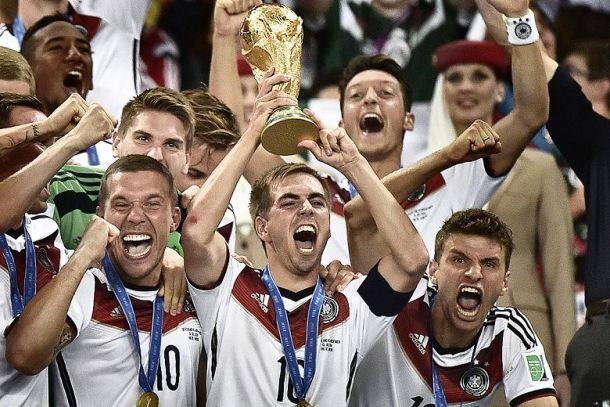

The moniker of "legend" and "great" gets thrown about much too often these days, which sometimes serves to depreciate the value of those who truly live up to such billing. In the case of Philipp Lahm, there is no description more apt or accurate to illustrate what a wonderful servant the diminutive right-back has been to not only German football, but also the beautiful game as a whole. Many times you will fail to hear his name mentioned amongst the greats of the game by casual observers, simply because his level of consistency and sustained brilliance becomes so commonplace that one tends to get used to it. Once known as the archetypal nearly man for both club and country along with friend and teammate Bastian Schweinsteiger, he now bows out from international competition as one of the most decorated players in modern history.
Philipp Lahm is Bayern Munich through-and-through, but as with every legend there were stumbling blocks and challenges to overcome at an early stage. At the tender age of 11, the young Bavarian was scouted by youth coach Jan Pienta numerous times while playing for his local team in Gern, Munich, leading to the club making him an offer to join the youth academy. Even from these early, developmental stages of his career, there was no doubting his natural talent, with one of his coaches, Herrmann Hummels, stating that "If Philipp Lahm does not make it in the Bundesliga, nobody will anymore". However, his small stature worked to his disadvantage, with bigger and more physically imposing players routinely making life difficult for the young star-in-the-making. There is a rumor doing the rounds that young Philipp Lahm had to be substituted at times against teams looking to negate his ball skills with brutal tackling for his own safety, which lead many to believe that, despite his skills, he was simply too small to make it big. Mindful of this fact, he started to adapt his game and movement to avoid contact situations as much as possible by improving his anticipation and reading of the game. His hard work paid dividends, as he won the youth Bundesliga title twice, captaining his Bayern Munich side on the second occasion which served as an indication of his leadership qualities at a very young age. At Bayern Munich II, coach Herrmann Gerland is said to have claimed that young Philipp Lahm is the most talented player he had ever coached, going on to captain the side after only one season prior as a player in the team.
Philipp Lahm made his senior Bayern Munich debut on 13 November 2002 against RC Lens in the UEFA Champions League, but found himself shipped out on loan to VfB Stuttgart due to Willy Sagnol and Bixente Lizarazu having monopolized the starting berths at full-back. Even though he was loaned as a back-up option, manager Felix Magath soon started playing him as his first-choice left-back ahead of then-German international Heiko Gerber. The young player went from strength to strength in his first season with the Swabians, adding to an ever-growing list of admirers with each passing game. His second season would be much tougher, though, as the disasterous Euro 2004 campaign left the full-back with little time to rest before the start of the new campaign - With the arrival of new manager Matthias Sammer also causing Philipp Lahm to have trouble adapting to a whole new system, resulting in a drop in performance over the opening stages of the season. He started to find his feet later, though, before consecutive stress-fractures to his foot and cruciate ligament injury put an end to his season and VfB Stuttgart career. However, on his return to Bayern Munich, he slowly but surely began to feature as the first-choice left-back, eventually going on to become an irreplacable part of the set-up in Säbener Straße.
Despite the domestic dominance of Die Roten over the next decade, winning six Bundesliga titles and another six DFB Pokal competitions, European success remained frustratingly absent, with the club routinely falling short of the ultimate prize in European football. Under manager Luis Van Gaal, Bayern Munich reached the final of the 2010 UEFA Champions League, only to lose to Inter Milan. During this period of time, Philipp Lahm was given the largest fine in club history for taking part in an unauthorized interview in which he criticized the transfer policy of the club and their apparent lack of a playing philosophy and strategic planning. This indirectly lead to a change in how the club conducted business, resulting in a much more aggressive transfer policy and desire for victory. After the departure of then-captain Mark Van Bommel, Philipp Lahm was also awarded the captaincy due to his ability to inspire and lead from the front. However, there was to be more disappointment under Jupp Heynckes as they succumbed to Chelsea in the final of the 2012 UEFA Champions League which was made worse by the fact that the game was hosted by the home stadium of Bayern Munich; the Allianz-Arena - Never mind an embarrassing DFB Pokal final loss to Borussia Dortmund by 5-2. Many were starting to question the mental toughness of Philipp Lahm and his teammates for falling at the final hurdle more often than not both domestically, and more significantly, internationally.
Philipp Lahm had been instrumental in the transitioning of Germany from a tedious side which would grind out results into a flowing, youthful and attacking unit which wowed with their talent. But, with the goal being to win trophies, he and his teammates were constantly falling just short. A semi-final appearance at the 2006 FIFA World Cup was followed by a loss in the final of Euro 2008, before consecutive semi-final exits in the 2010 FIFA World Cup and Euro 2012. After having taken over the captaincy in 2010 from Michael Ballack, he almost became a token of this new generation of German footballers; supremely talented, but lacking the mental strength to go all the way and win a significant tournament. It was an ugly blemish on an otherwise brilliant record, and even though his performances have not been culpible in any way for failures both domestically and for Die Nationalmannschaft, the responsibility rested on his shoulders, along with teammate and deputy Bastian Schweinsteiger. A renewed sense of purpose and desire was telling in a 2012/2013 campaign in which Bayern Munich went on to win a historic treble; the first of its kind for a German club. At the heart of this success was Philipp Lahm, who seemed to step up his game even more in a season which saw the Bavarians finally lifting the Champions League for the first time since 2001 after coming so close in the past three seasons.
Under Pep Guardiola, Bayern Munich refined their playing style, winning the double with a record points haul in the Bundesliga. It was another opportunity for Philipp Lahm to show his genius, having been moved successfully into midfield by his new manager, who also went on to call him the "most intelligent player he had ever coached", very high praise indeed. However, the lack of international success was still weighing on his concience, and the 2014 FIFA World Cup was the perfect opportunity to finally end years of heartbreak for the German footballing fraternity. Under the guidance of Joachim Löw, the consistently excellent Philipp Lahm led his Nationalmannschaft to ultimate glory, having been at his most influential when employed in his traditional right-back role. It was the culmination of a career of hard work and dedication, and in lifting the famed trophy aloft one could see the unbridled joy of an accomplishment that had eluded him for so long; and international title to finally put to bed any thoughts that he is not a born winner.
With Bayern Munich, there will surely be more chapters to write in a career that ranks among those of the very greatest players to ever play the beautiful game. However, with his retirement from international football, fans of Die Nationalmannschaft will always recall Philipp Lahm as triumphant, a captain to be remembered among such legends as Fritz Walter, Franz Beckenbauer and Lothar Matthäus.
An international great.
