



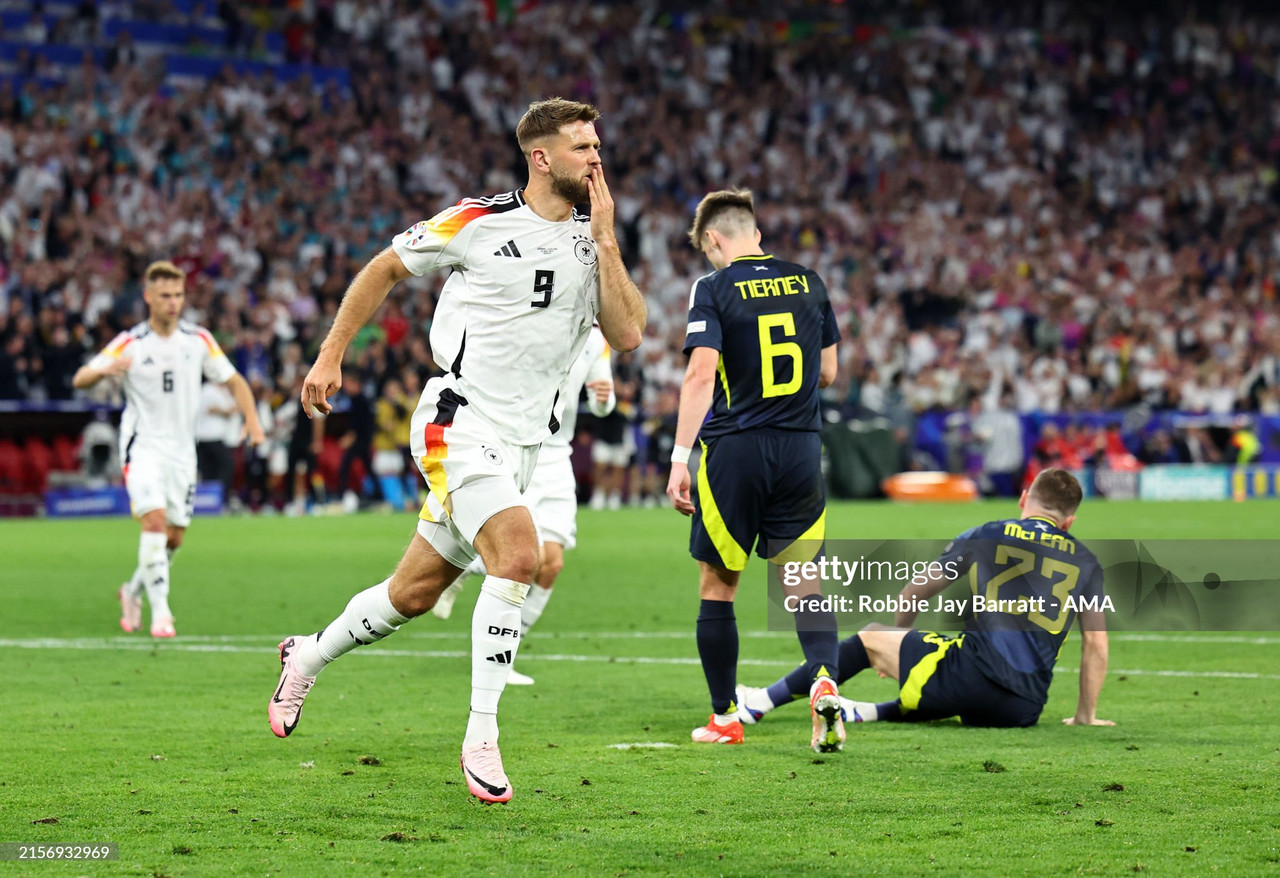

Group A continues in Stuttgart as hosts Germany take on Hungary on Wednesday evening.
The Germans arrive at this fixture following a scintillating start to the tournament on Friday night in which they defeated Scotland 5-1 at Munich’s Allianz Arena.
The Hungarians on the other hand failed to live up to pre-tournament expectations, losing 3-1 to an impressive Switzerland side despite having a number of chances.
Both teams still have a point to prove, with this fixture being the perfect chance for them to show just what they’re made of against a stronger opposition than those they played in matchday one.
-
Don’t get complacent
Die Mannschaft could not have hoped for a better start to their tournament with their convincing victory over dark horses Scotland, but if their recent tournament record is anything to go by, they have no room to believe it is going to be plain sailing from here.
Despite still managing to win matches later in the group stages at both the 2018 and 2022 FIFA World Cups, this didn’t stop them from suffering early exits, with these instances being a lesson for any team that a win does not guarantee anything in group stage football.
A fantastic performance in the first game also carries the same weight, a lesson Brazil learned in last year’s FIFA Women’s World Cup, failing to get out of the group despite an encouraging display against Panama in their opener.
Julian Nagelsmann’s team is full of star power, with the likes of Jamal Musiala and Kai Havertz proving so far to be influential, but it only remains to be seen whether or not this momentum will continue, or if Germany will once again fail to live up to expectations.
-
Take the chances you get
Magyarok failed to impress in their game against Switzerland, though they did manage a significantly better second-half performance that managed to result in a lifeline goal from Barnabas Varga following a fine assist from Liverpool star Dominik Szoboszlai.
However, despite rallying and looking likely to gain at least a point, a failure to make the most of these opportunities and a lapse in concentration at the end allowed Switzerland’s Breel Embolo to secure the win for his country.
Manager Marco Rossi has plenty of star power at his disposal that has a variety of strengths, from the passing and goalscoring of Szoboszlai, to the strength and power of forward Martin Adam, much of which could prove to be a problem for Germany’s young side.
It isn’t quite panic stations yet for Hungary, but if their conversion rate against the Swiss in which they only managed just two shots on target is anything to go by, there will be a real fear amongst supporters that if the problems shown in their first game persist against an even stronger opponent, an early flight back to Budapest may be on the cards.
-
Youth and experience
Germany and Hungary both possess squads that have a wide range in their age groups.
Die Mannschaft have always been known for this approach to their tournament lineups, with famous examples including Lukas Podolski at Euro 2004 and Mario Gomez at Euro 2008, both of which would go on to enjoy successful careers following these tournament debuts alongside much more experienced players such as Jens Lehmann and Miroslav Klose.
This theme continues in 2024 in the form of Musiala, playing at his second European Championship at the age of 21 and already impressing in the opening game whilst playing alongside German legends such as Manuel Neuer and Toni Kroos.
The Hungarians have also opted for this approach, with many of their squad having not appeared at Euro 2020.
These include Hertha Berlin defender Marton Dardai (who actually represented Germany at youth level), AFC Bournemouth midfielder Milos Kerkez and Barnsley midfielder Callum Styles, all of which are in their early or mid-20s and are representing Magyarok at a major tournament for the first time.
Amongst these newer additions are more experienced faces such as midfielder Adam Nagy and goalkeeper Peter Gulasci, both of whom were a key part of the short but impressive showing last time out.
-
Host's advantage?
The old myth of 'host’s advantage' is something that the Germans will hope comes in their favour as the tournament progresses, with history being somewhat on their side, especially since the turn of the millennium.
Though the likes of Belgium at Euro 2000 (co-hosts the Netherlands made it to the semi-finals) and Austria and Switzerland at Euro 2008 failed to make a big impact, tournaments being hosted by just one nation have proved much more fruitful for those involved, with Portugal making the final at Euro 2004, before France would replicate that achievement at Euro 2016.
However, both of those hosts would actually lose those finals, a streak that Germany will hope to break.
There is still a long way to go on the road to the final of course, but after their impressive opening showing, Die Mannschaft will be full of confidence that they can use this supposed advantage to push them to the big game, and hopefully for their sakes, actually win it on home soil.
