


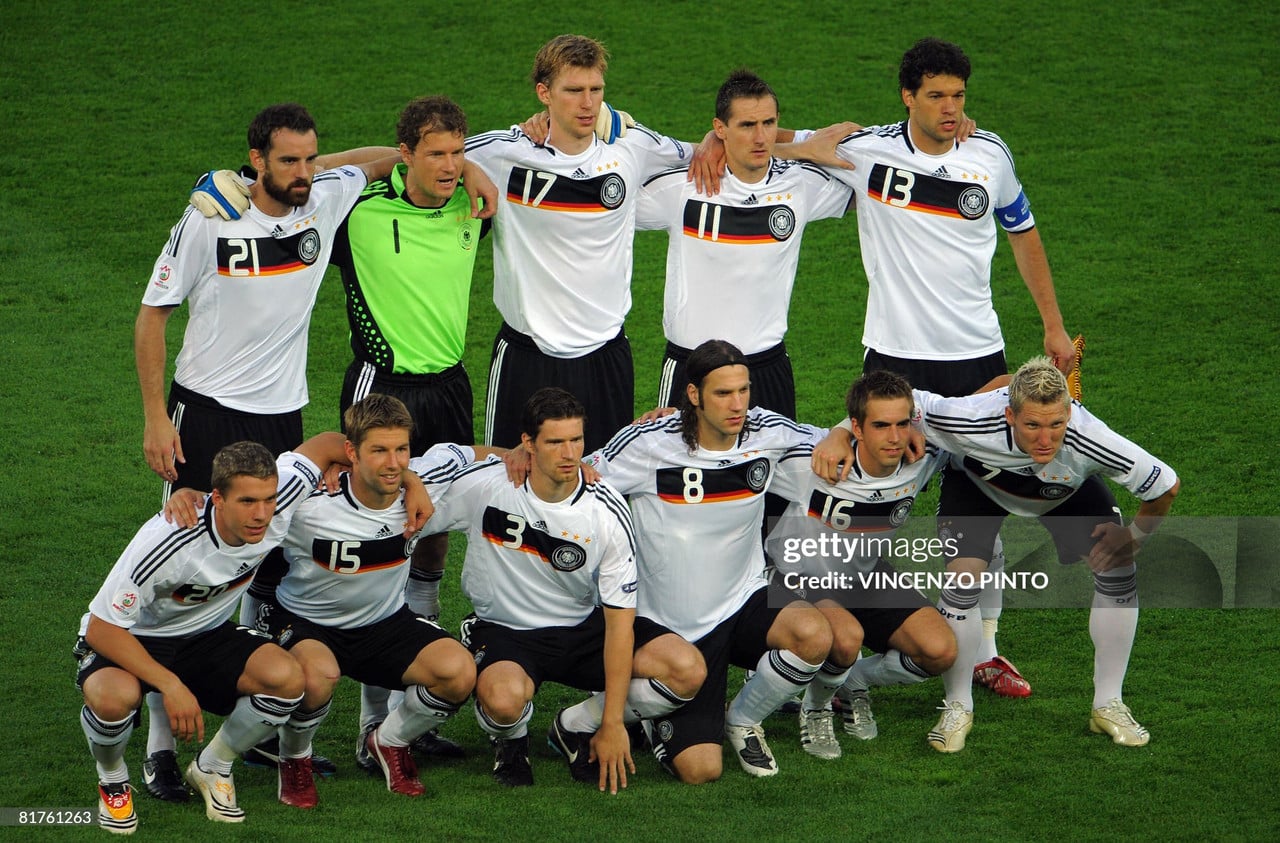

Germany are one of the Euro’s most successful sides, having lifted the trophy on three occasions, whilst finishing runners-up on three others.
With Die Mannschaft set to host the latest edition of UEFA’s premier football competition, here is a look back at a tournament in which they could not quite win the grand prize, but managed to impress and create exciting future prospects, Euro 2008.
-
The Group:
Germany arrived in Austria and Switzerland looking to regain their status as an excellent performer in the competition, having suffered disappointing group stage exits at both Euro 2000 and Euro 2004, though positive campaigns at the 2002 and 2006 FIFA World Cups were sandwiched in between these poor showings.
Their showing at Euro 2000 was seen as particularly disappointing as they arrived at that tournament as defending champions following their Euro 1996 success.
The side was a mix of experience and youth, with the ever-reliable Miroslav Klose and 38-year-old goalkeeper Jens Lehmann returning to the major tournament scene, whilst the likes of Lukas Podolski and Mario Gomez provided a much-needed burst of energy going up the pitch.
Die Mannschafft were placed into an interesting group alongside the always fancied Croatia, who had broken the hearts of Germany’s fierce rivals England in the final round of qualifying matches, alongside Poland and co-hosts Austria.
-
The Manager:
The Germans were led at a major tournament for the first time by Joachim Löw, who had been the assistant manager for their previous campaign at the 2006 FIFA World Cup.
Prior to his arrival in the national team set up following their early exit from Euro 2004, Löw was already an established figure in management, having won the 1997 Deutsche Pokal with VFB Stuttgart, before moving to Austria and finding domestic success with clubs such as FC Tirol Innsbruck and Austria Vienna, providing a good omen for Löw and Die Mannschaft as they got their Euro 2008 campaign underway in the country.
-
The Tournament:
Die Mannschaft began their campaign in Klagenfurt with an evenly contested affair against tournament dark horses Poland, prevailing by a 2-0 scoreline thanks to a brace from Podolski to get their tournament off to a perfect start.
However, a bump in the road would follow on matchday two after goals from Darijo Srna and Ivica Olic secured a 2-1 victory for Croatia, with Podolski’s lifeline goal being made all but meaningless after a late red card for star midfielder Bastian Schweinsteiger ended any hopes of a late German comeback.
This left Die Mannschaft heading into a must-win game against Austria in Vienna, a victory that experienced midfielder Michael Ballack made sure of, scoring a 49th-minute goal to break the co-hosts’ hearts and send his team into the last eight, where they would meet Portugal.
A Seleção were one of the tournament’s fancied sides, having finished as losing finalists at Euro 2004 before a semi-final exit at the 2006 FIFA World Cup, creating all the ingredients for an exciting quarter-final tie.
The game did not disappoint as Germany managed to secure a 3-2 victory in Basel thanks to some quickfire first-half goals from Schweinsteiger and Klose, before a second-half effort from Ballack proved to be enough to squeeze out the win in the tie and send the Portuguese packing back to Lisbon.
This set up one of the Euros' great semi-final matches and potentially this tournament’s best game as Die Mannschaft faced Turkiye for a place in the final.
In a game most known by television viewers for having its feed knocked out by a storm, those in the stadium were treated to a back-and-forth affair that was ultimately won by the Germans thanks to a stoppage-time winner from full-back Philip Lahm, securing a 3-2 victory and a showdown in the final against Spain.
Sadly for Die Mannschaft, this game would prove to be one game too many, with a Spanish side consisting of the tournament’s Golden Boot winner David Villa, Cesc Fabregas, Carles Puyol, Iker Casillas and goalscorer Fernando Torres ensuring that the Henri Delaunay Trophy was on its way to Spain thanks to a 1-0 victory over the Germans.
Despite this defeat, the spirit of Die Mannschaft wasn’t dampened, with the foundations laid at this tournament allowing for strong showings at the 2010 FIFA World Cup and Euro 2012, before they would finally win the big one again, triumphing over Argentina by a 1-0 scoreline in the final to win the 2014 FIFA World Cup in Brazil.
-
Star Player: Lukas Podolski
In a side full of talent, perhaps the most apparent star was this Euro's second-highest goalscorer, Lukas Podolski.
Undoubtedly the star of the group stage for the Germans, Podolski scored three times during this phase of the tournament before remaining a crucial part of Löw’s side as they made their way to the final.
Podolski would continue to thrive following this tournament for Die Mannschaft, whilst at club level he completed another season at Bayern Munich before a return to boyhood club 1. FC Köln in the summer of 2009, where he would stay for three years before moving to England and signing for Arsenal, becoming a cult hero at the Emirates.
Podolski remains active in football to this day, currently playing in Poland for Górnik Zabrze at the age of 39.
As hosts, Germany did not have to complete a qualifying campaign for Euro 2024, but instead have competed in a number of friendlies since the 2022 FIFA World Cup, gaining impressive victories over the likes of the USA, France and the Netherlands, but also suffering surprise defeats to Turkiye, Austria and Colombia.
Julian Nagelsmann will no doubt be determined to right the wrongs of previous recent tournaments for Die Mannschaft, with his side fancied to do so thanks to their mix of youth and experience, the same strengths that took them so far in 2008, though this time they will hope that this can deliver them the ultimate prize, the Henri Delaunay Trophy on German soil.
