


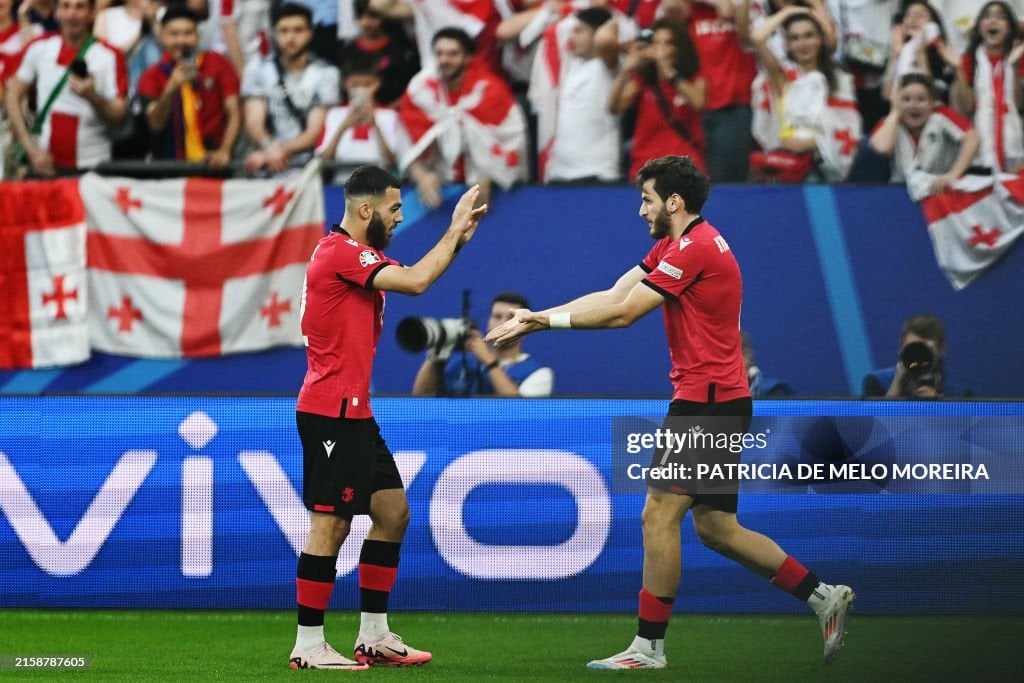

Khvicha Kvaratskhelia’s early effort and tournament top-scorer Georges Mikautadze’s second-half penalty saw Georgia – playing in their first senior men’s major tournament – beat Portugal 2-0 on Wednesday night and secure a Round of 16 tie against Spain.
What a night this was.
So much of this tournament has felt like a colour-filled celebration of football and its cultural diversity and significance.
Still, come the end of this month in Germany, it seems unlikely that many occasions will match the emotional weight, and the level of footballing achievement, that will be attached to this one.
The streets of Tbilisi – often the scene of protests in recent weeks – will doubtless be buoyant off the back of a display packed to the brim with grit, discipline and explosive class.
Georgia, the lowest-ranked team at the tournament, now have that knockout tie with Spain to look forward to in Cologne this Sunday, courtesy of a masterfully constructed victory over another of the tournament favourites, Portugal, on Wednesday night.
Having lost 3-1 to Turkey in a classic and drawn 1-1 with Czechia in their first two Group F matches, this result saw Willy Sagnol’s side reach four points and qualify for the knockout rounds as one of the group stage’s four best third-placed teams.
Turkey secured second spot with a 2-1 success over Czechia in the other concluding game in this group, which was played simultaneously in Hamburg.
Roberto Martínez’s Portugal – who will face Slovenia in the last-16 on Monday in Frankfurt – had already won the group and so, as expected, fielded a much-changed lineup in Gelsenkirchen.
Only goalkeeper Diogo Costa, captain Cristiano Ronaldo and midfielder João Palhinha kept their places from Saturday’s 3-0 win over Turkey but, such is the strength of A Selecão’s squad, Georgia still had a heavyweight outfit to overcome.
After Kvaratskhelia and Mikautadze ruthlessly capitalised on an Antonio Silva error to open the scoring, a relentlessly determined defensive display – sprinkled with bursts of attacking verve – bookended Mikautadze making it 2-0 from 12 yards early in the second half.
With the group stage now wrapped up, the last 16, which begins on Saturday, has fully taken shape.
The ties are as follows: Spain v Georgia, Germany v Denmark, Portugal v Slovenia, France v Belgium, England v Slovakia, Switzerland v Italy, Romania v Netherlands and Austria v Turkey.
-
Historic night for brilliantly balanced Georgia
This was, simply put, the greatest night in Georgian football history.
The first major tournament they entered qualifying for was Euro 1996 and, nearly three decades later, they secured their first place at such a competition via a penalty-shootout victory over Greece in March’s play-offs.
That they are now on their way to the knockouts – and have the look of genuinely awkward opponents for Spain, who have arguably been the team of the tournament to date – is a glowing reflection on what they have offered at Euro 2024.
What a performance this was.
In what was just their second meeting with Portugal, they may have only had 28% possession, but never did they appear passive, nor did their own sense of genuine threat fade.
Having taken a second-minute lead, their 5-3-2 shape shuffled, stepped out to apply pressure to the ball, plugged gaps and never shirked those extra yards that are so often the difference-makers in such scenarios.
23-year-old goalkeeper Giorgi Mamardashvili, linked with the likes of Newcastle United and Chelsea in recent times, is coming off a superb season with Valencia and displayed his excellence again here.
There were brilliant saves from Diogo Dalot and Nélson Semedo, amongst others, while he emitted a calm authority with the remainder of his work.
The first of two superb second-half stops from Dalot came seconds after Georgia had seemingly missed out on a penalty as Luka Lochoshvili was challenged in the box by Antonio Silva in the 54th minute. A subsequent check of the pitchside monitor, though, saw Swiss referee Sandro Schärer award a spot-kick that Mikautadze coolly converted to double his nation’s advantage.
The back five of Otar Kakabadze, Giorgi Gvelesiani, 36-year-old captain Guram Kashia, Lochoshvili and Lasha Dvali, and the midfield triumvirate of Giorgi Chakvetadze, Otar Kiteishvili and Giorgi Kochorashvili were a picture of sheer, cold focus, yet constant heart.
Quite the combination.
Sagnol’s lines of defence functioned superbly – spreading the workload, backing each other up and riding their luck when necessary.
Then, when the moments came, they sprung with precision and purpose.
Alongside the goals, Kvaratskhelia and Watford's Chakvetadze both came close at the end of viciously speedy counter-attacks.
However, no moment demonstrated the quality and efficiency of their attacking threat quite like their opener.
-
Kvaratskhelia and Mikautadze masterfully lead the way
This may have been an evening of virtually endless historical significance, yet – perhaps more pertinently – this also felt a notable marker of Georgia’s exciting present and future.
Born within four months of each other, these two 23-year-olds offered the effervescence of youth and the patient nous of seasoned performers.
What edge they offer this team and what leading lights they look set to continue to be over the coming years.
The opening goal offered a neat demonstration of their excellence.
The loose ball by Silva, an accomplished young centre-back, was a bad one, but it was a gift Georgia’s front two maximised. Mikautadze strode onto it, advanced and then timed and weighted his pass into the inside-left channel and the path of Kvaratskhelia to perfection.
The Napoli winger did not need to break his stride. One touch with his right foot took him into the box and face-to-face with Costa, a second with his left sent a superb finish across the goalkeeper and into the bottom-right corner.
Anticipation gleefully made way for delirium among the thousands of Georgians inside the Arena AufSchalke. The volume offered an apt measure of this moment's significance.
There have been persistent rumblings over Kvaratskhelia’s future at club level in recent days. Paris Saint-Germain appear keen to prize him away from Naples, but Gli Azzurri – whose supporters have affectionately nicknamed him ‘Kvaradona’ since his arrival in the summer of 2022 – understandably appear unwilling to budge in their desire to keep a player who’s been one of Europe’s breakout stars in recent seasons.
This, though, as he joyously wheeled away in celebration, was a moment of simplistic purity – the kind that international football can offer at its best.
Whoever he’s starring for at club level come the autumn, he will still be Georgia’s star.
You only need listen to the change in pitch of the crowd noise any time he gets on the ball. He fuels excitement and he magnetises opposition markers.
When he got the chance, he lit up this night. He did not see loads of the ball – much of his work was closing passing lanes and back-tackling – but when he did get it, he weaved and drove forward.
He offered purpose and pressure relief. That he had just 29 touches and managed to win four free-kicks over the course of the match says a lot about the efficiency of his output.
Blind alleys were not in his playbook here.
And then there is Mikautadze. Given the stature of the player alongside him, it is all too easy for his work to go under the radar.
It is pleasingly difficult to miss someone who is top of the tournament’s goalscoring charts, however.
Upon the conclusion of the group stage, his total of three goals is unmatched.
A clever near-post finish against Turkey has been followed by two smooth and successful spot-kicks – first to earn the lead in the draw with Czechia, then to reinforce the advantage here.
Was it a soft penalty? Probably.
Lochoshvili beat Silva to the ball, though, and was caught by the 20-year-old defender. The contact was not the heaviest but the speed the Georgia wing-back was travelling made emphasising it that bit easier.
Having struck 13 goals in 20 Ligue 1 appearances for Metz since joining on loan from Ajax in January – a move set to become permanent this summer – Mikautadze appears to have seamlessly transferred his club form into the Euros.
He and Kvaratskhelia complemented each other sublimely here. They and their teammates will likely need to be even better against Spain, but they will give their nation at least a fighting chance if they are.
-
Much-changed Portugal stake limited claims
This was billed publicly – and likely privately, by Martínez – as an opportunity for those coming into the Portugal line-up.
There are always challenges when a side comprised of relatively unfamiliar components are tasked with putting together a performance of balance and coherence.
The scale of that task was also, of course, somewhat exacerbated by the well-drilled nature of the opponent they were facing – an opponent who knew what they needed and the significance of reaching that goal.
However, speaking bluntly, this was still a Portugal side that would have been expected to win.
They switched to a 3-4-3 system and retained possession, width and different angles of attack to a decent degree, but rarely did they look genuinely incisive.
Martínez will likely still feel this was a night he could take plenty from. That Portugal got themselves into a position where, come the final group game, performance and fitness considerations were arguably of more long-term value than the result, reflects positively on their earlier work.
João Félix – nominally on the left of the front three but with licence to drift – perhaps offered the most eye-catching showing of those who came in. The 24-year-old has endured a tricky few years, highlighted by the mixed 2023/24 season he has just spent on loan at Barcelona from Atlético Madrid, but his talent remains evident.
The Benfica academy graduate intelligently drifted into pockets of space, saw one shot well saved by Mamardashvili and another whistle just wide, and played four key passes, creating one big chance.
Having been an unused substitute in both the late 2-1 win over Czechia and the 3-0 defeat of Turkey, he seems unlikely to start against Slovenia in the Round of 16, but he may have elevated himself in Martínez’s thinking when it comes to possible options from the bench.
He does not necessarily feel a natural fit within the 4-3-3 system that was used against Turkey, but he is an intriguing profile of player who tends to occupy spaces and make moves that ask opponents different questions.
Francisco Conceição, scorer of the winner in the opening group game, was another who was prominent, while Dalot was familiarly reliable in the bulk of his work from right wing-back.
Meanwhile, Gonçalo Inácio, from the left of the back-three, completed 108 of 115 passes – more than anyone else on the pitch – highlighting the distribution qualities that have contributed to the Sporting CP defender being linked with several clubs in recent times.
Wolverhampton Wanderers forward Pedro Neto looked a threat from a relatively unfamiliar left wing-back position, although the 24-year-old was yellow-carded for simulation in the first half – the third such booking Portugal have received at the tournament, with Rafael Leão serving a one-match suspension in this game, having been penalised for diving in each of his country’s first two Group F outings.
-
Low-block problems for A Selecão?
This is something that feels additionally tricky to measure when considering the number of changes Martínez made to the side for this one.
Even so, when we consider that Portugal failed to score here and struggled to overcome Czechia’s stubborn and deep set-up in their opening match, it doesn’t feel unreasonable to question their capacity to reliably break down a low block.
Discounting the Turkey match, as none of those three goals came when facing a genuine and settled deep-lying shape, the statistics suggest it may be more a case of wastefulness than bluntness. Four big chances were created both in that Czechia game and against Georgia.
How big chances are measured, and therefore perceived, can be an imperfect process but that does suggest Martínez’s team are creating.
And they do appear creative as an outfit – we need only look at their personnel – but the feeling both in Gelsenkirchen and for considerable spells of their opening game was that neither did a goal seem particularly imminent, nor did their opponents feel especially stretched or uncomfortable.
The frustrated demeanour of Ronaldo, who stung the palms of Mamardashvili with a sweetly struck 17th-minute free-kick and earned a booking of his own for dissent, also hardly painted a picture of assurance.
In fairness, it came across as exasperation at an inability to capitalise on the openings that were materialising, as much as anything.
The range of physical and technical attributes that the squad possesses suggests they ought to find a way through, one way or another.
It feels somewhat like picking hairs, but Slovenia may well be buoyed by some of what they’ve seen in Portugal’s group-stage showings, particularly given the clean sheet they kept against an admittedly hesitant England on Tuesday night.
A Selecão will likely be among those intending to hit fresh gears from here, however, as Euro 2024 edges towards the business end.
