


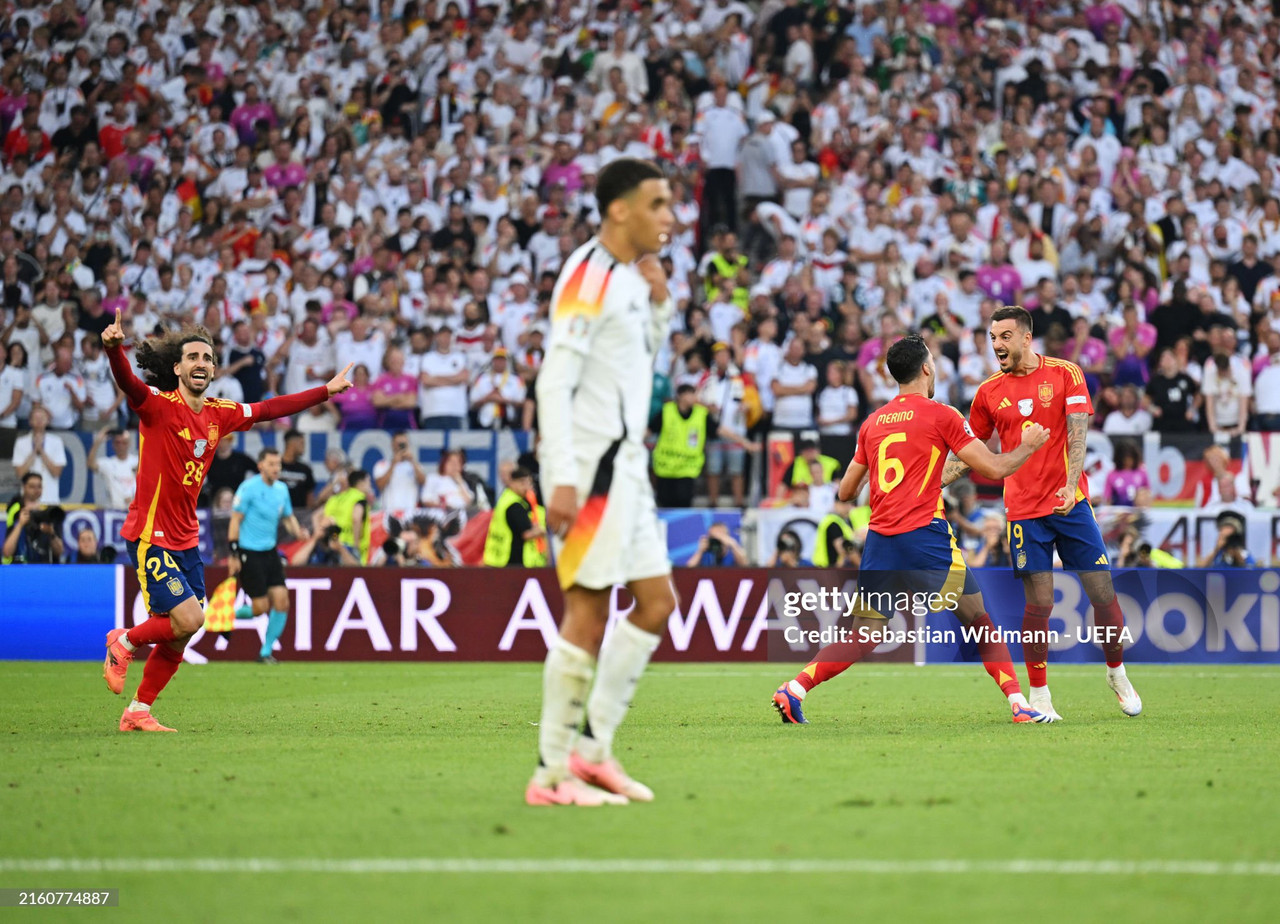

Germany's 36-year wait to beat Spain in a major tournament continues, as the hosts lost 2-1 at the Stuttgart Arena.
It is an unwanted record for Julian Nagelsman's team who are the first Euros host nation to be knocked out of the tournament at the quarter-final stage.
In a game which was cagey for the first 45, it only took six second half minutes for Spain to break the deadlock through Dani Olmo. He met Lamine Yamal's perfectly weighted pass to the edge of the box and slotted the ball into the bottom left corner of Manuel Neuer's goal.
It was from this moment onwards that the game sprung into life and Germany had to respond, which they did but it wasn't until the 89th minute where Florian Wirtz volleyed home an equaliser.
As the game was heading to penalties Mikel Merino rose highest in the German box to head home the winner in the 119th minute to send Spain through to the quarter-finals. Before tonight Spain had never beaten a host team in a knockout match in their previous nine attempts.
-
Dani Olmo has earned his place
Dani Olmo has been restricted to only one start during the tournament, which came when Spain had already progressed out of the group stage. He once again started from the bench tonight, but after only eight minutes he was called into action due to Pedri picking up an injury and being unable to continue.
Spain's progression to the semi finals is hugely down to Olmo after he scored the first goal of the game in the 51st minute and played the delicate cross into the box for Merino's winning goal in extra time.
While contributing to both goals, Olmo also played a team-high three key passes and had more shots and shots on goal than any other Spanish player. He may have been coming on at some point tonight but to come into the game as early as he did benefited Spain more than they would have expected.
The RB Leipzig attacker is a very different player to the man he replaced early in the game, meaning Spain has to change slightly to how they may have normally set up. Olmo is a very attacking midfielder where as Pedri dictates play a lot more, this of course ended up benefiting Luis de la Fuente and now may give him a decision to make for the semis. To start Olmo or not to?
-
Kai Havertz wasn't the answer
Kai Havertz has struggled all tournament to make a real impact for Germany at Euro 2024; the quarter-final with Spain followed that pattern as he was isolated up front and had very little to offer in the game. This was the same for his team, they didn't have much going forward, that was until Nagelsmann made a change in the 57th minute.
Once Niclas Fullkrug came on the pitch, the Germans were much more of a threat. The Spanish defence were untested until the Borussia Dortmund man was introduced, he provided a much-needed threat to what Kai Havertz had failed to do during the first half.
He was strong and aggressive with the Spanish centre-backs and gave them something different to deal with, holding the ball up for his team and laying it off to Jamal Musiala or Florian Wirtz to get a shot at goal.
Germany looked like a much better side with Fullkrug on the pitch, which begs the question if he started would things have turned out differently for Germany? There had been questions all tournament regarding the inclusion of Havertz over Fullkrug and many German supporters wanted their manager to give the former Werder Bremen man a chance from the start.
There had been warning signs since the tournament started, but Nagelsmann's persistence with Havertz may have been what cost his side.
-
Spain have strength in depth
Luis de la Fuente had changed his entire front line by the 80th minute, and while the trio which started have been key to their success this summer, the three replacements did a good job of keeping the German back line on their toes. Mikel Oyarzabal was a constant threat cutting in onto his right foot, while Joselu offered his team an outlet up front towards the end of the game and gave the German defence something different to deal with.
It was in fact two of the six Spanish subs who scored both goals for their side, just proving how important changes are in tournament football especially when it goes into extra time. This will only benefit Spain as they go deeper into the latter stages, where the games get tougher, and potentially longer, the whole squad will need to be utilised correctly.
There will be some forced changes for Spain which will require them to use players who haven't had as many minutes this summer. Real Madrid's Dani Carvajal received a red card at the end of the game giving him a one-game ban. Meanwhile, both Robin Le Normand and Alvaro Morata received yellow cards meaning they will miss the semi-final.
-
Luis de la Fuente's men have what it takes to go all the way
While Germany stepped it up after the opening goal, Spain's defence was strong and held their own. Germany were limited to very few efforts on goal and until the equaliser the only effort that worried the Spanish defence was Fullkurg's chance that came off the post.
Going forward they have the pace and technical ability to hurt teams, which we have seen all tournament, tonight however showed a different part of their game which was their experience and control they possess. Aymeric Laporte, Nacho and Rodri all showed their class under pressure in the second half, blocking nearly everything that came their way and dealing with a lot of German pressure.
Even after the equaliser, they held strong for the last few minutes and in extra time they seemed the team who were going to win it. Many sides would've been deflated after conceding a goal so late on like they had but instead, they pushed through and ended up winning the game.
Many have said Spain are the team to beat; they might just be right after tonight's performance.
