

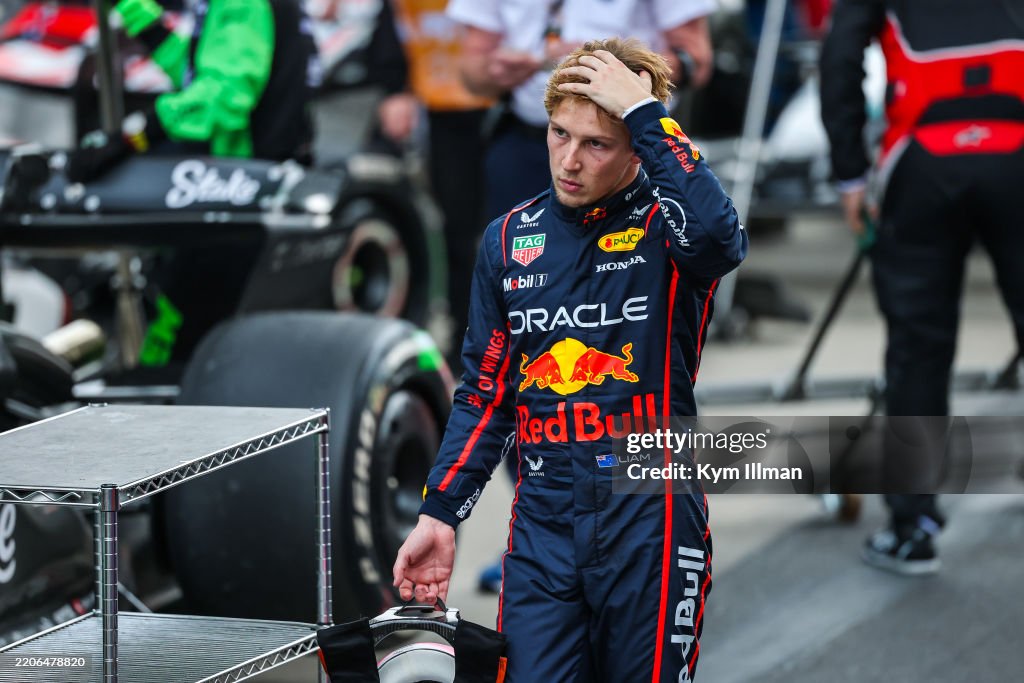

Liam Lawson's middle finger madness in last year's Mexican Grand Prix may be seen as a moment of silliness but yet there is a sense of derision about the situation. The Kiwi's decision to gesture towards Sergio Perez, the driver he would replace at Red Bull at the end of the season, highlights the sheer competitive nature of the sport.
Whilst in the heat of the moment, the gesture encapsulated the brutal reality of Red Bull's second seat - a position fraught with pressure, instability and shattered careers. Abrupt demotions and underperformance are becoming synonymous within the Austrian team.
Lawson's dismal start to 2025
It is somewhat ironic that Lawson now finds himself in the very position that Perez occupied for much of last season. The 23 year old had lots of expectation on his shoulders coming into the new campaign given his inexperience in the sport.
Lawson replaced Daniel Ricciardo with six races remaining last season in Red Bull's sister team, VCARB. He collected four points, with a notable P9 finish in his first race as a full time F1 driver.
His brief time in the VCARB car was enough to convince Christian Horner to promote him to Red Bull at the expense of Perez. However, Horner's decision to bring Lawson into the team appears to be swiftly unravelling.
You can point to Lawson's greenness as a driver given he only had a handful of races under his belt prior to moving up to Red Bull.
Two races have been held this season and Lawson already finds himself under pressure, having been unable to progress from Q1 in all three qualifying sessions so far (including sprint qualifying).
Lawson retired from the Australian Grand Prix and finished outside of the points in the sprint and race in China.
Remarkably, his troubling form has led to reports that he could be dropped for the next race in under two weeks time. Sky Sports are reporting that "Red Bull are seriously considering swapping Lawson for Racing Bull's Yuki Tsunoda for the Japanese Grand Prix".
Red Bull's ruthless philosophy
Red Bull operates differently from other top teams.
Where Ferrari, Mercedes and McLaren nurture their drivers with long-term stability, Red Bull employs a ruthless sink-or-swim approach. Helmut Marko and Horner have consistently demonstrated little patience for underperformance, quickly discarding drivers who fail to meet their exacting standards.
This philosophy, while effective in fostering young talent, has also contributed to a high turnover rate in the second seat. The lack of stability means that even promising drivers struggle to find their footing before being replaced, often leaving them to grapple with the psychological toll of uncertainty and pressure.
While Red Bull's aggressive strategy may seem like a straightforward method to ensure peak performance, it raises critical questions about the sustainability of such an approach.
The high turnover rate not only disrupts team cohesion but also hampers the development of a consistent racing identity, a quality that teams like Ferrari and Mercedes have cultivated over decades. These established teams invest in their drivers, providing a nurturing environment that allows them to learn from their mistakes and gradually refine their skills.
In contrast, Red Bull's cutthroat mentality can lead to a cycle where drivers are never given the time to truly settle in, potentially resulting in missed opportunities for both the team and the individuals involved.
Moreover, this model can deter talented drivers who may prefer the security and mentorship offered by its rivals. The fear of being discarded at the first sign of struggle could push potential stars to seek opportunities elsewhere, thereby limiting Red Bull's pool of talent.
While it is undeniable that the team has successfully unearthed gems like Max Verstappen, the question remains: at what cost?
The relentless pursuit of immediate success may ultimately undermine their long-term prospects, as a revolving door of drivers can lead to a lack of continuity in strategies and a diminished sense of team spirit.
Furthermore, the pressure to perform can stifle creativity and innovation among drivers who might otherwise bring fresh ideas to the table. Instead of focusing on collaboration and teamwork, the environment becomes one where individual survival takes precedence.
This competitive atmosphere could potentially breed resentment among drivers, particularly if they feel they are being pitted against one another rather than encouraged to grow collectively.
As a result, while Red Bull's approach may yield impressive short-term results, it risks eroding the very foundation of teamwork and loyalty that is essential for sustained success in Formula 1.
The challenge for Red Bull going forward will be to find a way to maintain its competitive edge without sacrificing the stability that could ultimately lead to greater achievements on the track.
Second seat hoodoo
Lawson is fast becoming the latest victim of Red Bull's second seat as he faces a huge setback in his Formula 1 career.
Drivers such as Pierre Gasly, Alex Albon and Perez have all tried and failed to tame the Red Bull car as they battle under the huge shadow of world champion Max Verstappen.
Gasly and Albon faced similar issues to Lawson as they were unable to secure regular points finishes and often found themselves in the barriers.
They were promoted perhaps too early in their careers and have since secured moves away from the team and out of the Red Bull driver programme to some success.
Gasly was demoted back to Red Bull's sister team and secured podium finishes in a less competitive car and memorably won the 2020 Italian Grand Prix. A move to Alpine then followed.
Albon spent a year in the DTM touring car championship before securing a return to the sport with Williams where he has shown his true form.
Perez's move to Red Bull was supposed to a statement of intent but it did not go to plan. On paper, his partnership with Verstappen was very strong with both being very experienced drivers.
However, Perez could not replicate his solid performances that he had put in for many years for Racing Point and was cynically dropped at the end of the 2024 season despite having signed a new contract just six months prior.
The inability for drivers to perform in Red Bull's second seat has cost the team valuable championship points, shown by McLaren's first Constructors Championship victory since 1998.
Is Verstappen Red Bull's main issue?
Verstappen is undoubtedly Red Bull's greatest ever driver and one of the best drivers Formula 1 has ever seen.
But, he may be causing more problems than solutions in the quest for a reliable second driver for the team.
Since taking over as Red Bull’s lead driver in 2016, Max Verstappen has built a dynasty within the team. His relentless speed, aggressive racing style, and unwavering confidence have made him nearly untouchable.
Red Bull’s car development, spearheaded by Adrian Newey up until this year, is tailored to Verstappen’s unique approach, making it exceptionally difficult for any teammate to match his pace.
Verstappen’s dominance is not just statistical - it is psychological. He exerts immense pressure on his teammates by consistently outperforming them in every aspect, from race craft to raw speed.
His aggressive overtaking style and ability to extract maximum performance from the car in any condition create an aura of inevitability around his success.
This level of excellence forces Red Bull’s second driver into a near impossible situation: they must keep up with Verstappen while knowing that the car is built around his driving preferences.
Moreover, Verstappen’s working relationship with the team is one of absolute trust. Red Bull’s entire strategy revolves around maximizing his potential, often at the expense of his teammate.
Whether through in-race strategy calls or car development direction, the team has fully committed to building around Verstappen, making it even harder for the second driver to establish themselves as an equal contender.
The consequence? The second driver is left struggling with a car designed around a champion, expected to deliver results while constantly being compared to one of the most dominant drivers in the sport’s history.
Lawson should be given time to develop his skills in the car and to learn where the car best performs.
He should be able to get the chance to tailor his driving style to the car rather than being dropped in favour of Tsunoda.
With McLaren, Mercedes and Ferrari all improving this season, Red Bull could quickly find themselves falling behind and chopping and changing their driver lineup may not be the best solution.
