



When I cast my mind back to Leicester City's historic Premier League winning season I remember the viral betting odds offered for such an outcome before the season began. They had been 5000/1 and whilst Girona’s were only 1000/1 this August the numbers do illustrate the perceived ridiculousness of either event actually occurring. Yet those brave few who took a punt on Leicester at 5000/1 were duly rewarded and anybody who did the same with Girona this season will be growing increasingly excited as we approach the halfway point.
Let me begin by saying that trying to draw lines of similarity from that Leicester team to this Girona one is inherently flawed. Football players, clubs and leagues do not exist in a vacuum and therefore a simple comparison which disregards the innumerable economic, social and culture factors which play upon professional football is largely analogous. That being said, there are interesting things to be learned about both clubs, their leagues and the development of professional football in less than a decade. What is more it is rather fun.
Girona: A brief Background
Girona Football Club hail from the Catalan region of Spain and were founded in 1930. You would be forgiven for not knowing much about them, as they have spent the majority of their history in the Spanish third and fourth tiers.
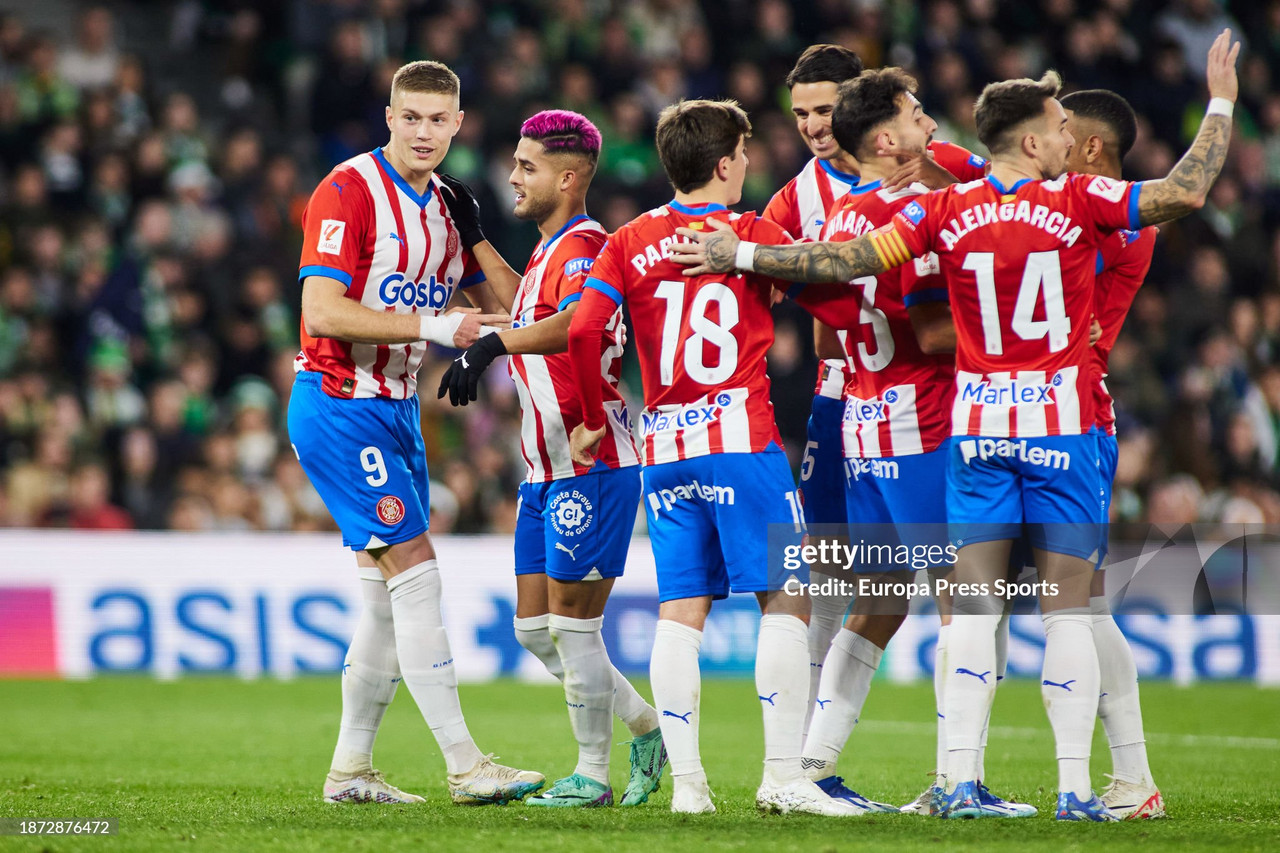
2023/2024 is Girona’s fourth season in the top tier of Spanish football and they currently sit second, only trailing Real Madrid on goal difference. Their start to the campaign has been remarkable and they became only the fifth team to win 10 of their opening 12 matches in LaLiga’s 94-year history. Girona’s impressive start to both top tier football and this campaign was exemplified by their 4-2 win over Barcelona earlier this month.
The Catalonian club are competing with some of Europe’s biggest superpowers whilst themselves on very modest footing. The Estadi Montilivi has seen average crowds of 12,500 in the first 18 games which when compared with the almost 70,000 in the renovated Santiago Bernabeu demonstrates this expansive gap.
This gulf is even more pronounced in financial terms. This summer Girona signed Ukrainian international Artem Dovbyk for a club record fee of €7.5 million. If he had joined Madrid he would be there 80th most expensive signing, sitting behind Robert Prosinecki who joined in 1991. Girona’s annual wage bill comes in at just below €28 million for this season whilst Barcelona will pay out over €200 million across the same period. Girona’s modest resource has framed their sporting philosophy and helps explain their ascendancy at a time when footballing success has never been more financially dependent.
Yet the tale of Girona is not entirely David and Goliath esq. In 2017 the club came under the ownership of the City Football Group as the conglomerates’ fifth acquisition in the professional game. Girona’s success is not solely the result of CFG’s purchase but its ramifications shall be evaluated below.
Comparing this Girona and that Leicester
Whether Girona will go on to La Liga title glory remains to be seen but the possibility for underdog comparison can clearly be drawn to Leicester City in 2015/2016. Both sides play(ed) direct football which encompasses overloads, long balls and clinical finishing. This attacking ferocity is coupled with defensive solidity which, whilst not the strongest in the league, was effective enough to ensure wins did not slip into draws or losses.
Players:
The total wage bill of a club illuminates its financial might but also the type of players it tends to buy and develop. Girona operate with a low wage bill which has meant they largely cannot bring in already established talent who demand high wages. Instead, under the chairmanship of Pere Guardiola (Pep’s brother) and sporting director Quique Carcel, Girona invest in either undervalued, undiscovered or discarded talent.
Girona’s defence exemplifies this. In goal is Paulo Gazzaniga who joined on a free transfer from Fulham having played as Premier League backup for half a decade. The Argentine has a post shot expected goals of+3. This number is xG minus goals actually conceded and demonstrates the keepers shot stopping credentials which went largely unproven in England.
He has been joined by the experienced Daley Blind who has been found a second wind in Catalan. The Dutchman has over one hundred caps for his nation as well as trophies in Germany, England and Europe. Partnering him is 34-year-old David Lopez who was also signed on a free.
These experienced, discarded and most importantly cheap players have been central to the defensive rigidity which, whilst not as watertight as La Liga’s elite, has allowed Girona to consistently win games. These older squad members who fit into my ‘discarded’ category are joined by some youth.
Manager Michel’s renown as a developer of young talents has allowed Girona to sign promising young defenders Eric Garcia and Miguel Gutierrez on loan from Barcelona and Real Madrid respectively. The pair of 22-year-olds have kickstarted their careers with Girona whilst giving the Catalans pace and attacking quality to combine with their experienced campaigners.
Further up the pitch the story of shrewd frugality continues. Centrally, Girona have masterminded the rebirth of Aleix Garcia. The once Manchester City prospect had, by 2020, found himself struggling for minutes in Romania. Girona got hold of him for free in the summer of 2021 and he has blossomed into the all-action midfielder he was once touted as being.
Girona’s attacking line is one of the most exciting in La Liga and explains why the Catalonians have registered more goals than anybody else. Record signing Dovbyk has already proven an astute move with 11 goals, making him third top scorer in La Liga so far. He is joined by compatriot Viktor Tsygankov who signed for €5 million in January.
The attacking trio is completed by 19-year-old Brazilian Savio who has been one of La Liga’s breakout stars with season. He has four goals and five assists for Girona so far in what is his first full season playing in Europe uninhibited by injury.
Girona’s core squad is comprised of undervalued, undiscovered or discarded talent. The financial restrictions on the relatively small club make such astute scouting and business necessary yet the team’s success halfway through 2023/2024 is astounding nonetheless.
The Leicester squad of 2015/2016 is characterised by largely the same three adjectives. Clearly once they won the Premier League those adjectives changed quite drastically, as the almost £40 million move to Chelsea for Danny Drinkwater illuminated. Yet at the start of the 2015/2016 season Leicester had the third lowest wage bill in the Premier League and a recruitment strategy to match.
The foxes lined up with a centreback partnership of Robert Huth and Wes Morgan, both 31 and signed for a combined total of £7 million. Between the sticks was Kasper Schmeichel who had joined from Leeds for £1.68 million. The back four was rounded off by Christian Fuchs and Danny Simpson who were both pushing thirty and not expensive acquisitions.
The philosophy in defensive recruitment is largely comparable between Girona and Leicester. Modest wage budgets mean creative and frugal recruitment which in turn produce a disproportionally solid back line. Yet the three players everybody pictures when they think of 2015/2016 Leicester is Jamie Vardy, Riyadh Mahrez and N’golo Kante.
The three were signed for a combined total of less than £10 million and considering their abundant quality it has to be some of the best business in recent Premier League history. All were undervalued and, in the case of Mahrez and Vardy, undiscovered.
The Premier League Gap:
This all being said, there are interesting financial discrepancies between the two sides which highlight the financial gap between the Premier League and everybody else. A 2023 mid-table La Liga budget is still behind that of a 2015 relegation contender in the Premier League by some distance. I stated that Leicester had the third lowest wage bill of any Premier League club in that famous season, yet it was still more than £10 million more than Girona today.
Furthermore, in that winning season Leicester made four signings equivalent or greater than Girona’s all-time record. These numbers illustrates how far ahead the Premier League is financially of even the biggest leagues in Europe.
Ownership:
The 2017 takeover of Girona by the City Football Group cannot be separated from the club’s recent success. Yet it should not overshadow it. In Girona’s first two years in La Liga they relied heavily on bringing in young talent from Manchester City to bolster their squad. Players such as Aston Villa star Douglas Luiz arrived on loan to assist the modest club. However, after relegation a more sustainable approach was adopted under the Chairmanship of Pere Guardiola.
Whilst loans still undoubtedly play an important part in Girona’s squad building they have smartly used CFG’s reputation, contacts and networks to sign players permanently. Sporting director Carcel has openly stated that the signing of key Ukrainian internationals Dovbyk and Tsygankov was made possible in part because of CFG’s renown. The acquisition of Savio was made possible because Troyes, his former club, are also part of the City Football Group.
As can be seen, CFG’s ownership of Girona has undoubtedly helped the club attract talent despite its modest financial footing. It has also allowed the team to train every pre-season in Manchester whilst exchanging ideas and experience with their sky-blue counterparts. Yet being a part of the City Football Group does not inherently breed success, as floundering Palermo can attest, and credit should also be given to the board and manager for using the partnership to their advantage.
Leicester’s sadly departed owner Vichai Srivaddhanaprabha, whilst a billionaire, was not the head of an international footballing group. Yet his team, under his tenure, did not spend frivolously either.
Will Girona do it?
Whilst this is impossible for me, or anyone, to say with any authority there is one point I feel is worth making. The season Leicester won the league they did so with 81 points, the lowest winning total in Premier League history. This is not to discredit the unbelievable achievement it was but it is a fact which should remain front of mind.
For Girona to win La Liga the elite of the division will need to be continually below par. Barcelona are obligingly following this trajectory and so Girona fans will hope for a similar Madrid drop off. Whilst Madrid seem to be building momentum their overreliance on Jude Bellingham, lack of a world class striker and numerous long-term injuries may cause the drop in form necessary for Girona to retake pole.
Girona on the other hand cannot drop off. They must continue to outperform their Xg and XgA and begin picking up results against the bigger sides consistently. I feel there is space for a Catalonian miracle if these two things can occur.
Longer term the picture is difficult to make out for Girona. They have a very high turnover of players with many being old or on loan. Interestingly, before 2023 only three of the current starting eleven had permanent contracts with the club. To get such a rate of turnover right is incredibly difficult and so maintaining this strong recruiting form is vital to avoid a drop-off in form.
Conclusions:
There are certainly parallels to be drawn between the two sides. Limited budget requiring excellent recruitment and the ability to create stars both young and old. As proven by 37-year-old striker Cristhian Stuani who still plays an important goalscoring role for Girona.
Yet the two sides differences exemplify how much football has changed in less than a decade. Never again, I think, we will see English elite clubs so off the pace as they were in 2015/2016. The financial backing has grown to such a degree that it will not be allowed to happen. Whether the same will be true in Spain remains to be seen.
Furthermore, Girona’s ownership by CFG cannot be escaped. Whilst they have not thrown the cheque book at it, as they did with Manchester City, the resources and expertise available to Girona dwarfs their traditional competition.
Perhaps it is a sign of the times that the standout underdog of the 2023/2024 season is backed by the richest football conglomerate the game has ever seen.
