
Team
Leopard Racing · History

Other languages2
ADVERTISEMENT
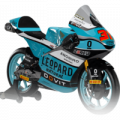
Leopard Racing is a motorcycle racing team based in Luxembourg. It has raced in the Moto3 World Championship since 2015. Luxembourg businessman Flavio Becca founded it at the end of 2014, and it took its name from the Leopard energy drink, its first sponsor. The team made its debut at the 2015 Qatar Grand Prix. In its first nine seasons it won four Moto3 riders’ world titles: Danny Kent in 2015, Joan Mir in 2017, Lorenzo Dalla Porta in 2019 and Jaume Masià in 2023.
Foundation and a first title with Danny Kent (2015)
The team was set up with one clear goal: to enter Moto3 the following year with its own project. Miodrag Kotur, listed as chief operating officer in 2015, was involved in running the sporting side from the start. In its first season the team raced the Honda NSF250RW with British rider Danny Kent, Spain’s Efrén Vázquez and Japan’s Hiroki Ono. Kent won six races, finished on the podium nine times and became Moto3 world champion in 2015 with 260 points. The title was settled at the final round in Valencia. Vázquez finished eighth with five podiums, so the team took fourteen podiums in its first year. At the Australian Grand Prix, a young Joan Mir replaced the injured Ono in his first world championship race.
Moto2 and a year with KTM (2016)
In 2016 Leopard Racing also entered Moto2 with Kalex chassis. Danny Kent moved up with the team, alongside Portugal’s Miguel Oliveira. Oliveira broke his collarbone in qualifying at Aragón, missed four races and finished one point short of the rookie title. The team’s time in the intermediate class lasted a single season. In Moto3 it switched from Honda to the KTM RC250GP and fielded a young line-up of Joan Mir, Andrea Locatelli and Fabio Quartararo. Mir won one race, finished fifth with 144 points and was named rookie of the year. Locatelli was ninth with two podiums, and Quartararo finished thirteenth.
Joan Mir and the return to Honda (2017)
For 2017 the team went back to Honda, the manufacturer it kept racing with in the seasons that followed. It retained Joan Mir and paired him with Belgium’s Livio Loi. The Majorcan was far ahead of the field, with ten wins, thirteen podiums and 341 points. He sealed the title in Australia, at Phillip Island, giving the team its second riders’ crown in three years. Loi finished thirteenth with one podium.
Bastianini, Dalla Porta and the 2019 title
In 2018 both riders were Italian. Enea Bastianini was fourth with 177 points and one win, and Lorenzo Dalla Porta was fifth with 151 points, also with one victory. The team finished third in the teams’ standings. Bastianini moved up to Moto2 the next year and was replaced by Spain’s Marcos Ramírez. In 2019 Dalla Porta won four races, took eleven podiums and became Moto3 world champion in 2019 with 279 points. Ramírez finished third with two wins. After the season, Dalla Porta moved up to Moto2.
Foggia, Masià and Artigas (2020-2022)
In 2020 the team ran Jaume Masià, from Valencia, and Italy’s Dennis Foggia. Catalan rider Xavier Artigas, who had already raced once for the team in 2019, took a full-time seat in 2021. That year Foggia fought for the championship until a crash at the Algarve and finished as runner-up, with five wins and 216 points. Artigas took the first win of his career in Valencia. In 2022 Foggia finished third with four wins and 246 points, while Japan’s Tatsuki Suzuki was seventh.
A fourth title with Jaume Masià (2023-2025)
Masià returned to Leopard Racing in 2023 and won four races that year. The last of them, in Valencia, gave him the 2023 Moto3 world title with 274 points, the team’s fourth riders’ championship. In September of that year he had won the first Indian Grand Prix. In 2024 the team signed two Spaniards, Adrián Fernández and Ángel Piqueras. Fernández was sixth with three podiums, and Piqueras eighth with one win. In 2025 Fernández won a race, took four podiums and finished the championship seventh with 179 points.
ADVERTISEMENT
Profile compiled by the VAVEL Editorial Team from historical records and official competition data. · Editorial policy