


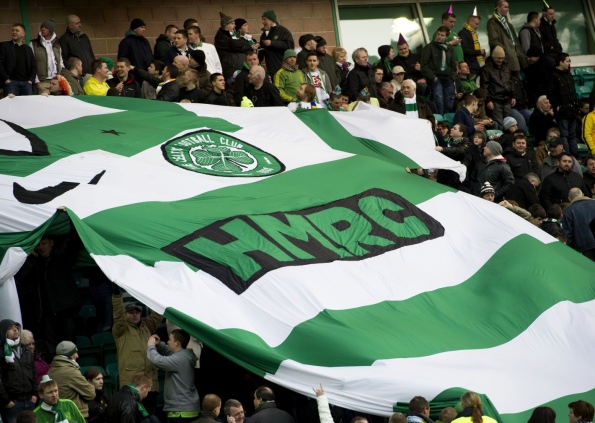

The fat lady is in full voice. The HMRC have finally acted, leaving Rangers FC, one of the cornerstones of Scottish football, in administration, causing chaos, forcing the club to let players go, resulting in them being deducted ten points, effectively handing Celtic the league title. The debate among Celtic fans at this moment in time is whether they would rather clinch the title in Ibrox, or their own back yard of Parkhead. That is not talk that hoops fans are accustomed to at this stage of the season, or at any stage of the season for that matter. The SPL title has not visited Celtic Park since the 2007/08 season; for Celtic to hold a 21 point margin in March was not quite on the agenda in any of their fans' wildest dreams last September. There will be widespread celebrations on the green side of Glasgow after the Old Firm on the 25th March, or whenever the league is finally clinched, but the question has to be posed; is this a good thing for the long-term future of Scottish football?
The downfall of Rangers has raised serious concerns for the Scottish FA. This is mainly due to the duopolistic nature of Scottish domestic football. Without a competitive Rangers, Celtic may well suffer. With a less competitive league, TV companies may lose interest in broadcasting rights, or may be reluctant to pay the current prices. This can have a knock-on effect on sponsors, who will receive less exposure. This has repercussions on clubs' firepower on the transfer market, leading to a decreasing interest in the league itself., resulting in a vicious circle, raising serious questions about the future of the domestic game in the country.
With a huge fan-base and shirt sales, Celtic are financially comfortable at this moment in time, but have been left behind in the international hyper-inflation of world football. This is evident through their lack of prowess in Europe in recent seasons. In the Martin O'Neill and Gordon Strachan era, it was customary for them to reach the last 16 of the Champions League or the latter stages of the UEFA Cup annually. Over the last two years however, they have lost in the qualifying stages for those tournaments, reaching the group stages of this year's Europa League purely due to the disqualification of FC Sion. Even with that, they made a timid exit from the group stages, hardly causing a stir. This is a far cry from the team who have visited traditional European strongholds such as Old Trafford, the San Siro and the Nou Camp in the last decade with relative success. You can even inspect the recent transfer activity of 'the bhoys' to notice that something has changed in the last few years. Deals with the likes of Barcelona, Chelsea and a host of other Premier League clubs have turned into barters with lower league opposition in the Mowbray/Lennon era, eg.
Gary Hooper from Scunthorpe Utd or Kris Commons from Derby County to name but a few. This is not entirely down to a loss in turnover in the club, but rather the fact that the SPL has remained immune to the spiraling exorbitant international transfer prices. However, this could be to their benefit, as the league will be in a safer position if and when the bubble bursts on the market and the international financial crisis finally takes its toll on the game.
As for Rangers, a medium term come-back remains a realistic possibility. Recent history suggests that clubs with a large fanbase relative to their respective leagues find it easier to bounce back from financial trouble. Leeds Utd are a prime example of this. Although their comeback is not complete, there is no doubt that they are a rising stock, after being promoted from League One where in their final year they averaged an attendance of 24,817, dwarfing the league average of 9,139. With a large fanbase relative to the league, teams generally do not struggle to reach the top. Newcastle Utd and Juventus also found this in 2nd tier football in recent seasons. This is not to say that Rangers are fully equipped to launch an assault on the league next year, but they seem to have the infrastructure in place to bounce back.
Scottish football is facing a critical year in its future. It could pan out a number of ways, but one thing is for sure; there is not going to be a quick solution, it will need to find its place in the changing economic world of football, or end up losing it altogether.
