



On the surface, Andrea Soncin came into Euro 2025 with one mission - to qualify from the group stage.
Four out of Italy's previous six European Championships ended at the first hurdle. Conversely, their first six appearances saw them reach at least the semi’s on each occasion.
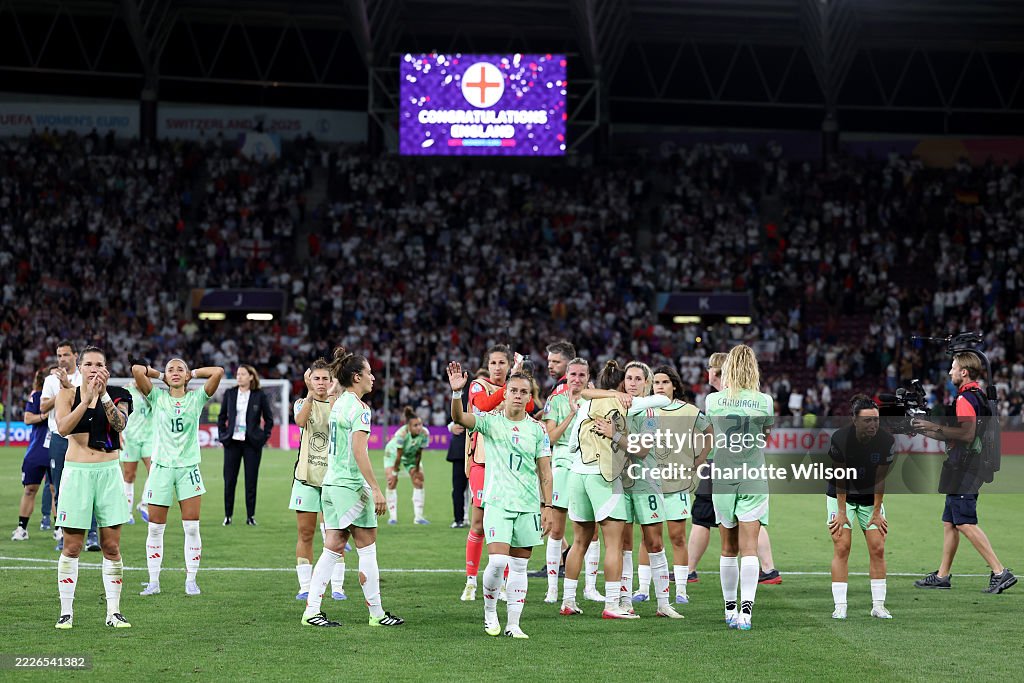
Now their most recent campaign is over, having come agonisingly close to reaching the final.
Taking the lead through Barbara Bonansea, - a fitting goalscorer as the longest serving player in the squad, having made her debut in 2012 - England equalised in the 96th-minute via Michelle Agyemang before Chloe Kelly’s follow up from her missed penalty sealed a comeback for the reigning the champions in the second period of extra-time.
"Well, of course, this defeat is difficult. Of course, it hurts," Soncin admitted.
"But we have to be proud. Before the tournament, [people] said it would be difficult to get past the group phase.
"We were one minute away from the final. The players would have deserved a different end, but unfortunately it happens sometimes, that you don’t get what you deserve."
In their best finish at a major tournament for nearly 30 years, it is a huge leap forward for the Blues in their quest to ascend again to and be competitive at the top of the women’s game.
"[We have] the basis, we're set for growth. The fact we didn’t get to the final can be an encouragement. There is another step we have to make. We have to manage these situations, but there is a lot of pride.
"We need some days to overcome this bitter moment. There will be constant monitoring of the girls, relations with the clubs.
"We have the goal of getting to the World Cup in Brazil, so we are already looking ahead."
The achievements of Soncin’s side will hopefully have a similar or even larger impact than the effects of Italy’s run to the quarter-finals in the 2019 World Cup. In the aftermath, plans were put in place to enable Serie A to turn professional, eventually ending 55 years of amateur contracts in 2022.
Considering the top division has only been a professionalised entity for three years, it is a mightily impressive achievement.
Women’s football in England was turned pro in 2018, while, although La Liga did not become professionalised until 2021, Spain have benefitted from Barcelona and Atletico Madrid’s earlier investment during the mid-2010s, with thirteen out of the current 23 squad have played for the Blaugrana.
The other semi-finalist, Germany, does still have a semi-professional league. Though, again, the DFB-Frauen have been helped by the longer lasting success of Eintracht Frankfurt, Wolfsburg and Bayern Munich.
All of these cases point to a key ingredient that Soncin noted after the loss to England.
"Time. You mentioned countries that started their football journey long before Italy. In Italy, clubs are structuring well, youth football is growing and these require time.
"This year the Under-17s and Under-19s went to the semi-finals [of their Euros], which are a symptom of what’s coming. The fruits will be taken in the long term. It is a shared journey that has to be done by the federation and by the clubs."
-
Tackling cultural problems
There have also been wider issues regarding the development of and the attitude towards women’s football within Italy that Le Azzurre have had to constantly battle against.
It has been merely a decade since the Coppa Italia final was cancelled after Felice Belloli’s homophobic and sexist remarks, though the then-Juventus sporting director Cristiano Giuntoli’s use of tired stereotypes in 2023 indicated that attitudes at the boardroom level have not yielded.
"Attention needs to be paid to the specifics, especially because, in our country, we have a culture that is improving but still needs to improve," head coach Soncin said back in January.
"We’re seeing the numbers increase, but there are still certain cultural barriers that probably slow down the process."
Recent reports regarding Italy’s gender equality at large have shown this is in need of addressing.
They ranked 87th in the World Economic Forum’s Global Gender Gap Index in 2024, while the European Institute for Gender Equality ruled that 'there has not been a significant improvement of gender equality in Italy' and that progress in this area is 'characterised by stagnation'.
"The gender gap in Italy is fueled by gender stereotypes and a lack of care services," stated Carlo Imperatore, who co-edited the report ‘Women and Work in Italy’ for Rome Business School.
"Traditional views limit women's career choices, while the scarcity of childcare and elderly care facilities hinders their participation in the workforce.
"This lack of representation negatively impacts gender equality policies and growth opportunities for women. These interwoven factors make achieving full gender equality in Italy still a difficult task."
If this is the case throughout wider society then participating in football has been far from easy, let alone making Le Azzurre part of the national conversation when their Azzurri counterparts retain ultimate popularity, even amid World Cup qualification struggles.
"I have been in football for 40 years. Football in Italy is the last men’s stronghold," said former long-serving manager Milena Bertolini said in 2017.
Coming up against this kind of vitriol and lack of assistance and care is not unique to Italian football and almost every women’s football team will have faced similar challenges at some point.
But as Bertolini added, "bad things can lead to good things, it’s the law of resilience."
That law also played its part in Italy going deep in this year’s Euros, bouncing back after setbacks against Spain and Norway to make it to the precipice of a major final.
Soncin alluded to this post-England, and how these deep runs into tournaments can help create a lasting legacy that goes beyond the here and now.
"Results like this can be an encouragement for all girls and players, so we reached our goal from this point-of-view.
"Because we allowed many girls to become passionate [about the team] but also boys have become passionate about women’s football.
"So, in a few years, these boys will be adults and respect women that want to play football more."
-
A hopefully endless summer
Italian football expert Mia Claydon wrote for VAVEL in 2023 that women’s football in the country was "well on its way to reaching a new level."
"As long as the fans keep filling the grounds, the players keep performing with such confidence, and further coverage of the league is given, the game for the Italians will continue to grow."
While the display in Australia and New Zealand may have prolonged further public interest, this summer's tournament may finally provide the explosion in popularity those involved have waited for.
On the pitch, changes are already tangible. Roma and Juventus have become increasingly competitive in the Champions League, while AC Milan and Inter have joined them and other stalwarts Fiorentina in making the league a closer fought contest at the top.
Exports like Arianna Caruso and Sofia Cantore have joined Bayern and Washington Spirit respectively as talent from the national team is now recognised more broadly.
Moreover, veteran players have finally been able to get a moment in the Swiss sun, with Cristiana Girelli in particular garnering a lot of international adulation after years of being predominantly known within Italy.
Dreams of becoming an elite team, alongside the likes of England and Spain on a regular basis, now have a ground zero to go from.
Soncin has repeatedly said that maintaining a close and transparent relationship to the players’ clubs have been key to helping maximise each individual. Something he highlighted again on Tuesday night when asked how this group of players can get better.
"Since I started with the group, the main goal was to constantly monitor the players so we could increase the level of internal competitiveness. This gave a lot of benefits.
"We study what the clubs do. Clubs are investing a lot, they are bringing in policies, so we have a lot of confidence for the future."
Off the pitch, time will tell. Boosted attendances and TV coverage were all a result of the 2019 World Cup journey, but this, an even more special run, could finally breakthrough the last of the cultural scepticism surrounding the women’s game in Italy.
