


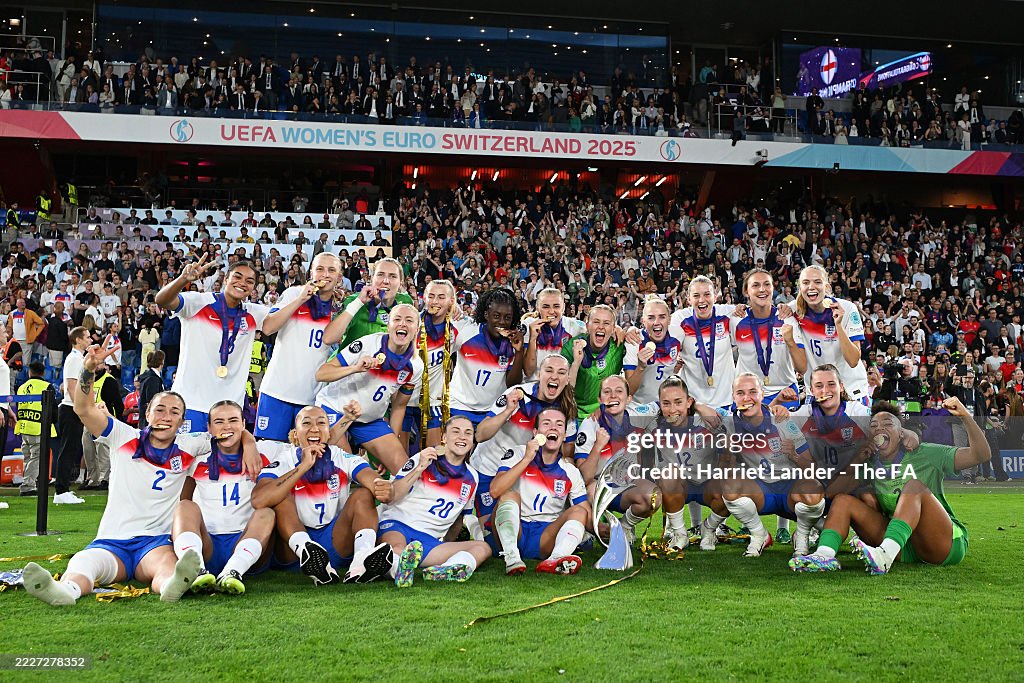

For the first time in senior football history, England won back-to-back major trophies after claiming a penalty shoot-out victory over Spain in the UEFA Women's Euro 2025 final.
Goals from Mariona Caldentey and Alessia Russo meant the sides could not be seperated after 120 minutes, meaning penalties had to settle things.
Conversions from the spot from Alex Greenwood, Niamh Charles and Chloe Kelly led to a 3-1 victory.
England now join Germany and Norway as multiple-time winners of the Euros. They will seek to become three-times winners in 2029, the hosts of which will be determined in December.
Here are four things we learnt from the Lionesses latest triumph.
-
Knockout specialist Wiegman continues to make history
Since becoming a full-time international manager in 2016, Sarina Wiegman has reached the final of every major tournament she has contested, winning all three at the European Championships.
It is an achievement unmatched at any level of senior football and victory yesterday cemented her place - if it was needed - as a knockout specialist.
What the 2025 Euros has shown is Wiegman’s nous at assessing the game state. This has been most clearly seen through her precise deployment of Chloe Kelly and Michelle Agyemang as super subs.
There have been some close calls, - namely the late show against Italy - but ultimately they worked.
Whether or not substitutions should be made earlier, the nature of cultivating a cohort of 'finishers' is incredibly difficult, especially when they continue to change games.
Getting footballers to buy into the fact that they will predominantly feature from the bench is likely not to be of the easiest conversations, but Wiegman has created such a unified group that everyone feels their value.
Those who have typically started games on the bench even have their own celebration - the 'positive clicks'. It is a clear sign of Wiegman’s skills as a communicator, where cliques are created intentionally yet each player recognises they will be called upon to deliver at vital moments.
Wiegman is Ancelotti-like on the touchline, oozing a calmness that seems to reverberate onto the pitch and reinforcing the belief she has in her players.
"We want to set standards," the Dutchwoman said pre-tournament. "But I think coaching is also about giving players responsibility - help players make their own decisions."
There will be another Finalissima before the next World Cup to add to her trophy haul, but clearing that one last elusive hurdle in becoming world champions will be firmly on her mind.
-
Carter shows how to shine through adversity
It has not been the smoothest journey to glory. On the pitch, there was the opening defeat to France and the knockout stages provided pulsating drama in each round. Off the pitch, however, these Lionesses have had to deal with some of the worst aspects of modern football.
The internet has afforded women’s football more coverage and celebration than it ever did during the days of traditional media. On the flip side, the increased attention has brought criticism and outright abuse to the fore.
In the week leading up to the final, defender Jess Carter revealed that online racist abuse she suffered had led her to step away from social media. She was later swapped out for Esme Morgan for the semi-final clash against Italy.
The Gotham FC player was brought back into the starting XI for Sunday’s final and was one of England’s best performers on the night, helping limit Spain’s frontline to five shots on target.
Admitting afterwards that she was "scared to play", her display during such a mentally draining and pressurised time was inspirational.
"I'm not normally someone who struggles with the hate they received because everyone is going to have their opinion," Carter stated after the final. "But this tournament has been tough and I wasn't sure I'd be able to get back on the pitch and do me."
As an aside from a technical perspective, Carter was still being played out-of-position, having told Sky Sports last year that she has "never liked playing on the left".
Such stories of overcoming abuse and harassment have unfortunately been prevalent in women’s sport in recent months, with a number of Lionesses like Lauren James, Alessia Russo and Lucy Bronze sharing how damaging some comments towards them can be.
Fierce scrutiny was directed at Hannah Hampton as she gradually became England’s No.1, while Millie Bright and Khadija Shaw both took time off playing after receiving abuse from the sidelines in WSL matches.
In tennis, Katie Boulter shared the death threats she received after the French Open, while World Rugby have said they are taking measures to protect players online hate ahead of the Women’s World Cup in August.
While online abuse is not exclusive to women’s sport, players are having to deal with it while at the same time trying to grow the game - which in today’s world almost requires online engagement in some form.
It is not an issue that will be solved overnight, but the continued resilience amid the vitriol from female athletes like Carter makes them even greater role models for the present and future.
-
Spain need different options up front
Spain’s forward line looked red hot during the group stage, smashing five past Portugal, six past Belgium and three past Italy.
With the likes of Claudia Pina, Mariona Caldentey and Esther Gonzalez being supported by arguably the strongest midfield three in the world, it was hard to see how anyone could stop them.
Then came Switzerland in the quarter-finals, who frustrated La Roja for large parts through tenacious, deep-lying defending. Ultimately the host nation fell but they did provide a blueprint for Germany on how to get at Montse Tome’s side.
Setting up in a mid-block to agitate the Guijarro-Bonmati-Putellas trifecta, they pressed them high and were unfortunate not to nick a goal or two on the counter during the semis.
England were able to be more brave on the ball given their individual quality and lack of injuries that the Germans endured, but the Lionesses still had to suffer through spells of defending close to their own net.
The technical quality of Aitana Bonmati in particular enabled them to work their way into the box on occasion. Although once there, issues regarding a strong presence in the box began to sprout.
One of the few times there was someone occupying England’s defenders in a dangerous area was when Caldentey headed home the opener.
Moreover, there was a strange lack of fluidity. The most in that regard is when the left and right wingers swap. The movement within the system did not really challenge England and the rigidity meant Spanish attacks were often blunted by the Lionesses knowing what each of their opponents was going to attempt.
Spain’s quality means at the moment they can take on most teams and simply overwhelm them. Come future major tournaments, however, every team will have improved, especially the likes of Germany, England and the United States, who they will be competing with for the grandest prizes.
They have shown their capabilities at mixing things up, going long and direct at times, particularly against DFB-Frauen. If they are to keep their place at the top of the world football tree, then finding ways to shake things up in attack will be a priority.
-
Europe paves the way ahead of Brazil World Cup
Footballing paradise now awaits as the FIFA Women’s World Cup heads to Brazil in 2027.
With the backdrop of one of the beautiful game’s spiritual homes, it looks set to be one of, if not the, biggest tournaments in women’s football history.
Euro 2025 has only built on the traction gained in recent years. It was the highest total attendance for a Women’s Euros in history and the Lionesses scored a peak live TV audience of 12.2 million - the most watched program of the year in the UK.
Although this is the case in Europe, where the tournament will be played - in South America - a different story emerges.
Copa America Femenina kicked off on July 11th but has not been gifted the same kind of attention the Euros has.
In fact, initially teams were not even allowed to warm-up on the pitch pre-match, with eight-time champions Brazil sharing the indoor training they had to do prior to their dismantling of Bolivia.
"I'm watching the Euros today... and man... The difference in structure, audience and investment is surreal," Manchester City forward Kerolin said on social media. "It's downright discouraging."
"While in Europe they break technology records, we're warming up in a MAXIMUM 20m room with the smell of paint. WEIRD!"
Furthermore, unlike Switzerland, most stadiums in Ecuador have been pictured with low attendances. Perhaps unsurprising given tickets only went on general sale eight days before the opening match.
There was also no VAR in use during the group stage, replicating the 2022 AFC Women's Asian Cup. That is in contrast to Europe, North America and Africa who use the Video Assistant Referees throughout.
This year’s Africa Cup of Nations - won in thrilling fashion by Nigeria - has also had a 100% increase in prize money as CAF works towards greater equity.
It has been an amazing summer of women’s football, but the hope will be that the standards Europe and North America are setting will be followed over the world by the time the World Cup lands on the shores of Copacabana.
