



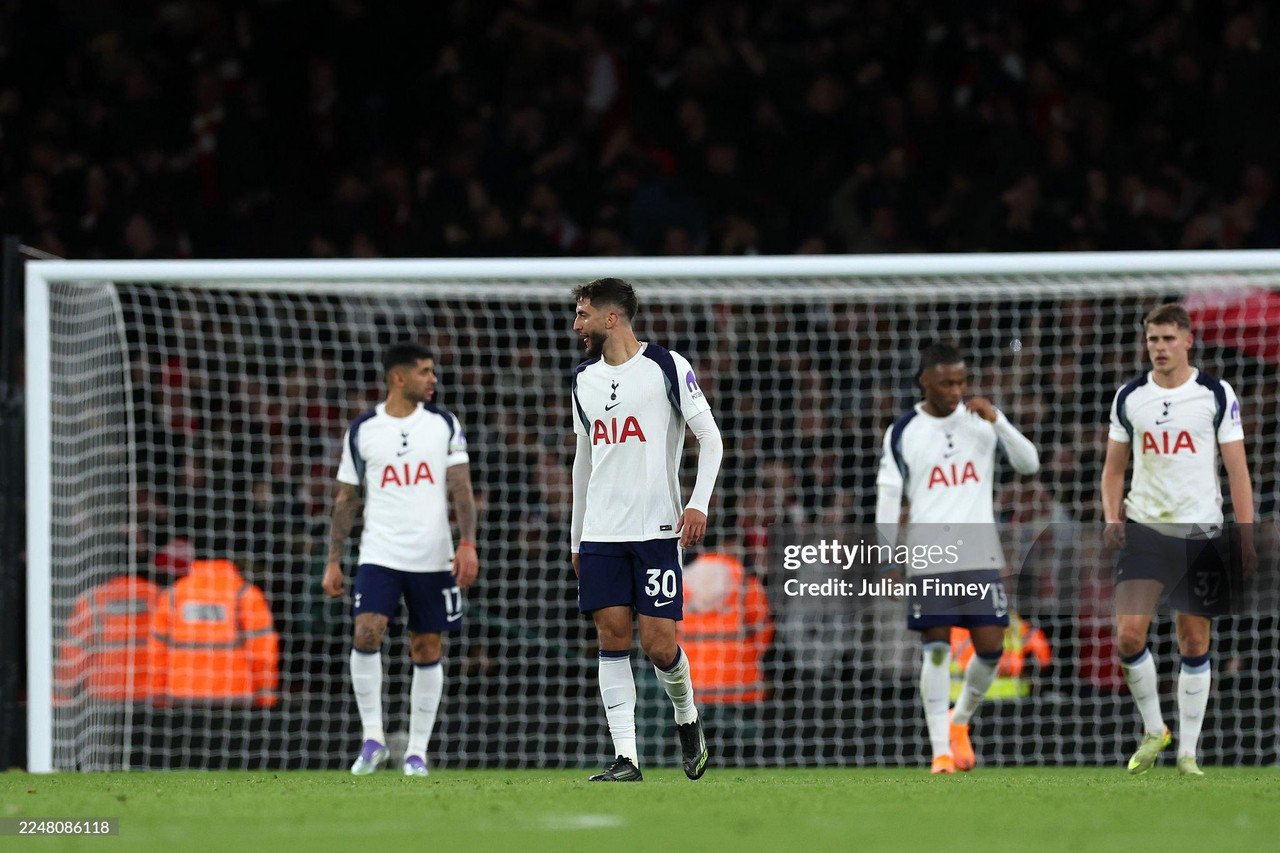

It was another dismal day in North London for Tottenham on Sunday. A 4-1 humbling at the hands of rivals Arsenal was the largest margin of victory in the derby since the Lilywhites’ last win in the encounter - a 3-0 win in 2022.
It has extended the Gunners’ recent dominance of the fixture, but the manner in which Spurs performed on the day will arguably be the sorriest sight for supporters.
Thomas Frank’s side struggled to live with Arsenal’s tricky, inventive attackers and could not touch their defenders.
This is not unfamiliar territory either. Their xG of 0.07 was bettered by their home defeat to Chelsea, where they registered 0.10 - both being the lowest across all Premier League matches so far this year.
A hat-trick from summer target Eberechi Eze poetically demonstrated a recurrent problem in the opening months of the Dane’s reign - a huge question mark in the centre of the pitch.
-
Dissection of the derby loss
Frank set his team out at the Emirates to not concede. This was no back three with wing-backs; it was a fully cemented back five. Djed Spence and Destiny Udogie barely got to peer over the shoulder of Arsenal’s wide players.
The plan seemed to be to negate the midfield entirely, starting the more defensively-minded partnership of Joao Palhinha and Rodrigo Bentancur. Both offered moments of tenacity, but their job was also joining the backline and struggling to progress the ball in any way.
Moreover, not matching Arsenal in the middle proved detrimental as they gave Declan Rice and Eberechi Eze ample space on the edge of the area.
Having almost no midfield presence meant the front three were tasked with making the most of fast breaks from passes played deep in Tottenham's half.
The trouble was that not only was Spurs’ forward line often dominated by one of the most physically impressive defensive units in Europe. The quality of passes to them were subpar given they were always coming from so deep.
It struck as a very Brentford setup. Now, of course, Frank has earned this opportunity after his wonderful work in West London, but when you are Spurs in a North London Derby, the only time it is acceptable to sit so deep is if protecting a lead.
Compare this to a rosier night on Merseyside. Tottenham beat Everton 3-0, having had less of the ball - and only 3% fewer possession than they did at the Emirates - and conceded 1.74xG.
As Micky van de Ven demonstrated on the night, Spurs were superb from set-pieces. With Guglielmo Vicario taking deep free-kicks even in the first half, it appeared Frank and set-piece coach Andreas Georgson’s plan was to contest things there.
However, it is difficult to do that when you have just four touches in the opposition box that Spurs had at Arsenal, and 72 passes in the Gunners’ half.
If you want to win via corners, throw-ins, etc., then earning those scenarios is quite important. This is reflected in the lack of risk or imagination in Spurs’ attacking patterns that help produce those situations.
The Lilywhites have only completed 4 through balls all season - rock bottom of the league and five fewer than Wolves in 19th. They are also third bottom for key passes (79), with only relegation zone occupiers Wolves and Burnley lower.
-
Strategy vs. tactics
The nature of this loss now means that, after twelve games, Spurs not only only have 18 points compared to 19 in 2024/25, but they have now conceded 14 goals - one more than this stage last season.
Though Frank has been more flexible than his predecessor, there is yet to be a central idea as to what they are adapting around.
The Athletic’s Jon Mackenzie spoke about this notion on the TIFO Football Podcast, stating the difference between a team’s strategy and their tactics.
"Strategy is the overall picture of what [you're] trying to achieve. How are we going to generate chances? How are we going to stop opponents?
"Tactics are small structural things, how [you're] going to achieve the strategy. I would put formations in that."
It feels as though, at present, Frank and his staff are comfortable changing the tactics yet lack a solid strategy. If the plan is to make the most of set plays or focus on the wide areas, how do they do that?
In contrast to Ange Postecoglou, he was a head coach who firmly outlined his strategy for high-line-high chance creation football, but rarely adjusted his tactics enough to improve things when it was not working.
Injuries notwithstanding, - an issue Frank also has to deal with - he rarely adjusted his tactics within that to improve things.
This strategy changed in the Europa League, with Postecoglou saying that cup competitions always bring out the pragmatist in him. Such a change, however frustrating for Spurs fans, made sense when gunning for a winnable European trophy and allowed them to galvanise around that.
By the sounds of Frank’s post-match comments, he is aiming to have Spurs to be much more imposing.
"I think especially in the first half we lacked the ability to have pressure and get close to them and be aggressive enough in the duels.
"We had to absorb too much pressure throughout the first half. In the second half, we got a little bit better, but nowhere near the level we want."
Desire should be a bare minimum in a derby match. Even so, a more combative Spurs need extra bodies in midfield, regardless of whether the Lilywhites want to be a team that focus on the flanks.
-
Potential solutions
A possibility has been moving Mohammed Kudus into the middle, but that would take away from the upside he gives as a right winger.
If it is aggression that Frank wants, then Pape Matar Sarr or Lucas Bergvall as auxiliary 10s could work. Neither is a mercurial playmaker, though they would offer more energetic presences higher up the pitch.
This extra player in the centre opens up avenues for Kudus, Wilson Odobert and Pedro Porro out wide – all three being the most creative players this season. Again, honing in on these players is not a bad strategy per se, but the tactics to get them into dangerous situations has been iffy at best.
Porro is Spurs' most progressive passer, and there is the suggestion that he could invert into the middle to aid this. However, a more consistent midfielder is probably what is required, rather than a right-back who, like Kudus, would probably lose a lot of his upside being forced to juggle both.
There remains a Xavi Simons-shaped elephant in the room. The Dutchman has operated mostly from a left-sided role since his arrival, although he has also provided sparks as an advanced midfielder. Against Arsenal, he started from the bench.
"He's [Simons] getting better and better but it was a tactical decision," Frank said. "It was between him and Wilson [Odobert], who has also played well in recent weeks."
Simons came on after half-time and ended the game with the most shots and joint most progressive carries and take ons. They were not quality chances but it was something.
Going back to the strategy-tactics argument, the greater plan has to be in place first.
If Frank wants to be on the front foot, Tottenham can still do that in a mid-block, but the aim would then have to be winning it back centrally and pouncing at pace out wide. Just ask Crystal Palace.
That style does favour players like Odobert and Kudus, but more risk would have to be involved in order to maximise that. It means either Simons as a consistent number 10, or the likes of Sarr and Bergvall to win it high up and contest for second balls.
Results-wise, it has not been a woeful start to life at Tottenham for Frank by any means. The ante needs to be upped quickly in order to avoid a slippery slope.
